What Is a Web Hosting Control Panel, and Why Does It Matter?
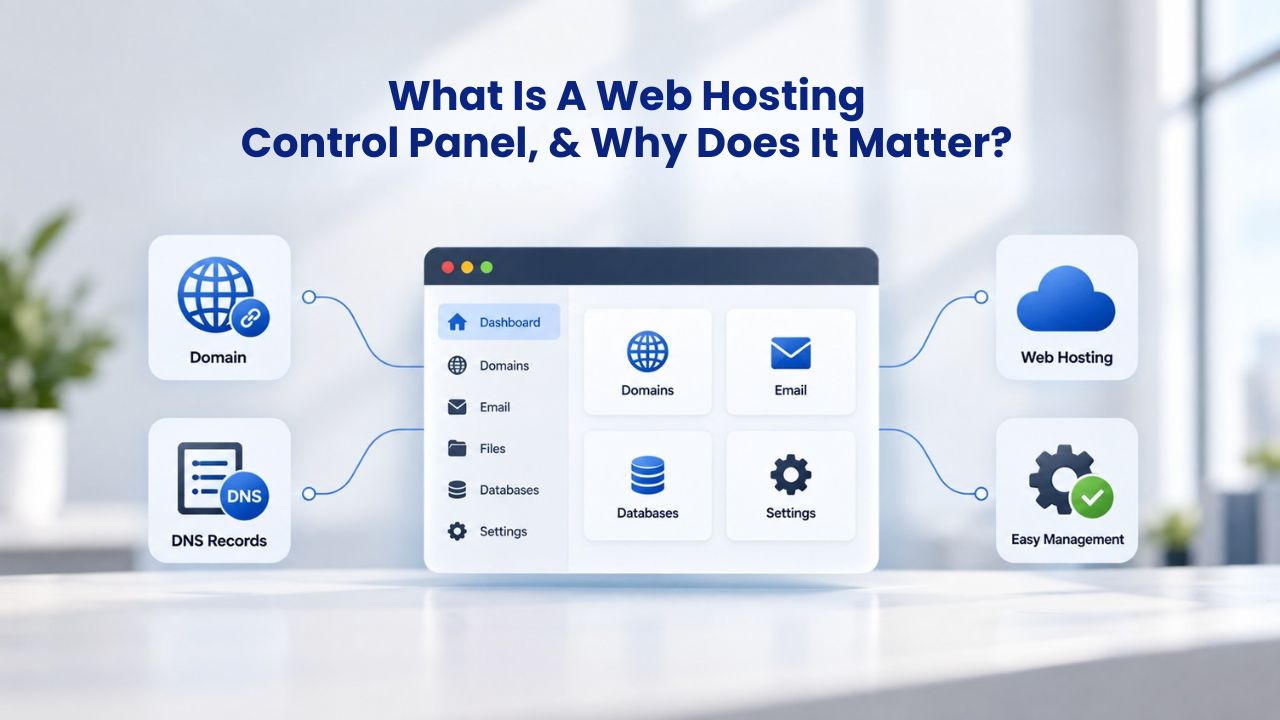
A control panel is the command center for your web hosting account. Instead of typing terminal commands, you use a graphical interface to manage your domains, email accounts, databases, file uploads, SSL certificates, backups, and security settings. Think of it as the dashboard between you and your server; it translates technical server functions into point-and-click options that anyone can understand.
How Control Panels Simplify Server Management
Without a control panel, managing a web hosting account would require command-line knowledge and direct server access via SSH (Secure Shell), which is impractical for most website owners. A control panel abstracts server complexity into visual menus and buttons. You don’t need to know Linux commands or server configuration files; you click “Create Database,” enter a name, and the system handles the technical setup behind the scenes. This democratization of hosting management is why control panels became standard in shared and reseller hosting environments: they let non-technical users maintain websites independently.
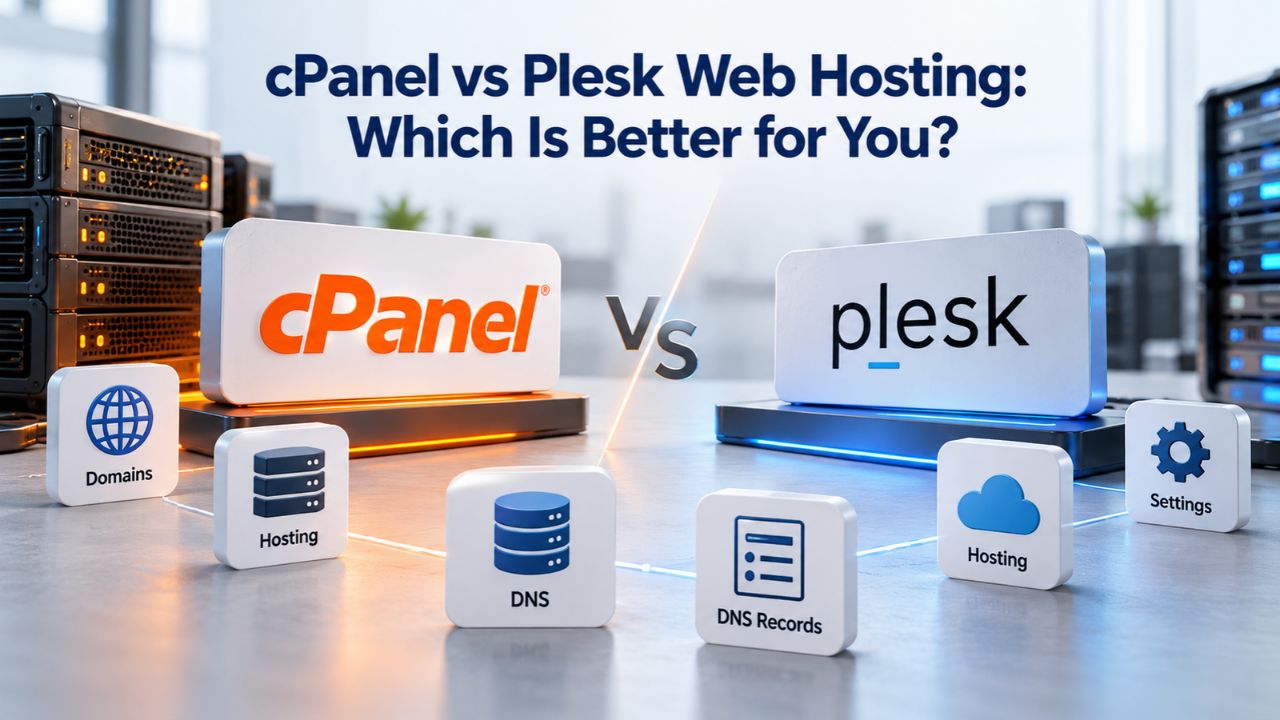
cPanel and Plesk are the two most widely used control panels globally, each handling millions of hosting accounts. Both are mature, feature-complete systems that handle domains, email routing, SSL certificates, application installation, backups, and account security through intuitive (though visually different) interfaces. The choice between them is not a binary “one is better” decision; it’s a fit question based on your hosting environment and preferences.
Why Control Panel Choice Matters to Your Hosting Experience
Your control panel is where you spend time every time you update your website, add an email account, back up files, or troubleshoot an issue. If you choose the right one for your setup, the interface feels natural, and the process is straightforward. If you choose poorly, for instance, picking cPanel on a Windows Server plan (not possible, since cPanel is Linux-only), you end up with a mismatch that your hosting provider will have to resolve.
Control panel familiarity also affects your learning curve significantly. If you’ve used cPanel before and your new host offers Plesk, you’ll face a navigation learning curve, even though both panels do the same essential tasks. Understanding what each control panel is, how they differ, and which fits your specific hosting plan is a practical first step before committing to a web hosting provider. This comparison unpacks those differences so the choice becomes clear rather than overwhelming.
Business Web Hosting Plans & Pricing
Choose the hosting plan that fits your website, WordPress site, or growing business. Compare features, storage, performance, security, and website capacity to find the right hosting environment for your needs.
cPanel Starter
cPanel Hosting that's easy, reliable and lightning-fast.
- 1 website
- 30 GB storage
- Unmetered bandwidth*

cPanel Economy
cPanel Hosting that's easy, reliable and lightning-fast.
- 1 website
- 100 GB space
- Unlimited bandwidth*
- 100 email accounts**
- 10 MySQL databases (1 GB ea.)
cPanel Deluxe
cPanel Hosting that's easy, reliable and lightning-fast.
- Unlimited websites
- Unlimited space
- Unlimited bandwidth*
- 500 email accounts
- 25 MySQL databases (1 GB ea.)
cPanel Ultimate
cPanel Hosting that's easy, reliable and lightning-fast.
- Unlimited websites
- Unlimited space
- Unlimited bandwidth*
- 1000 email accounts
- Unlimited MySQL databases (1 GB ea.)
- 2X Processing power & memory (available for Linux/cPanel only)
- Premium DNS
- 1-year SSL certificate to secure customer data and increase search rankings
*We don't limit the amount of storage and bandwidth your site can use as long as it complies with our Hosting Agreement. Should your website bandwidth or storage usage present a risk to the stability, performance or uptime of our servers, we will notify you via email and may be required to upgrade, or we may restrict the resources your website is using.
**Email account storage is limited to 100 email accounts with 100 MB of total storage.
WordPress Basic
A great way to get started.
- 1 website
- 10 GB NVMe storage
- Unmetered bandwidth
- Free SSL Certificate *
- WordPress pre-installed
- Weekly backups
- Web Application Firewall
- Daily malware scans
- One-time malware removal

WordPress Deluxe
Improve your site performance with Cloudflare CDN.
- 1 website
- 20 GB NVMe storage
- Unmetered bandwidth
- Free SSL Certificate *
- WordPress pre-installed
- Daily backups
- Web Application Firewall
- Daily malware scans
- One-time malware removal
- Up to 2x faster performance with global Cloudflare CDN **
- Enhanced security with DDoS protection
- Staging site
WordPress Ultimate
Add online marketing with more sites, storage and security.
- 1 website
- 30 GB NVMe storage
- Unmetered bandwidth
- Free SSL Certificate *
- WordPress pre-installed
- Daily + on-demand backups
- Web Application Firewall
- Daily malware scans
- Unlimited malware removal
- Up to 2x faster performance with global Cloudflare CDN **
- Enhanced security with DDoS protection
- Staging site
- WordPress code optimizer
- Smart WordPress plugin manager
- Sell online with WooCommerce
*An SSL certificate is included with every site and free for the life of the hosting plan. Certificates are automatically installed, validated and renewed.
Web Hosting Plus Launch
For multiple basic sites.
- 100 GB storage*
- 4 GB RAM
- 2 CPUs
- Unmetered traffic
- 50 websites & databases
- Free, unlimited SSL for all your websites**

Web Hosting Plus Enhance
For high-traffic WordPress, Joomla, and other sites.
- 200 GB storage*
- 8 GB RAM
- 4 CPUs
- Unmetered traffic
- 100 websites & databases
- Free, unlimited SSL for all your websites**
Web Hosting Plus Grow
For advanced eCommerce sites like Magento.
- 300 GB storage*
- 16 GB RAM
- 8 CPUs
- Unmetered traffic
- 150 websites & databases
- Free, unlimited SSL for all your websites**
Web Hosting Plus Expand
For multiple basic sites.
- 400 GB storage*
- 32 GB RAM
- 16 CPUs
- Unmetered traffic
- 200 websites & databases
- Free, unlimited SSL for all your websites**
*The total amount of usable storage capacity for your particular Hosting Service(s) may differ from the represented capacity as there is required space for the operating system(s), system file(s) and other supporting file(s).
**If you cancel the Web Hosting Plus product, you will lose the associated SSL certificate as well.
Operating System Foundation: Linux vs. Windows Hosting
The control panel you get isn’t a free choice; it depends on the underlying operating system of your hosting plan. cPanel runs only on Linux/Unix servers. Plesk runs on both Linux and Windows Server. Understanding this OS constraint is the single most important factor in control panel selection; it often eliminates half the “choice” before you even start.
Linux Web Hosting and cPanel’s Native Ecosystem
Linux, an open-source operating system, powers most shared hosting environments worldwide. It is lightweight, stable, and optimized for web server software like Apache and Nginx. When you sign up for a shared web hosting plan on a Linux server, you typically get cPanel as the standard control panel on most provider plans. cPanel is built for Linux environments and includes integrations for Linux utilities (Apache, MySQL, PHP, Perl, Python, Ruby, Node.js, etc.).
If your site runs PHP, WordPress, Drupal, Python, Ruby, or Node.js, all common on Linux servers, cPanel will feel native and integrated. cPanel includes Softaculous, a one-click installer with 400+ pre-packaged applications including WordPress, WooCommerce, PrestaShop, and many others, ready to deploy in seconds. For bloggers and small businesses building sites on the open-source stack, this Linux + cPanel combination is ubiquitous, deeply documented, and supported by Niya Digital’s team through its Web Hosting onboarding and setup services.
Windows Server Hosting and Plesk’s Dual-OS Strategy
Windows Server is Microsoft’s enterprise operating system, less common than Linux in shared hosting but essential for sites requiring Windows-specific technologies: the .NET framework, SQL Server databases, or Windows-hosted applications. Plesk is one of the few control panels that runs on both Linux and Windows Server, making it the practical choice for hosts offering mixed-environment server farms.
If you’re building an ASP.NET application, relying on SQL Server, or using a Windows-specific CMS, you need a Windows Server plan, and thus Plesk. Even if you prefer cPanel’s interface or community, cPanel does not run on Windows Server, so the choice is made for you by your technology requirements, not by preference. Many businesses don’t realize this constraint exists until they’ve already committed to a tech stack; understanding it upfront prevents costly mismatches. GoDaddy Web Hosting, which powers Niya Digital’s Web Hosting infrastructure, offers cPanel on Linux plans and Plesk on Windows Server plans, reflecting this OS-to-control-panel pairing.
cPanel: Interface, Ecosystem & Best-For Use Cases
cPanel is the older, more established control panel (developed since 1997) and remains the most widely adopted globally. Its interface is icon-driven, organized by function: a grid of feature boxes (File Manager, Email Accounts, Databases, Domains, SSL/TLS, Backups, etc.) that site owners click to access each tool. This design prioritizes comprehensive feature accessibility over aesthetic hierarchy, giving you quick access to the functions you need most.
cPanel’s Features and Workflow
The cPanel interface is immediately recognizable to anyone who’s used shared hosting before. You land on the main dashboard and see all available tools at once, each represented by an icon and label. Click “File Manager” to upload files; click “Email Accounts” to add a new mailbox; click “MySQL Databases” to set up a database and user. This flat, breadth-first design means everything is one or two clicks away, which can feel intuitive once you know where to look.
cPanel’s ecosystem includes Softaculous (400+ one-click application installers), native backup and restore tools, SSL certificate management (including Let’s Encrypt automation), domain DNS management, email forwarding and filtering, and password-protected directories. For resellers, cPanel includes WHM (WebHost Manager), a higher-level administrative interface for creating and managing multiple cPanel accounts under one reseller license. cPanel also integrates with ConfigServer Firewall (a third-party add-on) and supports manual advanced configurations for experienced administrators who need fine-grained control.
Why Businesses Choose cPanel
cPanel dominates shared hosting because it was first to market, has the largest community, and benefits from decades of tutorials, courses, and community support. If you search “how to set up WordPress on shared hosting,” the tutorial almost certainly assumes cPanel. If you ask for help in a web hosting forum and mention cPanel, someone usually responds quickly because cPanel users are everywhere. For a blogger launching their first WordPress site on Linux-based web hosting plans, cPanel offers the shortest learning curve and the most one-click convenience.
Small businesses and developers who’ve used cPanel before often prefer it for its familiarity. Because cPanel is Linux-only, it’s the default choice for anyone running a traditional PHP/MySQL site, which still makes up most small-to-medium web hosting deployments. Niya Digital’s Linux web hosting offerings include cPanel, making it the natural option for customers building on open-source stacks and preferring a well-documented, widely supported interface.
Plesk: Interface, Ecosystem & Best-For Use Cases
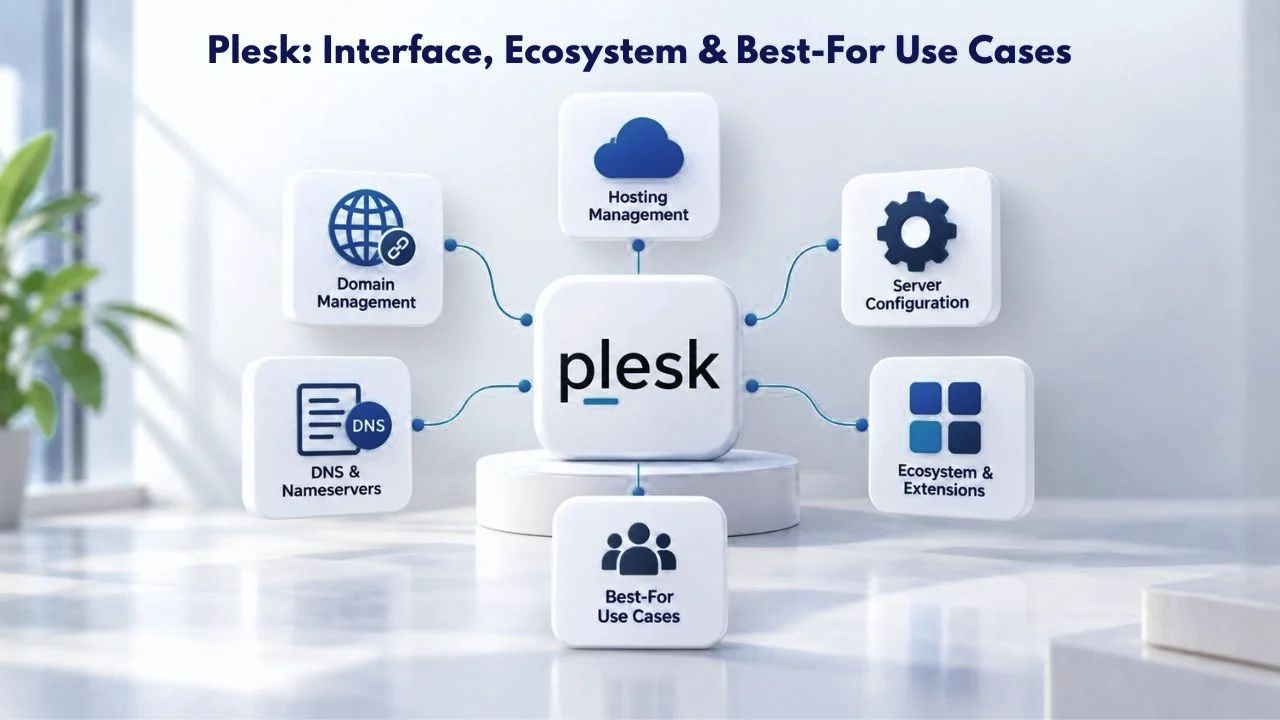
Plesk is a control panel designed as a unified platform for both Linux and Windows hosting. Its interface is tab-based and hierarchically organized: instead of a flat grid of icons, you navigate through collapsible sections (Websites & Domains, Mail, Files, Databases, Extensions, Account Settings). Plesk Obsidian, the current major version, introduced a redesigned interface that appeals to users accustomed to modern web app UI patterns.
Plesk’s Features and Modern Architecture
Plesk’s navigation is structured around what you’re trying to manage. Your websites and domains come first, then mail, files, and databases appear as sub-sections. This hierarchy can feel more intuitive to users coming from modern cloud platforms or SaaS applications, though it takes a few more clicks to find less-used functions. Plesk includes its own one-click installer marketplace (100+ apps), native backup and restore, SSL automation, email management, and extensions for advanced functions (backup integrations, security extensions, monitoring).
Plesk’s dual-OS design means a single interface works on both Linux and Windows Server plans, valuable for hosting providers managing mixed server environments. Plesk integrates natively with cloud backup providers (AWS S3, Microsoft Azure, Google Cloud Storage, Dropbox), offering disaster-recovery and offsite backup options directly from the control panel without third-party add-ons. Plesk includes built-in firewall rules, ModSecurity/WAF (Web Application Firewall) integration, and brute-force login protection. For resellers, Plesk Reseller edition provides a sub-admin interface similar to cPanel WHM, allowing resellers to manage multiple accounts efficiently.
Why Professionals Choose Plesk
Plesk appeals to hosting providers and businesses managing multiple server types (mixed Linux and Windows), developers who prefer a modern, minimalist UI over a dense icon grid, and anyone needing advanced backup and disaster-recovery integrations. Because Plesk supports Windows Server, it’s the only choice for .NET and SQL Server sites, a significant segment of enterprise and custom-application hosting.
A growing community of web professionals, managed hosting providers, and agencies prefer Plesk for its unified interface across multiple operating systems, its modern UI design, and its deeper integration with cloud backup and disaster-recovery tools. Niya Digital’s Web Hosting offerings may include Plesk on Windows Server plans and on advanced Linux plans where a modern interface or cloud backup integration is desired, giving customers flexibility to choose the control panel that matches their technical preference and business needs.
Feature Comparison, Security, Backups, Performance & Extensibility
When choosing between cPanel and Plesk, the “features” question is less about which has more and more about which features suit your actual needs. Both are feature-complete systems for shared hosting and reseller hosting; the differences are in implementation and integration style, not in capability gaps. The table below compares the key areas where these control panels differ.
| Feature / Capability | cPanel | Plesk |
|---|---|---|
| Operating System Support | Linux/Unix only | Linux and Windows Server |
| Interface Design | Icon-driven dashboard, flat layout | Tab-based, hierarchical (Plesk Obsidian modernized) |
| One-Click App Installer | Softaculous (400+ applications) | Plesk Extensions Marketplace (100+ applications) |
| Backup & Restore | Built-in backup/restore; third-party integrations available | Built-in backup/restore + native cloud provider integrations (AWS S3, Azure, Google Cloud, Dropbox) |
| Firewall & Security | ConfigServer Firewall (add-on), native SSL/TLS, account isolation | Built-in Plesk Firewall, ModSecurity/WAF, brute-force protection, native SSL/TLS |
| Community & Documentation | Very large community, extensive tutorials, decades of adoption | Growing community, comprehensive official documentation, modern resources |
| Typical Use Case | Linux-based shared/reseller hosting, PHP/Python/Node.js sites | Mixed-OS environments, Windows/.NET sites, advanced backup requirements |
Security and Backup Capabilities
Both cPanel and Plesk handle security and backups, two critical hosting functions, but with different philosophies. cPanel’s security model relies on account isolation (each account is sandboxed from others), native SSL/TLS certificate installation (including Let’s Encrypt automation), and optional add-ons like ConfigServer Firewall. Backups in cPanel are handled through WHM for administrators, with file-level and full-account restore options.
Plesk includes similar account isolation and SSL automation. Still, its firewall is built directly into the Plesk interface (no add-on needed), and its backup system natively integrates with major cloud storage providers. If your disaster-recovery plan includes regularly syncing backups to AWS S3 or Azure Blob Storage, Plesk’s integrations let you configure that without third-party tools. For small businesses and resellers, this cloud backup integration can be a major convenience and peace-of-mind factor. For a simple blog, cPanel’s local backups are usually sufficient.
Ecosystem and Extensibility
cPanel’s strength lies in Softaculous: 400+ pre-packaged applications ready to install with one click. This ecosystem is unmatched for bloggers and small businesses deploying WordPress, WooCommerce, PrestaShop, or other established open-source projects. The large user base means that if you hit a Softaculous setup issue, documentation and community solutions are usually available within minutes.
Plesk’s app marketplace is smaller (100+ applications) but growing, with a more curated selection and emphasis on modern apps and business software. Plesk’s extensibility lies in its add-on marketplace: security extensions, backup integrations, website monitoring, and third-party services integrate directly with Plesk’s interface. For resellers and managed hosting providers, this extension ecosystem is powerful; for a single-site blogger, the difference in app ecosystem size matters less for day-to-day operations.
Explore Your Web Hosting Options Today
Both cPanel and Plesk are proven, reliable control panels used by millions of websites globally. The choice between them is rarely about superior features; it’s about which environment matches your site’s technology stack, your hosting provider’s server infrastructure, and your personal preference. Niya Digital’s Web Hosting service supports both control panels across its Linux and Windows Server plan tiers so that you can choose the right fit for your needs. Start by choosing your operating system, then let that guide your control panel preference.
cPanel’s Genuine Strengths, Community, Maturity & Documentation
cPanel’s dominance in shared hosting isn’t accidental; it stems from genuine strengths that have persisted for 25+ years. For many site owners, these strengths matter and are worth understanding before you commit to any hosting plan.
The Advantage of Community Scale and Tutorials
cPanel benefits from network effects: because so many sites use it, an enormous body of tutorials, courses, forum posts, and how-to guides exist. If you search “how to create an email account in cPanel” or “how to point a domain to cPanel,” you’ll find detailed, video-accompanied guides published by independent educators, hosting providers, and cPanel itself. This knowledge density is invaluable for a first-time site owner trying to understand hosting without a technical background.
When you’re new to web hosting, control panel familiarity matters more than feature parity. A slightly less-featured control panel that you understand intuitively is far more valuable than a powerful, confusing interface. Because cPanel users vastly outnumber Plesk users globally, finding help, answers, and step-by-step guidance for cPanel is faster and easier. If you hit a roadblock with cPanel, someone in a web hosting forum has likely hit the same issue and documented the solution. This community advantage is real and time-saving.
Softaculous’s Unmatched Application Ecosystem
cPanel’s Softaculous installer includes WordPress, WooCommerce, Drupal, Joomla, Magento, PrestaShop, Moodle, and 390+ other applications, all one-click-ready. For a blogger launching WordPress, a WooCommerce store, or a small business deploying a recognized CMS, Softaculous is unbeatable for speed and convenience. You don’t need to download WordPress, set up a database, or upload files manually; Softaculous handles it all in seconds.
This ecosystem advantage makes cPanel the default choice for Linux-based shared hosting providers building plans for bloggers, small businesses, and non-technical site owners. If your hosting provider offers both cPanel and Plesk on Linux servers, Softaculous’s breadth and maturity are likely to tip the scales toward cPanel for a WordPress-based site. The one-click installation alone saves hours of manual configuration and reduces the risk of setup errors.
Plesk’s Genuine Strengths, Modern UI, Windows Support & Enterprise Integration
Plesk’s slower adoption relative to cPanel masks real, substantive advantages that matter to businesses with specific requirements. These are real decision drivers for many users, especially those managing multiple sites or diverse technology stacks.
Dual Operating System Support and Unified Management
Plesk’s biggest architectural advantage is running on both Linux and Windows Server through a single interface. For a hosting provider managing a fleet of diverse servers, this unification dramatically simplifies training, support, and operations. For a reseller or small agency managing client sites across mixed environments, some on Linux/PHP, others on Windows/.NET, Plesk eliminates the friction of switching between interfaces.
If your business requires Windows Server hosting for custom .NET applications or SQL Server databases, Plesk is not just preferred; it’s often the only control panel option available. There is no cPanel equivalent for Windows Server, period. For businesses with that requirement, Plesk is not a choice; it’s the solution. A unified interface across all your hosting clients, regardless of their OS choice, saves time and significantly reduces support burden.
Modern Interface Design and Cloud-Native Integrations
Plesk Obsidian introduced a redesigned interface that appeals to users familiar with modern web applications: a cleaner sidebar, organized navigation, and a contemporary aesthetic. If you’ve used cloud platforms (AWS, Azure, Google Cloud) or modern SaaS applications, Plesk’s hierarchical, minimalist layout feels more intuitive than cPanel’s dense icon grid.
Plesk’s native integration with cloud storage (AWS S3, Azure, Google Cloud, Dropbox) for backups is powerful for businesses serious about disaster recovery. Instead of relying on third-party add-ons or manual processes, you configure cloud backups in the Plesk interface, and your account backups automatically sync offsite. For resellers and managed hosting providers, this cloud-native architecture is a competitive advantage in selling uptime and disaster-recovery confidence to clients.
How to Choose: Suitability for Bloggers, Small Businesses & Online Stores
The real decision test is not which control panel is universally better, but which fits your specific situation. Let’s walk through common scenarios where one control panel makes more sense than the other, based on real business needs and technical requirements.
| Your Situation | Recommended Approach | Why |
|---|---|---|
| Blogger launching first WordPress site on Linux | cPanel | Softaculous one-click installer, largest tutorial base, community support available immediately |
| E-commerce store (WooCommerce/PrestaShop) on Linux | cPanel (preferred) or Plesk | cPanel’s Softaculous ecosystem is faster for WordPress/WooCommerce setup; Plesk works but has less ecosystem depth |
| Custom .NET or ASP.NET application | Plesk (required) | cPanel does not run on Windows Server; Plesk is the only standard choice available |
| Small business with SQL Server database | Plesk (required) | Windows Server is necessary for SQL Server; cPanel unavailable in this scenario |
| Agency managing 20+ client sites (mixed Linux/Windows) | Plesk | Single interface for Linux and Windows sites reduces admin overhead and training costs |
| Developer preferring modern UI over ecosystem breadth | Plesk | Obsidian interface more appealing; cloud backup integrations valuable for serious developers |
| Budget-conscious host deploying shared Linux servers | cPanel | Widely supported, low training cost, community handles first-level support questions |
| Reseller migrating existing cPanel customers | cPanel | Continuity; avoid re-training customers on a new interface unnecessarily |
The Blogger and Small Business Case
A blogger launching a WordPress site on Linux shared hosting should choose cPanel. The one-click Softaculous installation is unmatched; the tutorials are everywhere, and if something goes wrong, community help is plentiful. Your time is valuable, and cPanel gets you online faster than any other option. For a small business selling products via WooCommerce, the same logic applies: cPanel’s WooCommerce integration via Softaculous is seamless, the setup is one-click, and the learning curve is flat.
If you’re a small business in a different industry, say, a service business with a custom-built site running PHP frameworks like Laravel, either control panel works equally well for hosting those applications. The choice then depends on whether you’ve used cPanel before (stick with familiarity) or if you prefer a modern interface (choose Plesk). But the business value comes from site uptime, support quality, and adequate plan resources, not the control panel itself.
The Enterprise and Windows-Only Case
If your application is built on Microsoft technologies (.NET, ASP.NET Core, SQL Server, Active Directory), the decision is not actually a choice: you must use Windows Server hosting, and thus Plesk. This is a hard constraint, not a preference question. Niya Digital’s Web Hosting includes Windows Server options for businesses with these requirements, powered by GoDaddy’s infrastructure and accessed through Plesk.
For resellers managing multiple client sites across mixed technology stacks, Plesk’s dual-OS unification is genuinely valuable. Instead of jumping between cPanel on Linux client sites and Plesk on Windows client sites, you use one interface for everything. This reduces training, speeds up support, and minimizes human error in account management. The business case for Plesk in this scenario is clear and financial, not just aesthetic or preferential.
Migration, Support & Ongoing Management
A common question is: if I choose the “wrong” control panel, can I switch later? The answer is yes, but it’s not straightforward, and you should avoid that situation upfront by choosing correctly the first time.

Switching Control Panels Is Possible But Burdensome
Migrating from cPanel to Plesk (or vice versa) is technically possible but requires site downtime and manual file/database transfers in most cases. Your hosting provider may offer paid migration services, but the process is never as seamless as staying with your original choice. You’ll need to re-establish application configurations, email routing, SSL certificates, and DNS records from scratch. For a small blog, this might take a few hours; for an e-commerce site with custom integrations, it could take days. The lesson: choose correctly upfront so you don’t face this burden later.
This is why understanding the OS constraint early matters. If you realize mid-project that you need Windows Server and chose a cPanel-only Linux host, the migration cost, both financially and in time, is substantial and frustrating. By understanding whether cPanel (Linux-only) or Plesk (Windows-capable) suits your technology stack before signing up, you avoid this entirely. Take the time to research your stack and needs upfront; it saves time and money downstream.
Support Quality Matters More Than Control Panel Choice
Here’s a less-obvious insight: your satisfaction with web hosting depends far more on support quality, plan resources (storage, bandwidth), and uptime than on which control panel you’re using. If your hosting provider’s support team is responsive, helpful, and knowledgeable, you’ll feel supported whether they’re managing cPanel or Plesk accounts. If support is slow or unhelpful, the wrong control panel adds another layer of frustration.
Niya Digital’s team has found that customers often focus too heavily on control panel choice when they should prioritize overall plan resources, support quality, and uptime guarantees. Once they’re in either system, they become productive within weeks. Onboarding, ongoing support, and troubleshooting quality are consistent regardless of control panel choice. Focus your decision-making on overall plan fit, support reputation, and resource levels; the control panel follows naturally from those factors.
Making Your Decision, Questions to Ask Your Host & No Wrong Answer
By this point, the decision should feel less overwhelming. Most of the time, your control panel choice is already made by your other decisions: your technology stack determines whether you need Windows Server (Plesk) or Linux (either cPanel or Plesk), and your site size/complexity determines how much the control panel ecosystem matters.
Key Questions Before Choosing
Does your site require Windows-specific technologies (.NET, SQL Server, Active Directory)?
If yes, you need Windows Server hosting, and thus Plesk. cPanel is not an option. If no, you’re on Linux, and either cPanel or Plesk works fine for your needs.
Are you deploying a popular open-source application (WordPress, WooCommerce, PrestaShop, Drupal)?
If yes and you’re on Linux, cPanel’s Softaculous ecosystem is unmatched for speed and convenience. Plesk works too, but you lose the one-click installation advantage.
Is modern UI design important to you, or do you prefer breadth of features in one view?
If you like minimalist, hierarchical interfaces (like cloud platforms), Plesk Obsidian appeals. If you want everything visible at once (icon grid), cPanel suits you better. This is purely preference, not a technical blocker.
Do you need advanced backup integrations (cloud storage, disaster recovery)?
If yes and you’re evaluating Plesk, you get native cloud backup integration built in. cPanel requires third-party add-ons, though they work well.
Have you used one of these control panels before?
If so, choose the one you know to minimize your learning curve and ramp-up time.
The Bottom Line
Neither cPanel nor Plesk is objectively “better.” Both are mature, secure, fully featured, and can run successful websites at any scale. The “better” choice fits your operating system, technology stack, and personal preference. Your control panel is important; it’s the interface you’ll use regularly, but it’s not the most important factor in web hosting success. Plan resources, uptime, support quality, and your site’s configuration and security practices matter far more.
Choose your host based on those factors first. The control panel choice will follow naturally from your platform choice. Once you’ve decided, commit to learning the one you have and don’t second-guess yourself. You’ll be productive and capable in cPanel or Plesk within weeks. Choose wisely now, before signing up; after that, the choice is made.
Start Your Web Hosting Journey Confidently
You now understand what cPanel and Plesk are, how they differ, and which scenarios suit each. The next step is selecting a host that offers the right control panel for your stack and provides excellent support during setup and beyond. Niya Digital’s Web Hosting service is available with either cPanel (on Linux plans) or Plesk (on Windows or advanced Linux plans), giving you the flexibility to choose the control panel that matches your needs. Start with our hosting plans, and let our team guide you to the right fit for your site.
Frequently Asked Questions
Is cPanel or Plesk faster for website performance?
Both cPanel and Plesk have negligible performance impact on your website itself; they’re administrative tools, not the server software that actually serves your site. Website speed depends on your hosting plan’s resources (CPU, RAM, disk type), your application code, and traffic patterns. A slow site on cPanel is slow because of plan limitations or code, not because of cPanel. The same applies to Plesk. Choose your control panel based on functional fit, not perceived speed.
Can I switch from cPanel to Plesk if I change my mind?
Technically yes, but it’s not simple. You’d need to back up your site files and databases, migrate them to a new hosting account with Plesk, update DNS records, and reconfigure email and SSL certificates. Many hosting providers offer paid migration services to handle this. The process takes hours to days depending on site complexity and usually causes brief downtime. Choose the right option upfront to avoid this burden.
Which control panel has better security?
Both cPanel and Plesk offer similar core security: account isolation, SSL/TLS automation, firewall options, and password policies. Plesk includes a built-in firewall; cPanel requires a third-party add-on (ConfigServer Firewall). Neither is significantly more secure than the other. Your site’s security depends far more on keeping your CMS and plugins updated, using strong passwords, and following basic hardening practices than on which control panel you use.
If I’m a WordPress blogger, must I use cPanel?
No, but cPanel is the more convenient choice. cPanel’s Softaculous one-click installer makes deploying WordPress nearly instant. Plesk can also run WordPress and works perfectly well; you lose the instant one-click convenience and have to upload WordPress files manually or use Plesk’s installer. For a blogger who values simplicity and speed, cPanel is the natural choice.
What does “one-click installer” actually mean?
A one-click installer (Softaculous in cPanel, Plesk Extensions Marketplace in Plesk) is software that automatically downloads your chosen application (WordPress, WooCommerce, etc.), creates the required database, uploads files to the right directory, and configures initial settings. Instead of downloading WordPress, creating a MySQL database, uploading files via FTP, and running the WordPress setup wizard, you click one button, and it’s done in seconds. It’s not literally one click, but it’s one “go” button instead of 10 manual steps.
Does my choice of control panel affect my site’s SEO or search ranking?
No. Search engines rank your site based on content quality, technical structure (site speed, mobile-friendliness, SSL), backlinks, and user engagement. The control panel is invisible to search engines; they see only your website’s HTML, CSS, and JavaScript. Whether you use cPanel or Plesk has zero SEO impact.
Which control panel is easier for beginners?
cPanel is often easier for complete beginners because it has more tutorials, a larger community, and Softaculous’s one-click convenience. Plesk has a modern interface that feels intuitive if you’re familiar with contemporary web apps, but it has fewer tutorials. If you’re brand new to web hosting, cPanel is the gentler learning curve. If you’ve used cloud platforms or modern SaaS, Plesk feels natural.
Can I use Plesk on a Linux server, or is it Windows-only?
Plesk runs on both Linux and Windows Server. You can choose Plesk on Linux if you prefer its interface or cloud backup integrations, but cPanel is the standard (and often lower-cost) option on Linux. Some hosting providers offer both; others default to cPanel on Linux. Ask your host what’s available on Linux plans if Plesk on Linux interests you.
What’s the difference between cPanel and WHM?
cPanel is the user-level control panel for individual site owners; you manage your own domains, email, files, and databases. WHM (WebHost Manager) is the administrator-level interface used by hosting providers and resellers to create and manage multiple cPanel accounts. As a site owner, you use cPanel, not WHM. Your hosting provider’s staff uses WHM. This distinction doesn’t affect your control panel choice.
Does Plesk work on Linux-based shared hosting, or only on Windows?
Plesk works on both. You can find Plesk on Linux servers and on Windows Server environments. cPanel is Linux-only. On Linux, you typically have a choice: cPanel (more common, cheaper) or Plesk (modern interface, cloud backup integration). On Windows Server, Plesk is your only choice.
What happens if my hosting plan comes with the “wrong” control panel for me?
First, take a step back: the “right” control panel is the one that comes with your OS choice. If you’re on Linux and the host offers cPanel, that’s the standard choice. If you’re on Windows, Plesk is standard. If you’re on Linux and the host offers Plesk, and you prefer that interface, choose it; it works perfectly well. There’s no such thing as the “wrong” control panel for your situation if it matches your OS.
Can I access my website files without using the control panel?
Yes. Most hosting providers allow FTP or SFTP (Secure File Transfer Protocol) access to your files, so you can upload and edit files using an FTP client or terminal. A control panel is a convenience; it simplifies file management through a graphical interface, but it’s not required. You can manage a website entirely without it if you’re comfortable with FTP and the command line.
Will Niya Digital help me navigate my control panel if I get stuck?
Yes. Niya Digital’s Web Hosting support team can help with control panel navigation, setup steps, and troubleshooting for both cPanel and Plesk. Contact support during onboarding or whenever you hit a roadblock. Our setup and account management support covers both control panel types.
How do I know which control panel my Niya Digital plan uses before I buy?
Each Niya Digital Web Hosting plan tier is listed with its operating system (Linux or Windows Server) and corresponding control panel. Linux plans specify cPanel or Plesk (depending on the plan level); Windows plans use Plesk. Check the plan details on Niya Digital’s hosting plans page to see which control panel each tier includes.
If I’m migrating my site from another host, will the hosting provider handle control panel differences?
Niya Digital’s migration support team can help migrate your site and guide you through any control panel differences as you set up your new account. If you’re moving from cPanel to Plesk (or vice versa), we’ll help re-establish email routing, SSL certificates, and DNS configuration on your new plan. Contact setup support to discuss migration options.
Glossary
- Control Panel: Server-management software providing a graphical interface (instead of command-line terminal commands) for managing domains, email accounts, databases, files, SSL certificates, backups, and security settings within a web hosting account.
- Linux: An open-source operating system widely used in web hosting environments for its stability, security, and native support for web server software and programming languages (PHP, Python, Ruby, Node.js).
- Windows Server: Microsoft’s enterprise server operating system, used for hosting sites requiring Windows-specific technologies such as the .NET framework, SQL Server databases, and Windows-hosted applications.
- Reseller Hosting: A hosting plan that allows the account holder to create and manage multiple sub-accounts for their own clients, with the reseller’s own branding and control panel access at the administrative level.
- One-Click Installer: Automated software (such as cPanel’s Softaculous or Plesk’s Extensions Marketplace) that downloads, uploads, and configures an application (WordPress, WooCommerce, Drupal, etc.) with a single button click, eliminating manual setup steps.
- WHM (WebHost Manager): The administrative-level control panel interface used by web hosting providers and resellers to create, manage, and monitor multiple cPanel accounts under a single license or plan.
- Softaculous: A one-click application installer included with cPanel, offering 400+ pre-configured applications (WordPress, WooCommerce, PrestaShop, Drupal, Joomla, and many others) ready to deploy instantly.