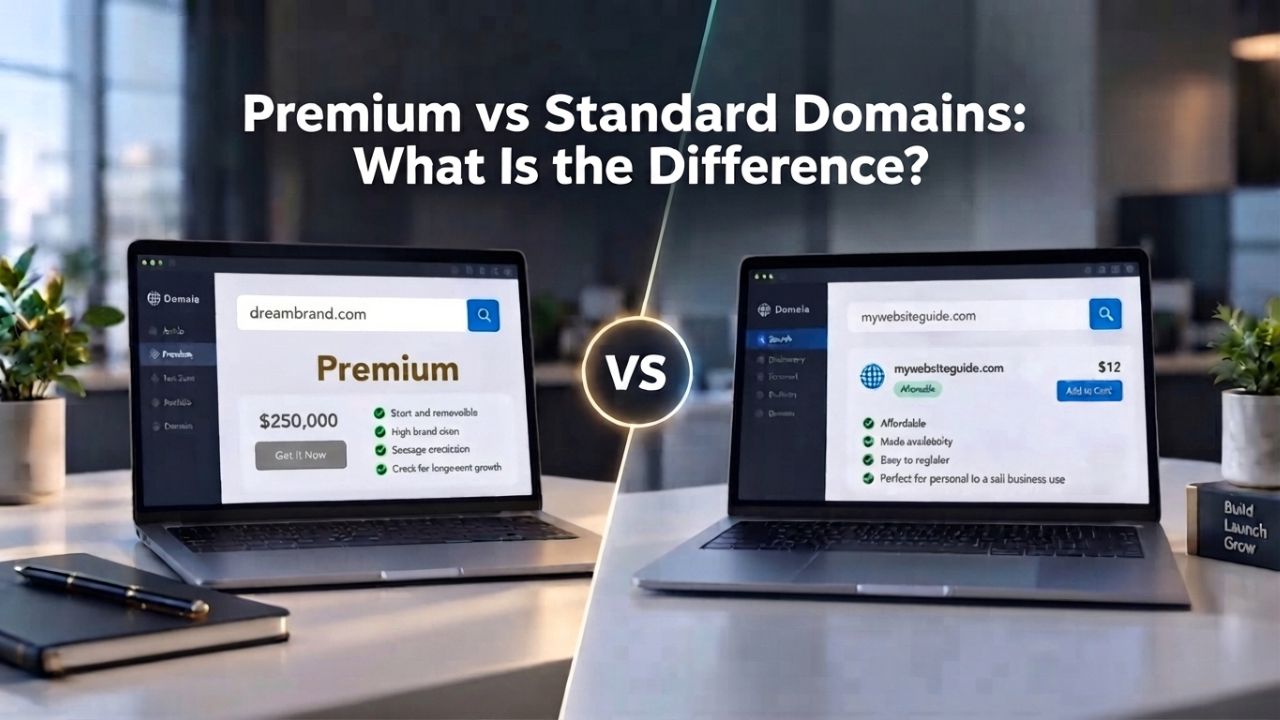
Choosing between premium and standard domains can feel like a high-stakes decision. Still, the distinction comes down to a few key factors: acquisition cost, renewal pricing models, and how you get them. While both operate identically once registered, understanding what makes a domain premium and the long-term cost implications of registry premiums versus aftermarket premiums helps you make an informed investment in your online identity. Niya Digital resells domain registration and hosting services in partnership with an ICANN-accredited registrar.
Registry Premium vs. Aftermarket Premium: The Renewal Cost Difference
The cost structures of registry premiums and aftermarket premiums diverge so dramatically that choosing between them should dominate your acquisition decision. A registry premium charges elevated fees indefinitely, while an aftermarket premium front-loads the cost and then normalizes. Understanding which path you’re considering, and what it means for your budget over 5, 10, or 20 years, is essential to making a sound investment decision that aligns with your financial capacity and business timeline.
The Permanent Cost of Registry Premiums
A registry premium domain carries elevated renewal fees that persist indefinitely. As long as you own the domain, you pay the registry’s premium renewal rate every year without exception. ICANN registry agreements require uniform renewal pricing, meaning the registry must charge the same premium renewal fee to all registrants in the same premium tier at renewal, preventing discriminatory pricing against individual registrants.
This uniformity protects against abuse, but it also means your renewal cost is locked into the premium tier permanently. The registry can increase renewal rates subject to 30+ days’ advance written notice to registrars, and those increases typically pass through to end registrants over time.
Registry premiums make sense for short, highly brandable names where the commercial value justifies permanent elevated fees. If you’re acquiring a premium domain because it directly matches your business name or a core product, and you plan to hold it long-term, the renewal investment may pay for itself through improved brand recognition and customer recall. However, if you’re acquiring premium domains speculatively or for portfolio diversification, the ongoing renewal costs should factor heavily into your decision-making, as they will compound significantly across a diverse portfolio.
Aftermarket Premiums: One-Time Cost, Standard Renewals
An aftermarket premium domain, a name purchased from its current owner through secondary marketplaces like Sedo, Afternic, or Dan.com, or through direct negotiation, operates under a completely different cost model with dramatically different long-term implications. Once you purchase the domain from its previous owner, it typically reverts to standard renewal rates for that TLD going forward, regardless of the acquisition price you paid. This means the high acquisition cost is a one-time expense. Still, your annual renewal costs thereafter match standard rates indefinitely. This distinction is the most common source of confusion among domain buyers, and clarifying it upfront can prevent expensive mistakes or regrets years into ownership.
The long-term cost advantage of aftermarket premiums is substantial and measurable. An acquisition cost paid once upfront is far less expensive over 10 years than ongoing elevated renewal fees every year compounding indefinitely. Many domain investors prioritize aftermarket acquisitions because they avoid perpetual premium renewal obligations and let them model long-term costs with certainty. When evaluating whether an aftermarket premium is worth the acquisition price, always confirm the renewal rate before committing, as some aftermarket platforms or resellers may not clearly display renewal terms.

Domain Name Registration
Each and every domain name comes with all you need to get online.
- Domain Forwarding and Masking: Direct any domain name you own to your website. Anyone who types that domain name into their browser is taken directly to your website.
- Domain Locking: Domain locking prevents accidental or intentional transfers of domain ownership and stops anyone from redirecting your nameservers.
- Total DNS Control: Manage your domain nameserver (DNS) records and set your email, FTP, sub-domains and website location all from one control panel.
- Change of Registration: Assign your domain name to someone else or change the contacts for your domain online anytime.
- Status Alerts: Monitor the status of your domain and get instant alerts if there's been a change.
- Auto Renew Protection: No need to watch expiration dates to make sure you renew on time! Auto renew keeps your domains, hosting, website builders, and other products in your name and under your control.
Domain Disclaimers:
- Special savings apply only to first year of registration. You must purchase entire section to qualify for special savings.
- The final price may differ because of additional sales, fees, and promotions.
- Products will automatically renew until cancelled. You may turn off the auto-renewal feature by visiting your account.
- Change of registration may require a fee for certain domains.
What Makes a Domain Premium: The Characteristics
Premium domains command higher valuations across the market because they possess qualities that make them inherently more desirable, memorable, and commercially valuable than standard domains. The most valuable domains typically combine multiple premium characteristics- shortness, keyword relevance, and brandability- which compound their market value and make them worth pursuing strategically. Understanding what creates premium status helps you identify domains worth acquiring and value them appropriately in the marketplace.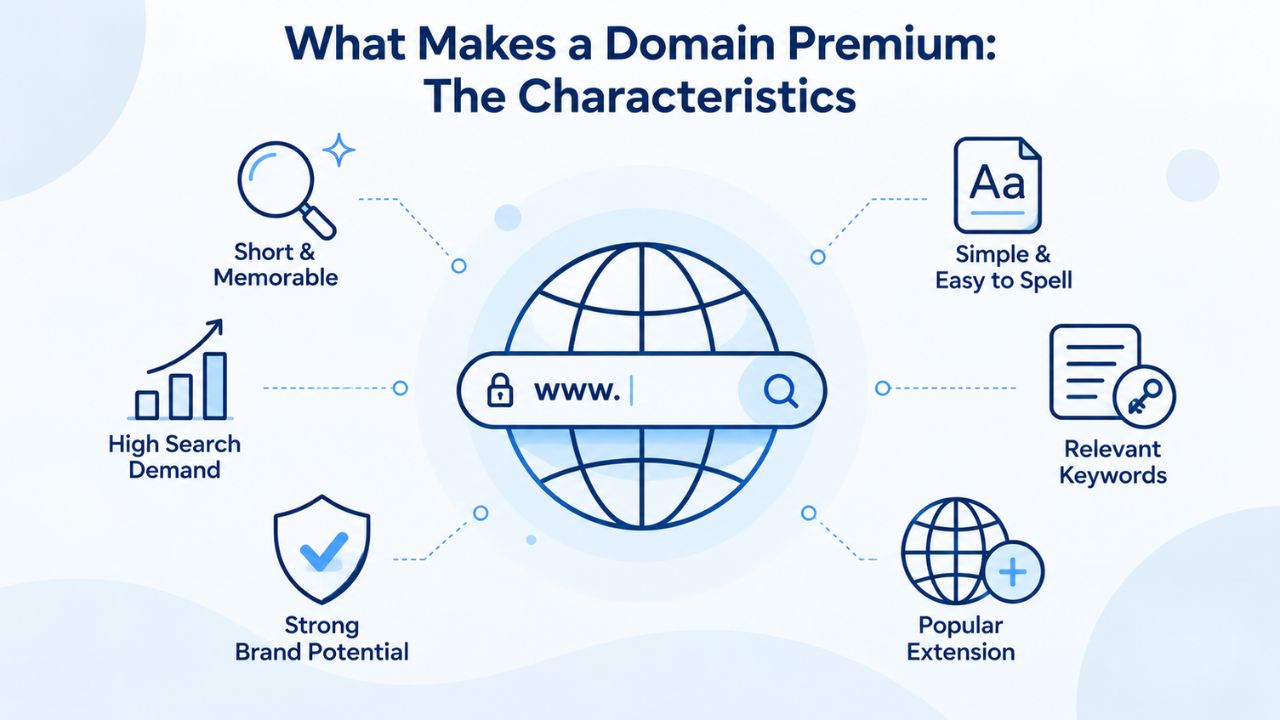
Length, Memorability, and Scarcity
The shortest domains command the highest premiums because they are inherently scarce and memorable, functioning as rare digital real estate. Domains with two to five characters, or single common words like “Hotels” or “Loans,” are valued far higher than longer, more descriptive names, and this applies whether the premium status comes from the registry or from aftermarket demand. Scarcity comes from the finite number of possible character combinations. With only 26 letters and 10 digits, shorter names are mathematically rare and become increasingly valuable as more longer domains get registered. Memorability compounds the value: a short, clean domain is easier for customers to type, remember in conversation, and share through word-of-mouth marketing.
Studies on user behavior consistently show that domains under 15 characters earn higher click-through rates in search results because users perceive short names as more trustworthy and can enter them more easily. This makes short premiums particularly valuable for businesses competing for direct navigation traffic. The relationship between length and value is dramatic and measurable: a five-character domain might command premium acquisition values on the secondary market. At the same time, a two-character name can reach exceptional valuations. New registries releasing gTLDs frequently reserve their shortest available names as premium inventory precisely because they know these names will attract speculative interest and justify premium pricing strategies from launch.
Dictionary Words and High-Intent Keywords
Generic industry terms and common dictionary words carry premium valuations because they align with how people search and what they remember, serving as shorthand for entire business categories. Domains like “Loans,” “Travel,” or “Hotels” are valuable because they directly match common search patterns and commercial intent, creating an immediate connection between the domain name and the searcher’s need.
When a potential customer searches for relevant industry terms and sees a website on a direct-match domain, the domain name itself reinforces the site’s relevance and credibility before they even land on your homepage. This phenomenon applies across industries: a dentistry business benefits from a dental-focused domain, a SaaS company gains authority from a relevant name, and an e-commerce platform gains legitimacy from category-specific names.
Dictionary words and keyword-rich names also tend to retain or appreciate over time, making them potential long-term investments for businesses planning to hold and develop them. A business that acquires a domain matching its service category might use it for a decade and later resell it to another company in the same industry, maintaining robust aftermarket demand. However, keyword-focused premiums can also become commoditized or dated if the industry or technology landscape shifts unexpectedly, so the key is selecting keyword premiums for domains that represent enduring business categories or brand concepts rather than temporary trends or jargon.
Premium Domain Value Drivers and Branding
Beyond measurable factors like length and keywords, other characteristics can dramatically influence premium domain valuation and should guide your acquisition strategy. The most successful premium domains often combine technical appeal (short length, strong keywords) with branding power (memorable, distinctive, emotionally resonant). Understanding these value drivers helps you identify domains worth the investment and avoid overpaying for names that lack true strategic value for your business.
Brandability and Creative Appeal
Some premium domains command high valuations not because they’re short or keyword-rich, but because they’re great brand names. These are creative, pronounceable, and emotionally resonant. Invented or creative domains work as standalone brand identities, without needing explanation or context, and carry premium valuations because they function as complete brand assets from day one, instantly recognizable and memorable.
Names known for building strong companies demonstrate the power of distinctive branding, standing as unique, memorable identities that have become synonymous with their respective services or products. For startups and enterprises building a new brand from scratch, acquiring a premium domain with this kind of creative appeal can justify the investment because it becomes a cornerstone of brand identity and market positioning.
Brandable premiums often appreciate fastest because they’re genuinely scarce and irreplaceable: there’s only one truly distinctive name, and its owner retains complete brand differentiation in perpetuity. Unlike keyword-based premiums that compete on relevance with potentially hundreds of similar names, branded premiums are often one-of-a-kind and provide a sustainable competitive advantage.
However, the risk is higher too: a creative name must resonate with your target audience and not inadvertently conflict with existing brands or trademarks, so trademark research is essential before acquiring a premium branded domain to avoid legal challenges or cease-and-desist letters.
Top-Level Domain (TLD) Extension Credibility
The extension itself, .com, .net, .org, .tech, .co, etc., influences premium valuation significantly and should be weighed carefully in your acquisition decision. Popular established extensions like .com, .net, and .org carry inherent credibility that users recognize and trust. Premiums in these extensions typically command higher valuations than the same name in newer gTLDs.
A domain matching your business category will almost always be valued higher in .com compared to newer extensions, even if all variants are equally useful for your purposes, because .com occupies a privileged position in user psychology and search behavior built over decades of internet history. This dynamic hasn’t shifted significantly, even after ICANN introduced hundreds of new gTLD extensions starting in 2013, though newer extensions have built credibility in specific communities.
Newer extensions like .tech, .io, .agency, and .co have developed strong associations with specific communities and industries; tech startups gravitate toward certain extensions, creative agencies toward others, but none have achieved the universal trust factor of .com. For premium acquisitions, choose extensions carefully based on your industry and audience expectations, as the extension itself can meaningfully add or subtract value. Niya Digital’ team has found that businesses renewing domains registered years ago often report that universal TLD recognition influences customer behavior and search engine appearance more than the name’s specific keywords or creative appeal, making extension choice a strategic decision.
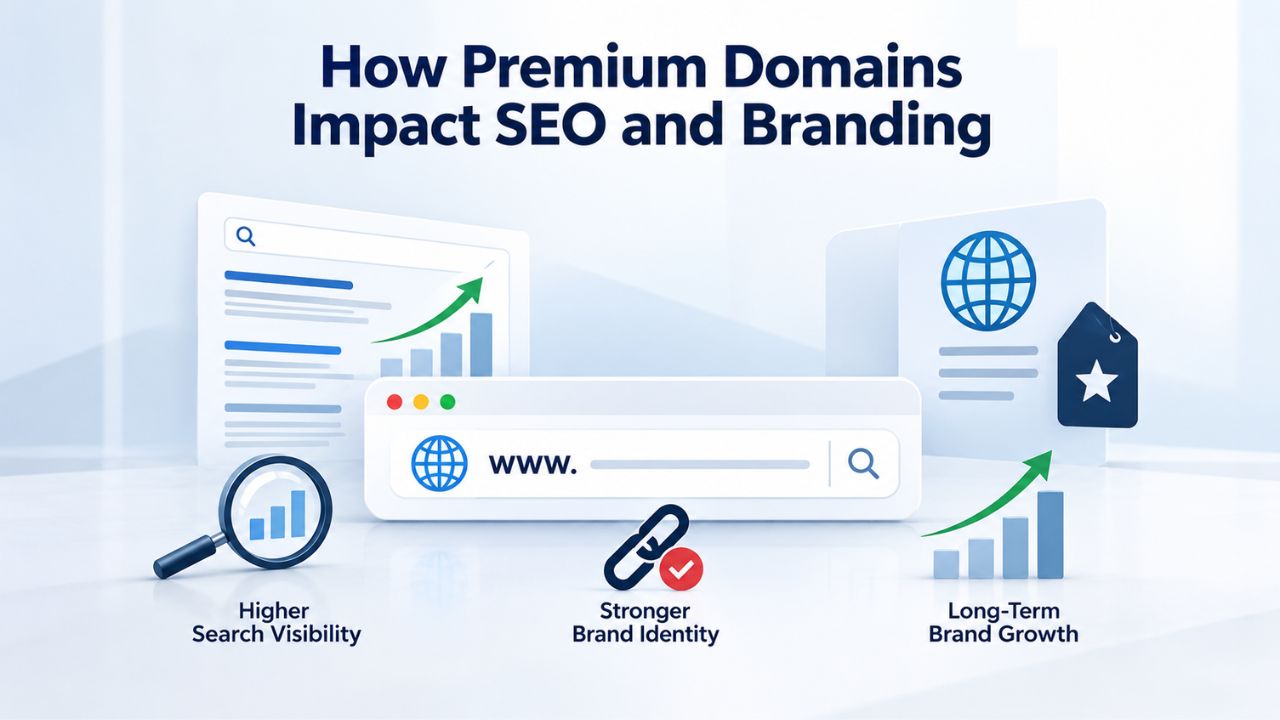
How Premium Domains Impact SEO and Branding
Premium domains deliver measurable benefits across SEO, branding, and customer perception, but these benefits are indirect and require strong execution across other business fundamentals to fully materialize. A premium domain can speed your path to SEO success and brand recognition, but it can’t replace high-quality content, strong marketing, or customer-focused operations. Understanding both the genuine benefits and the honest limitations of premium domains helps you invest appropriately and maintain realistic expectations about what a domain can accomplish.
The Indirect SEO Value of Premium Domains
Domain names are not a direct search engine ranking factor, and Google’s algorithms do not rank domains higher simply because they’re premium or contain specific keywords. However, premium domains influence SEO indirectly through multiple channels that do affect rankings and visibility in measurable ways. The most tangible indirect benefit is improved click-through rate (CTR) on search results pages, where short, memorable domains earn significantly more clicks. Domains under 15 characters consistently earn higher click-through rates than longer domains because users perceive short names as more trustworthy and can enter them more easily without typos.
The second indirect SEO advantage applies specifically to aftermarket premium domains acquired from previous owners: inherited domain authority and backlink history. When you purchase an established domain from a previous owner, you inherit the domain’s backlink profile, years of search engine indexing history, and accumulated domain authority metrics accumulated over years or decades of web presence.
A domain that has existed for many years and accumulated high-quality backlinks from established websites carries significant SEO credibility that a brand-new domain cannot match, giving you a ranking head start from day one. This inheritance works both ways; however, if the domain was previously used for spam or adult content, you also inherit those negative signals, which is why thorough domain history research is essential before acquiring aftermarket premium domains.
Branding, Memorability, and Customer Trust
Beyond SEO mechanics, premium domains deliver measurable branding value that directly impacts customer acquisition and retention in ways that extend far beyond search engines. Premium domains reduce marketing friction by building immediate credibility and trust, as users instinctively associate short, clean, keyword-relevant domains with established, legitimate businesses and organizations. When a customer lands on a site via a distinctive, relevant domain rather than a long, descriptive one, the first domain signals authority and professionalism before the customer even sees your homepage, creating a psychological advantage that shapes their perception of your business.
A premium domain also simplifies offline marketing and brand communication across all channels, from business cards to billboards to radio ads to social media bios, where customers can easily recall and type the domain into their browsers later without errors. Additionally, premium domains often attract direct navigation traffic passively; users searching for relevant terms may find your site simply because the domain name matches their search intent, creating a passive marketing channel that arrives without any advertising spend. For many businesses, the reduction in marketing burden from direct navigation traffic and improved brand memorability alone justifies the premium acquisition investment over several years of ownership and operation.
Registry Premiums vs. Standard: A Structured Comparison
Understanding how registry premiums and standard domains differ across key factors helps you make an informed acquisition decision aligned with your budget and long-term business strategy. The table below summarizes the essential differences:
| Factor | Registry Premium | Standard Domain |
|---|---|---|
| Acquisition Model | Pre-reserved by registry at TLD launch | Available on a first-come, first-served basis |
| Pricing Authority | Set exclusively by registry operator | Set by registry; registrar adds markup variably |
| Renewal Costs | Elevated, permanent, same tier every year | Standard rates; consistent across registrars |
| Price Increase Notice | Registry provides 30+ days’ advance notice | Wholesale increases rare; registrar markup varies |
| Negotiability | No, fixed pricing across all registrars | Possible through promotions or aftermarket |
| Reclassification Risk | Not applicable (always premium) | ICANN prohibits retroactive reclassification |
| Typical TLD Homes | New gTLDs (.tech, .luxury); short names | .com, .net, .org; longer or unique names |
| SEO/Technical Differences | None, functions identically to standard | None, functions identically to premium |
| Long-Term Cost Profile | Higher indefinitely due to renewals | Lower total cost of ownership |
| Resale Value Potential | Depends on aftermarket demand | Established aftermarket with pricing history |
Understanding the Key Differences
The most critical difference between registry premiums and standard domains is the renewal cost structure, which shapes your long-term financial commitment and planning horizon. A registry premium locks you into higher costs forever, so calculate the total cost of ownership over your expected holding period before you buy. For example, a domain costing substantially more each year than standard rates will accumulate high costs over a 10-year business lifecycle, creating a perpetual financial drag on your domain portfolio management budget.
Standard domains, by contrast, offer transparency and stability: you know renewal costs because the registry publishes standard rates, and registrars compete on service rather than price. This predictability allows you to model long-term costs accurately and allocate budget confidently across multiple domains. The choice between registry premiums and standard domains ultimately depends on your assessment of the strategic value that a particular premium name will provide to your business over many years of ownership and operation.
Choosing Based on Your Needs
Choose a registry premium if you’ve identified a specific domain that directly aligns with your core brand, represents your primary market category, and will generate sufficient customer value to justify the perpetual elevated renewal costs. A registry premium makes sense for flagship domains that define your primary online presence and brand identity, where the extra brand power and memorability justify the ongoing financial commitment. However, avoid registry premiums for portfolio diversification, speculative holding, or secondary brand properties, where the cost-benefit calculus doesn’t justify the elevated expenses.
Choose standard domains if you’re bootstrapping with limited capital, testing a business model before major investments, or building a secondary brand or property portfolio that doesn’t require premium positioning. Standard domains allow you to acquire multiple domains across different market segments or backup brand variations without the financial burden of perpetual premium renewal fees. Many of the most successful businesses operate their primary brands on standard-priced domains because their content, marketing execution, and brand building have exceeded the domain’s initial perceived value, turning standard assets into premium brand properties through business success.
Ready to Secure Your Premium Domain Strategy?
Building your online presence takes more than a domain; it takes the right domain paired with strategic management and reliable support. Niya Digital helps you navigate premium and standard domain options, assess your long-term positioning, and manage your entire domain portfolio with transparency and expertise. Whether you’re protecting your brand, launching a new venture, or expanding your digital footprint, our partnership with an ICANN-accredited registrar ensures you have access to comprehensive domain solutions and expert guidance every step of the way.
Understanding Aftermarket Premiums and Secondary Market Acquisition
Aftermarket premiums make up most premium domain transactions globally and offer fundamentally different economics than registry-designated premiums, with critical advantages for long-term cost management. Understanding how aftermarket acquisition works, what it costs, and how to navigate the process helps you acquire premium domains strategically without committing to perpetual elevated renewal costs. The secondary market for premium domains has matured significantly over the past decade, with established marketplaces, pricing precedent, and professional services available to guide transactions.
How Aftermarket Premiums Work
Aftermarket premium domains exist on secondary markets where previous owners list or negotiate the sale of already-registered domains to new buyers seeking premium positioning. The three primary marketplaces for aftermarket premiums are Sedo and Afternic, which function as public domain auction platforms and Buy-It-Now listings with transparent pricing, and Dan.com, which combines marketplace listings with brokerage services for high-value acquisitions and professional negotiations. When you search for a domain on one of these platforms, you’re seeing names currently owned by individuals or domain portfolio companies, not names available directly from registries.
The price displayed is the current owner’s asking rate. For high-value acquisitions above a certain threshold, both parties typically use an escrow service like Escrow.com to protect themselves from fraud or payment disputes during the transaction. If you want to acquire an aftermarket premium not listed on public marketplaces, you can run a WHOIS lookup, identify the domain’s current owner, and negotiate directly by email or phone, which often yields better terms than public marketplace listings for motivated sellers.
Acquisition Timeline and Transfer Process
Once you’ve agreed to purchase an aftermarket premium, the transfer process begins when the seller provides an authorization code (EPP code or auth code) to their registrar, which you then submit to your preferred registrar to initiate the transfer. Under ideal conditions, the standard transfer timeline is 24–48 hours if both registrars and the registrant respond quickly to confirmation requests and approvals. However, delays at any point can extend the timeline to a week or longer, so it’s wise to build extra time into your project schedule.
All ICANN-regulated domain transfers are subject to a 60-day transfer lock after the move completes, per ICANN policy, which prevents the new registrant from immediately transferring the domain away again. This lock is automatic and can’t be waived regardless of circumstances. One important detail often overlooked: transferring a domain includes a mandatory one-year registration extension at your new registrar’s rates, so compare renewal rates between registrars before initiating a transfer, as this extension can create significant savings or unexpected costs.
Registration, Renewal, and Transfer Considerations for Premium Domains
Managing premium domains requires attention to the cost structure and timing of renewals, transfers, and rate changes, as decisions in these areas can significantly impact your long-term expenses and operational efficiency. Understanding how registration, renewal, and transfer processes differ for premium domains compared to standard domains helps you avoid costly mistakes and plan your domain portfolio strategy with confidence and accuracy.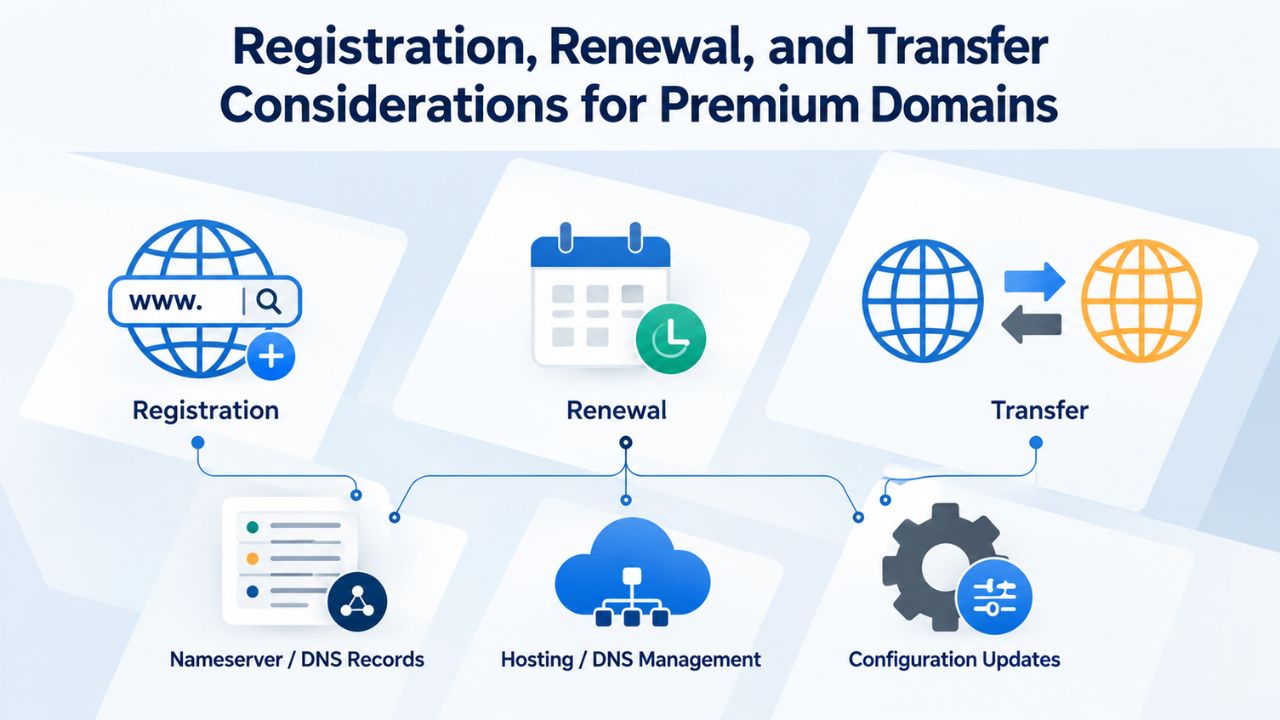
Registration Process Differences
The registration process for premium domains differs only in the displayed checkout price; the operational steps remain the same as standard domain registration in all other respects. When you search for a domain on a registrar’s site and it returns results, the interface will clearly mark premium names or show higher pricing than standard rates, making the premium status immediately obvious. Some registrars display both registration and renewal costs upfront. In contrast, others require additional clicks to access renewal information, so always verify renewal rates before completing any registration to ensure complete transparency about total costs.
For registry premiums, the registry operator sets pricing, and it typically cannot be negotiated or transferred between registrars. If you register a premium domain at one registrar and later transfer to another, the premium pricing follows the domain, as it’s determined by the registry rather than the registrar. This differs from standard domains, where registrars sometimes offer promotional first-year rates that differ dramatically from renewal rates, creating the illusion of affordability followed by surprise cost increases at renewal.
Renewal Costs and Long-Term Budgeting
Renewal costs are where premium domains and standard domains diverge most dramatically in their financial implications for your business. For a registry premium, the renewal rate matches the registration cost year after year indefinitely, creating a perpetual financial obligation that requires budgeting and planning. For an aftermarket premium acquired at a high one-time price, the renewal rate drops to the standard TLD rate after acquisition, meaning the financial commitment is front-loaded rather than distributed across decades of ownership. This distinction changes your long-term cost calculus and should drive your acquisition decisions.
If you’re managing a portfolio of domains and planning multi-year budgets, you absolutely must know which domains are registry premiums (with perpetual elevated renewal costs) and which are aftermarket acquisitions (with one-time costs and standard renewals). Many domain portfolio management tools allow you to set renewal alerts and track expiration dates, which simplifies management across numerous domains. For registry premiums, assume you’ll pay the elevated renewal rate every year and budget accordingly; never underestimate these costs in your financial projections.
| Characteristic | Why It Matters | Impact on Premium Valuation |
|---|---|---|
| Short length (2-5 characters) | Memorability, scarcity, direct navigation | Highest, extremely rare, commands exceptional acquisition costs |
| Dictionary words & keywords | Commercial intent alignment, search relevance | High, matches buyer search patterns; appreciated over time |
| Brandability & uniqueness | Standalone brand asset, competitive differentiation | High, irreplaceable, one-of-a-kind value; fastest appreciation |
| TLD extension (.com vs newer) | User trust, credibility, market positioning | Medium-High, .com premiums worth more; newer extensions lower |
| Domain age & backlink history | SEO inherited authority, ranking signals | Medium, aftermarket domains with clean history carry value |
| Industry relevance | Category specificity, target audience clarity | Medium, varies by industry maturity and competitive saturation |
How to Identify and Evaluate Premium Domains for Your Needs
Successfully acquiring a premium domain requires more than finding a name you like; it demands a thorough evaluation of valuation, strategic fit, domain history, and financial impact before you commit to acquisition. Understanding how to identify, research, and value premium domains helps you avoid overpaying and ensures your investment aligns with your business strategy and long-term goals.
Red Flags and Overpriced Premiums
Not every domain with elevated pricing is worth the premium asking price, and overpaying can drain resources that should go to product development, marketing, or customer acquisition. Just because a seller lists a domain at a high figure doesn’t mean it’s worth that amount; compare aftermarket premiums with recent sales data to avoid overpaying for inflated valuations. Use domain valuation resources and recent transaction data to understand the market range for similar domains before making an offer, as this research provides crucial context for negotiating effectively.
Another red flag is domains with questionable or niche appeal being marketed at premium rates without justification, as highly specific, narrow-appeal domains carry far less resale value and don’t warrant high asking rates even if they’re relevant to your specific business niche. Be cautious of sellers who refuse to negotiate or provide comparable sales data to support their asking rate, as legitimate domain brokers and experienced sellers can always explain why their domain commands a premium, backed by market data, sales comparables, and clear reasoning about strategic value.
Decision Framework: Should You Invest in a Premium Domain?
Invest in a premium domain if all of the following conditions are true:
(1) the domain directly aligns with your brand, product name, or core business category;
(2) you plan to own the domain long-term (5+ years minimum for aftermarket premiums to justify acquisition costs);
(3) your business model or customer base will benefit demonstrably from the domain’s branding power and memorability;
(4) you’ve validated that the acquisition cost fits within your overall business budget without compromising other essential investments; and
(5) you’ve confirmed through market research that the domain has resale potential if circumstances change.
Avoid premium domains if:
(1) you’re bootstrapping with limited capital and should invest in product/service quality first;
(2) the domain is specific to a trend or niche that may fade;
(3) you plan to hold only 1–3 years before reselling;
(4) you haven’t validated customer demand or market fit yet; or
(5) the lifetime costs of a registry premium far exceed your business’s realistic budget.
Premium domains suit flagship properties, core brand assets, and high-value market categories where strategic positioning justifies the investment.
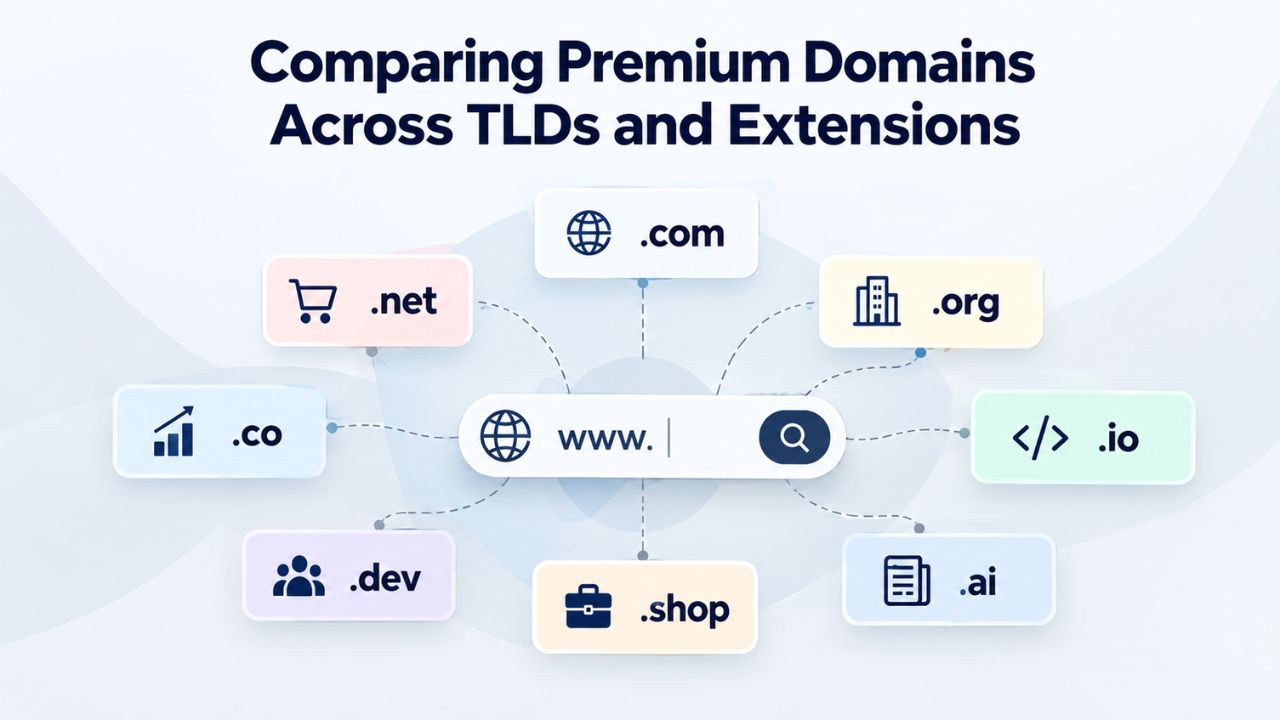
Comparing Premium Domains Across TLDs and Extensions
The cost and positioning of premium domains vary significantly across top-level domain extensions, and understanding these differences helps you choose the most cost-effective and strategically appropriate extension for your business identity and market positioning.
Premium Pricing Strategies in New gTLDs
When ICANN introduced hundreds of new generic top-level domains starting in 2013, many registry operators adopted premium pricing strategies to capture value from short, keyword-rich, and commercially attractive domains at launch. New gTLD registries frequently reserve short names and dictionary words as premium domains, with tiered pricing structures that vary considerably by registry. This approach reflects registries’ business models: they must recoup startup costs and ongoing operational expenses while competing for market share in a crowded TLD landscape, making premium pricing on desirable names a key revenue generator.
As a result, new gTLDs often have steeper premium costs than older, more established extensions like .com or .net, which already have mature market positions and established registrars. A short name in a newer extension might command substantially higher yearly costs than the same name would in .com, even though both are equally useful for specific business purposes or market segments. For startups and small businesses evaluating new gTLDs for branding, this cost difference matters and should factor into your extension choice and budget planning.
Established TLDs: Limited Premiums, Abundant Aftermarket
Established TLDs like .com, .net, .org, .edu, and country-code domains (ccTLDs) rarely include registry-designated premiums, with few exceptions, and instead support a mature, active aftermarket for premium domain resales. The vast majority of “premium” names in these extensions are aftermarket acquisitions, domain names that previous owners registered at standard rates years or decades ago and now offer for resale at market rates based on strategic value and demand. This bifurcated market creates an opportunity: standard domain registration in .com remains accessible and affordable. In contrast, premium positions in .com are available through the secondary market at prices reflecting actual market value rather than arbitrary registry designations.
The practical implication is that if you need a short, brandable, or keyword-rich domain in .com, you’ll almost certainly be shopping the aftermarket at premium acquisition rates rather than registering a fresh name at standard rates. However, if you’re flexible on your domain name and willing to accept longer or more creative names, standard registration remains accessible, cost-effective, and a legitimate way to build your online presence. This dynamic applies across most established TLDs and should shape your long-term domain strategy for your business or organization.
Secondary Marketplace Dynamics and Pricing Trends
Understanding how the secondary market for premium domains functions, what pricing trends reveal about market value, and how to interpret aftermarket valuations helps you make strategic acquisition decisions aligned with genuine market conditions rather than inflated seller expectations. The premium domain aftermarket has matured into a sophisticated marketplace with transparent pricing, professional services, and established valuation methods that guide buyers and sellers alike.
Market Research and Comparable Sales Analysis
Successful premium domain acquisition requires researching recent comparable sales to establish realistic market value ranges for similar names before making acquisition offers or deciding whether listed prices are reasonable. Use domain valuation resources like DomainTools, NameBio, and domain brokerage sites to find transaction data on similar names in the same TLD and length category, establishing clear pricing precedent for your specific acquisition target. This research provides negotiating leverage, protects you from overpaying based on inflated seller expectations, and helps you distinguish genuine market value from optimistic asking rates.
The secondary market provides valuable public data about what similar domains have sold for recently, giving you concrete reference points for evaluating seller claims about value. If a seller is asking substantially more for a multi-word domain than comparable multi-word domains have sold for recently, the asking rate is likely inflated and signals an opportunity to negotiate, skip the domain, or pursue alternatives. Domain holders often negotiate readily, especially if their asking price is disconnected from market reality, making respectful, data-supported offers an effective negotiation strategy.
Professional Services and Broker Assistance
For particularly high-value acquisitions above certain price thresholds, engaging professional domain brokers can facilitate negotiations, coordinate escrow, provide market analysis, and manage the transfer process on your behalf, often resulting in better terms than you could negotiate independently.
Professional brokers have access to private sales data, maintain relationships with major sellers and portfolio holders, and understand market dynamics that public aftermarket data alone cannot reveal. They charge a percentage of the transaction value for their services. Still, this cost is often offset by better negotiation outcomes or avoided mistakes in high-value acquisitions where the stakes are substantial.
Brokers can also provide expert valuation guidance for domains above a certain acquisition cost, helping you determine fair market value based on comparable sales, domain history, backlink profile quality, and market demand for similar names in your industry or market segment. This professional guidance is especially valuable for acquisitions in the higher price ranges, where miscalculations or overpayment can cause significant financial losses that far exceed brokerage fees.
Explore Premium Domain Solutions With Niya Digital
Niya Digital partners with an ICANN-accredited registrar to help you register, transfer, manage, and protect premium domains across thousands of top-level domains globally. Whether you’re acquiring a new premium domain or transferring an existing premium name to a more reliable platform with better rates, our team provides transparent guidance on long-term cost considerations, expert support navigating acquisition complexities, and tools for effective domain portfolio management. From domain registration to DNS management and security features, Niya Digital simplifies securing and maintaining your premium digital assets while protecting your investment.
Frequently Asked Questions
What is the simplest way to tell if a domain is premium?
When you search for a domain on a registrar’s website, the displayed cost will immediately indicate whether it’s premium. Standard domains show straightforward rates that match typical TLD pricing, while premium designations show notably higher pricing. Checking two or three different registrars can also confirm whether it’s a registry premium (same elevated cost across all registrars) or an aftermarket premium (listed only on certain registrar marketplaces).
Can I negotiate the rate of a registry premium domain?
No, you cannot negotiate registry premium rates directly, as the registry operator sets the rate and all registrars selling that domain must charge the same registry-determined amount per ICANN policy.
However, you can shop registrars for promotional discounts on first-year rates or multi-year packages, and you can watch for special offers some registrars provide periodically. Aftermarket premiums are fully negotiable with the current owner, and many sellers will negotiate, especially for cash offers that close quickly.
Will my premium domain renewal rate change every year?
For registry premiums, your renewal rate will stay in the same tier every year unless the registry raises rates across the entire tier uniformly; in that case, the increase applies to all registrants in that tier at the same time.
For aftermarket premiums, your renewal rate will match the standard TLD rate once you acquire the domain and remain stable indefinitely at that standard level (unless the registry raises standard rates, which is rare). Registry operators must provide 30+ days’ advance notice before implementing rate increases.
What happens if I let a premium domain expire?
If your premium domain registration lapses and expires, the domain enters a redemption grace period, typically 30 days, where you can renew it at standard renewal rates plus a recovery fee.
If you don’t renew during that window, the domain enters a pending-delete phase, after which it’s released back to the registry for general public availability. At that point, anyone can register it, including competitors or domain speculators. For premium domains you value, enable auto-renewal to prevent accidental lapse.
Is inherited domain authority from an aftermarket premium guaranteed to help my SEO?
No, inherited domain authority can accelerate your SEO progress, but it’s not guaranteed to deliver ranking improvements on its own. If the domain has a clean history with high-quality backlinks from authoritative sites, the inherited authority gives you a ranking head start compared to a brand-new domain.
However, if your content is weak, your site has technical SEO issues, or your backlink profile remains poor after acquisition, inherited authority alone won’t produce competitive rankings.
Are there legitimate reasons to choose a standard domain over a premium domain?
Absolutely. Standard domains are appropriate if you’re bootstrapping with limited capital and should invest in product quality first, testing a business model before committing to major domain expenses, or building a brand around a unique or creative name that doesn’t command premium pricing from the market.
Many of the most successful businesses operate on standard-rate domains because their content, marketing execution, and brand building have exceeded the domain’s initial perceived value.
Can I transfer a premium domain to a different registrar?
Yes, you can transfer a premium domain to a different registrar exactly like you would transfer a standard domain. Request an authorization code (EPP code) from your current registrar, provide that code to your new registrar, and initiate the transfer.
However, transferring a premium domain includes a mandatory one-year renewal at the new registrar’s rates, so compare rates before transferring to avoid surprise costs.
What’s the difference between a registry premium and a premium TLD extension?
A registry premium is a single domain name a registry has designated as high-value and priced above standard rates. A premium TLD extension is an entire top-level domain where the registry sets different rate structures for certain name categories.
When you register any name in a premium-tier TLD, you might encounter standard or elevated costs depending on that registry’s specific policies for different name categories.
Do premium domains have special technical features that standard domains lack?
No, premium and standard domains have no technical differences whatsoever. Both support DNS records, email forwarding, subdomains, DNSSEC, domain locks, and all standard domain features identically. The difference is purely in acquisition cost and renewal-rate structure, not functionality or capabilities.
How should I value an aftermarket premium domain before making an offer?
Research recent sales of comparable domains to establish realistic market value ranges using domain valuation resources, Namebio, and domain brokerage sites to find transaction data on similar names in the same TLD and length category.
Consider the domain’s keyword relevance, history, backlink profile quality (if acquiring for SEO value), and potential resale market. If the seller is asking substantially more than comparable sales support, make a lower offer, as domain holders often negotiate.
Should I prioritize acquiring a premium domain in .com, or could I choose a different TLD?
This depends on your industry, customer base, and branding strategy. .com carries universal recognition and psychological credibility that other TLDs haven’t replicated, justifying premium acquisition costs for desirable .com names. However, newer TLDs like .io, .co, .tech, and .app have developed strong associations with specific communities.
If a premium name in an alternative TLD better matches your brand and audience expectations than a .com option, it may deliver value with different acquisition costs and positioning advantages.
What should I check before purchasing an aftermarket premium domain?
Audit the domain’s history using DomainTools, the Wayback Machine, and Ahrefs to confirm it hasn’t been used for spam, adult content, or other penalized activities that could carry SEO penalties.
Check the backlink profile to ensure links come from legitimate, high-quality sources rather than spam or low-authority sites. Research trademark conflicts to confirm the name doesn’t infringe on registered trademarks. Verify the renewal rate to understand total cost of ownership accurately.
How much should I expect to spend acquiring a premium domain?
Premium domain acquisition costs vary dramatically based on domain characteristics: short two-letter names can reach exceptional values, while four- to six-character or keyword-focused domains typically command mid-range acquisition costs.
Geographic domains, age, backlink profile, and market trends all influence valuation. Research comparable sales for your specific domain category, and expect to negotiate substantially from initial asking rates in most aftermarket acquisitions.
Can I hold multiple premium domains without overcommitting financially?
Yes, but you must understand each domain’s renewal cost structure before acquiring it. Aftermarket premiums with one-time acquisition costs and standard renewals can be accumulated without high ongoing costs.
Limit registry premiums with perpetually elevated renewals to avoid a cumulative financial burden. Plan your portfolio carefully and budget for all renewal obligations.
Glossary
- Aftermarket Premium: A previously registered domain offered for resale by its current owner through secondary marketplaces (Sedo, Afternic, Dan.com) or direct negotiation, typically at high one-time acquisition cost but with standard renewal rates thereafter.
- Registry Premium: A domain designated by a top-level domain registry operator as high-value, subject to elevated acquisition and renewal costs set by the registry, which apply uniformly to all registrants in the same premium tier.
- Inherited Domain Authority: Search engine ranking signals and credibility accumulated by a domain through years of registration history, backlinks from established sites, and prior web presence, which transfer to a new owner when acquiring an aftermarket domain.
- ICANN Transfer Lock: A 60-day automatic registration lock applied to any domain immediately after it transfers between registrars, during which the registrant cannot initiate another transfer elsewhere.
- WHOIS/RDAP Privacy: A registrar service that replaces a domain owner’s personal contact information in public domain-lookup databases with the registrar’s proxy details, reducing unsolicited contact and data-harvesting risk.
- Escrow Service: A neutral third-party intermediary (typically Escrow.com) that holds payment from a domain buyer until the seller confirms the transfer is complete, protecting both parties from fraud in high-value transactions.
- EPP Code (Authorization Code): A unique alphanumeric code provided by your current registrar that authorizes the transfer of your domain registration to a new registrar; required to initiate any domain transfer.