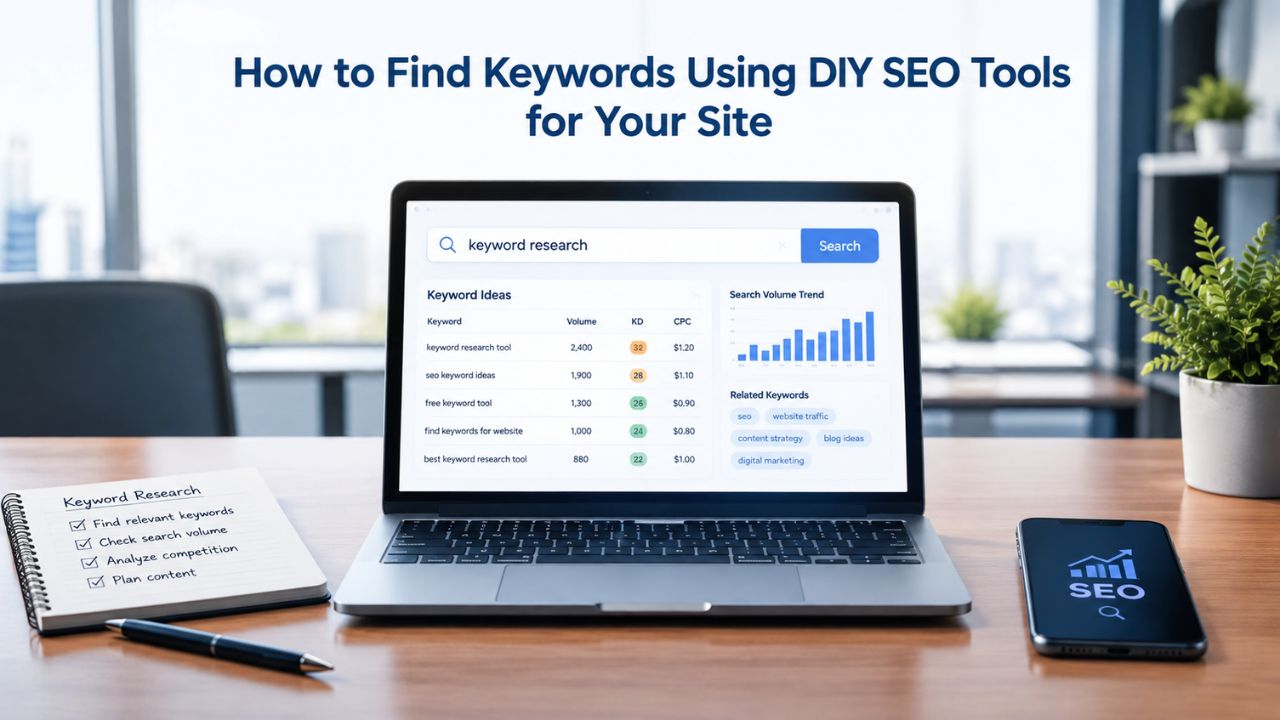
Transactional keywordsFinding the right keywords is the cornerstone of SEO strategy. Without understanding what your audience searches for, you’re essentially guessing at content and optimization priorities. DIY SEO tools have made keyword research accessible to small businesses and site owners without agency budgets, enabling you to uncover opportunities, analyze competition, and build a data-driven content plan. Niya Digital’s DIY SEO tool draws on third-party search and keyword-data sources to generate keyword metrics; like all keyword-research tools, volume estimates are approximations and refresh periodically, not in real time.
Why Keyword Research Is the Foundation of DIY SEO
Keyword research forms the backbone of every successful SEO initiative. It answers a fundamental question: what are people actually searching for, and how can your content match that demand? Without this foundation, even technically perfect pages and high-quality content won’t reach the audience you need. Every page you publish, every topic you choose, and every downstream optimization decision depends on the keyword research decisions you make upfront. When you skip keyword research, you’re building a content strategy on guesswork instead of evidence.
Connecting Keywords to Business Goals
Every website exists to serve a purpose, whether that’s generating leads, selling products, building authority, or providing information. Keyword research bridges the gap between what your business offers and what potential customers are actively searching for. When you understand the keywords your audience uses, you can create content that ranks, attracts qualified traffic, and aligns with genuine user intent. This alignment is why DIY SEO tools focus so heavily on keyword data: targeting the right keywords reduces wasted effort on topics nobody searches for and helps you capture high-intent keywords that drive conversions.
Google’s Search Central documentation emphasizes that keyword relevance and user intent are primary ranking factors. By researching keywords before you write, you’re not guessing; you’re building strategy on public search behavior data. This means every hour you spend on keyword research saves you ten hours of wasted content creation. You avoid writing about topics that sound interesting but have zero monthly search volume, and you focus effort on topics your target audience is actively seeking.
Search Engine Optimization Plans & Pricing
Choose the right SEO plan for your website. Improve search engine visibility, discover relevant keywords, monitor rankings, and access customized optimization services to support your business growth.
Search Engine Optimization (SEO)
Bring more traffic to your website with Search Engine Optimization.
- Search Optimization: Improve search engine rankings with keyword and suggested topics tool
- Keyword suggestions: Get personalized phrases and words to add to increase traffic to your website and help it rank better.
- Tracking your ranking: Track the progress of your website’s rank on Google over time
- Create your sitemap: Customize, create and submit a site map to aid search engines in crawling your site.

Customized SEO Plan
Get Customized Plan For your Business Website SEO (Search Engine Optimization)
- On-Page & Off-Page Optimization: Update Meta Tags, Titles, Descriptions, Alt Tags, Schema / JSON-LD / Microdata Format, HTML + TXT + XML Sitemap, Robots.TXT, Google Analytics & Google Search Console integration
- Keyword Research & Analysis: Improve Keyword Effectiveness Index (KEI) with main heading & sub-heading tags, Content Review by professional content editor
- Competitor Research & Analysis: Compare and Compete with competitors search engine ranking positions, Track and analyse competitor trends
- Diversify Back Link Profile: Relevant Business Directory Submission, Article Submission, Blog Creation, Web 2.0 asset creations, Author Profile Links, Social Book Marking links
- Monthly Task Review & Progress Reporting: Get Monthly SERP Reports and Task Performance Reports
Why DIY Keyword Research Beats Guessing
Many small-business owners start with assumptions: “People probably search for X” or “My competitors rank for Y, so we should too.” Assumptions often miss high-value opportunities and waste time on keywords with little search demand. DIY SEO tools replace guessing with data. They show you actual search volumes, competitiveness metrics, and trending topics, so you can confidently allocate content effort where it will have the most impact.
Niya Digital’s team has found that businesses switching from guesswork to data-driven keyword selection typically identify 20–40% more viable content opportunities in their first month of research. This isn’t hypothetical: when you plug your business into a DIY SEO tool and run competitor analysis, you discover keywords you never would have thought of manually. You see gaps in competitor coverage, emerging long-tail opportunities, and seasonal trends that guide your content calendar for months ahead.
Understanding Search Intent and Keyword Categories
Not all keywords are created equal. A keyword’s value depends on the intent behind it, the reason someone typed that phrase into a search box. Matching your content to the right intent is just as important as targeting high-volume keywords. Two keywords might have identical search volume, but if one needs a blog post and the other needs a product page, creating the wrong format wastes your effort. Search intent is the filter that separates keywords worth pursuing from keywords that will never drive conversions, no matter how much content you create.

The Four Types of Search Intent
Keywords fall into four broad intent categories, and recognizing which category a keyword belongs to is essential for planning content that ranks.
Informational keywords are research-focused: “how to write a blog post,” “what is SEO,” “best practices for email marketing.” Searchers want answers, education, or explanation; they’re not ready to buy. Informational keywords are perfect for blog posts, how-to guides, and educational resources.
Commercial keywords show purchase interest but may not result in an immediate transaction: “best project management software,” “affordable email marketing tool,” “top CRM platforms for small business.” These searchers compare options and research before deciding. Commercial keywords work well for comparison posts, feature breakdowns, and landing pages designed to educate prospects before the sales conversation.
Transactional keywords indicate immediate buying intent: “buy running shoes,” “book a hotel in Boston,” “download SEO audit tool.” These searchers have decided and are ready to convert. Transactional keywords suit product pages, checkout pages, and direct-offer pages.
Navigational keywords direct users to a specific brand or page: “Gmail login,” “Amazon Prime,” “Slack workspace settings.”
Searchers know exactly where they want to go and are using a search engine as a shortcut. Navigational keywords are typically low-priority for content strategy, but important for brand awareness and site structure. According to Google Search Central guidelines, matching content type to search intent is critical for relevance and rankings. A DIY SEO tool helps you categorize keywords by intent so you can plan content strategy strategically rather than creating random pages and hoping they rank.
Why Competitors’ Intent Can Mislead You
You might notice competitors rank for a keyword and assume you should target it too. But if your content serves a different intent than what searchers expect, you won’t rank, and you’ll waste time optimizing the wrong page. For example, if competitors ranking for “email marketing tools” all published comparison articles (commercial intent), but you publish a beginner’s how-to guide (informational intent), your page won’t satisfy search intent, even if the keyword is relevant to your site.
Search engines evaluate pages against user intent; if your page doesn’t match what the searcher expects to find, they’ll rank other results higher. DIY SEO tools with SERP analysis features show you what type of content actually ranks for each keyword, guiding your content strategy toward pages that match proven intent patterns. This reconnaissance step, spending five minutes checking top-ranking results, prevents weeks of wasted effort on mismatched content.
Setting Realistic Expectations for DIY SEO Keyword Data
Before you dive into keyword research, understand what DIY SEO tools can and cannot do. Keyword data is powerful, but it’s not a guarantee, and transparent expectations keep you focused on strategy, not false confidence. Every number a DIY SEO tool shows you is an estimate based on available data, not an exact measurement. Understanding this distinction is the difference between using keyword research strategically and being misled by incomplete data.
How Keyword Volume Estimates Work
DIY SEO tools estimate monthly search volume by aggregating third-party search and keyword-data sources, historical search patterns, and clickstream data. These estimates are reliable for high-volume keywords, words that are searched thousands of times per month, but become less precise at the tails. Especially for new, emerging, or ultra-niche keywords where search history is sparse, estimates can be significantly off. A DIY SEO tool might show a keyword as “100 monthly searches,” but the true volume could be 80 or 120; for very low-volume keywords, estimates can vary by 50% or more. This variance is normal and reflects the inherent uncertainty in working with public data.
Data refreshes typically happen monthly or quarterly, not in real-time, so you’re always working with a snapshot from the past 1–3 months. This lag doesn’t break keyword strategy; monthly trends matter for most sites, but it means you won’t catch brand-new search trends instantly. If a keyword is trending upward or downward, you might see a delayed reflection in the tool. This is why experienced DIY SEO practitioners cross-check high-priority keywords using multiple tools and Google Keyword Planner, which offers official search-volume data for many keywords. The consistency or conflict between tools tells you whether the data is reliable or uncertain.
Keyword Difficulty Is Comparative, Not Absolute
Keyword difficulty scores indicate how hard it would be to rank for a keyword relative to your competitors in your niche, based on the backlink profiles and domain authority of pages currently ranking. A difficulty score of 45 doesn’t mean “you will rank in 45 days” or “45 is your threshold to succeed.” It means: on this tool’s scale, this keyword is moderate-difficulty compared to other keywords. The actual ranking time depends on your site’s current authority, content quality, the quality of your backlinks, and how many competitors are actively targeting that keyword right now.
One site might rank for a 60-difficulty keyword in three months; another might take nine months. Use difficulty scores to prioritize (tackle low-difficulty keywords first to build momentum), not to predict timelines. A difficulty score is a directional guide, not a deterministic forecast.
The Step-by-Step DIY SEO Keyword Research Workflow
A structured keyword-research process turns data into actionable strategy. Here’s how most DIY SEO workflows flow, using common tool capabilities. Tens of thousands of DIY practitioners follow this workflow when they sit down to research keywords for the first time. This process reduces decision fatigue and helps you capture relevant opportunities before moving to content creation.
Phase 1: Seed Keywords and Initial Expansion
Start with seed keywords, 3 to 10 broad terms that describe your core offerings or expertise. If you run a dog-training business, seeds might be “dog training,” “puppy training,” “obedience training,” and “dog behavior.” These are terms you know your audience uses and terms that directly relate to your business. Plug each seed into a DIY SEO tool’s keyword-research or expansion feature, and let the tool suggest related keywords, long-tail variations, and questions people ask around that topic. Most tools generate 100+ related keywords from each seed within seconds, creating a starting pool you can filter and refine.
This expansion step surfaces keywords you might never have thought of manually, like “puppy training near me,” “how to stop puppy biting,” “board and train dog programs,” or “puppy training cost.” These expanded keywords often have lower competition and higher commercial intent than your original seed terms. They’re also more specific to different customer segments: someone searching “how to stop puppy biting” is at a different stage of the customer journey than someone searching “dog training,” and may be more ready to book a service or purchase a training guide. By expanding your seed terms, you capture keywords across the entire customer journey, not just the obvious broad terms.
Phase 2: Volume, Difficulty, and Intent Analysis
Now filter and rank your expanded keyword list. Use the tool’s search-volume and difficulty columns to identify keywords worth pursuing. Generally, start with keywords that show 100+ monthly searches (enough traffic potential) and low-to-moderate difficulty (reasonable ranking chances for newer sites). Add a manual intent assessment: does each keyword align with the content you plan to create? A keyword might have decent volume, but if it requires a different content format or topic than you’re equipped to produce, deprioritize it. This filtering step makes strategy actionable: you’re moving from “all possible keywords” to “keywords we will actually target.”
Create a simple scoring system: high volume + low difficulty + strong intent match = high priority. This forces objective prioritization and prevents you from chasing high-difficulty keywords too early. Export your filtered list into a spreadsheet and sort by priority score. Now you have a ranked list of keywords that represent genuine opportunities: reasonable traffic potential, lower competitive barriers, and alignment with your content capability. This list becomes your content calendar for the next 3–6 months.
Phase 3: Competitor Keyword Gap Analysis
Identify 3–5 of your strongest competitors, sites that rank for keywords in your space. Use your DIY SEO tool’s competitor-analysis feature to pull a list of keywords they rank for. Most tools let you enter a competitor domain and instantly see which keywords that site ranks for, what position they hold, and estimated traffic. Compare this list to your own target keywords. Any keywords ranking for competitors but not yet targeted by you are “gap keywords,” low-hanging fruit because competition has already proven demand. If a competitor is ranking for a keyword, you know at minimum that searches happen, that content on that topic can rank, and that traffic is high enough to justify competitor investment.
This step often reveals 20–50 untapped opportunities per competitor review. These gap keywords are typically easier to rank for because you’re not starting from scratch; you have proof of concept from competitor success. You can analyze what the competitor did right, create better content, and potentially outrank them. Gap analysis is one of the highest-ROI steps in keyword research; five minutes analyzing a competitor’s keyword portfolio often yields more actionable opportunities than hours of brainstorming alone.
Phase 4: Keyword Clustering and Content Planning
Group related keywords into content clusters based on topic and search intent. For example, “how to train a dog,” “dog training methods,” “positive reinforcement dog training,” and “clicker training for dogs” all address the same topic and could be covered in one comprehensive guide or linked as part of a pillar-and-cluster content strategy. Clustering prevents topic overlap (two pages targeting almost identical keywords) and helps you plan content that serves multiple keywords with one strong piece. It also reveals where you need one big authoritative article versus multiple targeted pages.
When keywords cluster naturally around a topic, it signals that searchers want comprehensive coverage. Creating one 3,000-word guide on dog training methods that covers multiple keyword variations will rank for all of them better than creating five separate 600-word pages with keyword cannibalization. Clustering also helps you think about your content structure: what’s the main pillar topic, and what are the supporting subtopics? This hierarchical view speeds up content planning and ensures your site structure matches how searchers think about your topic.
Key Criteria for Evaluating a DIY Keyword Research Tool
Not all DIY SEO tools offer the same depth or usability. Before choosing one, know what to look for. The tool you select will directly impact your research speed, data reliability, and strategic depth. Investing time in evaluation now saves months of regret later.
Essential Tool Features for DIY Keyword Research
| Evaluation Factor | Why It Matters for Small Business | Questions to Ask |
|---|---|---|
| Search Volume Accuracy | Inflated volume estimates waste time on low-traffic keywords; underestimated volume causes you to miss opportunities. | Does the tool show confidence levels or data freshness? Can you cross-check with Google Keyword Planner? |
| Keyword Clustering & Grouping | Prevents scattered content strategy and helps you group related keywords into one strong page or pillar content. | Can you tag or group keywords by topic, or do you need to export and sort them manually? |
| Competitor Keyword Discovery | Saves weeks of guessing which keywords matter in your niche; competitor gaps reveal quick wins. | Can you input a competitor domain and see their ranking keywords? How many competitors can you analyze simultaneously? |
| Search Intent Classification | Mismatched intent wastes effort; clear intent labeling prevents writing the wrong content type. | Does the tool label intent (informational/commercial/transactional) or show top-ranking page types for each keyword? |
| Export & Reporting | Spreadsheet export and custom reporting let you share findings with team members or collaborators. | Can you export filtered keyword lists? Do reports auto-generate, or require manual building? |
| Mobile vs. Desktop Breakdown | Mobile and desktop search volumes and intent vary; a tool that separates them helps you prioritize mobile-first strategy. | Do mobile and desktop metrics appear separately, or are they lumped together? |
Look for tools that handle at least four of these factors well. A tool that covers all six usually offers more comprehensive capabilities, though standalone tools may excel in specific areas. The right tool depends on your priorities: if keyword research is your primary need, a specialized tool with exceptional accuracy might suffice. If you also need technical audits, rank tracking, and competitor analysis, an all-in-one platform reduces tool switching and ensures data consistency across modules.
Comparing Tool Types: Standalone vs. All-in-One Platforms
Some DIY SEO tools focus narrowly on keyword research, useful if you already have solutions for technical audits or rank tracking. All-in-one platforms bundle keyword research with technical audits, competitor analysis, rank tracking, and reporting, streamlining workflow and reducing the learning curve by consolidating features in one interface. All-in-one platforms often offer deeper integration between modules; for example, rank tracking automatically checks your progress on keywords identified in your keyword-research module, and technical audits flag on-page optimization opportunities for your target keywords.
Standalone tools may excel in raw keyword-research depth; a specialized tool might offer more sophisticated keyword clustering, better SERP analysis, or superior data freshness than an all-in-one platform. Evaluate your priorities: if you need keyword research only, a specialized tool might suffice. If you’re building a complete DIY SEO stack, an all-in-one platform reduces switching costs, data-sync effort, and training time by keeping everything in one familiar interface.
Keyword Prioritization Matrix
| Search Volume (Monthly) | Difficulty Score | Intent Match | Priority Level | Typical Timeline to Rank | Recommended Action |
|---|---|---|---|---|---|
| 50–200 | 0–20 | Strong | Critical | 4–8 weeks | Target immediately; build authority foundation |
| 200–500 | 0–20 | Strong | Critical | 6–10 weeks | Target in Month 1–2; quick wins for momentum |
| 500–2,000 | 0–30 | Strong | High | 8–16 weeks | Target after initial wins; build content volume |
| 2,000–5,000 | 30–50 | Strong | Medium | 3–6 months | Target after 3+ months of site authority building |
| 5,000+ | 0–40 | Strong | Medium | 2–4 months | Target if site has existing authority; high-value opportunity |
| Any volume | 50+ | Strong | Low | 6–12+ months | Defer until site authority established; revisit quarterly |
| Any volume | Any | Weak or Mismatch | Skip | N/A | Reject; do not pursue; redirect effort to high-intent keywords |
Ready to Start Your Keyword Research?
Keyword research is the launchpad for every content and optimization decision. Armed with data from a DIY SEO tool, you move from guessing to strategy and from scattered efforts to focused, high-impact keyword targeting. Niya Digital’s DIY SEO tool combines keyword research with technical audits, competitor analysis, and rank tracking, all in one platform designed for small businesses managing their own SEO. Start exploring your market’s keywords and build a data-driven content plan today.
Long-Tail Keywords: The Hidden Goldmine for Small Sites
Long-tail keywords are longer, more specific phrases (typically 3+ words) with lower search volumes individually but higher commercial intent and dramatically lower competition. For small sites competing against large brands, long-tail keywords are often the fastest path to traffic and the most sustainable approach to building organic visibility. While established players dominate head terms, long-tail keywords represent underserved niches where smaller sites can win.
Why Long-Tail Keywords Convert Better
A search for “keyword research tools” is highly competitive; you’re up against established software companies, review sites, and agencies with enormous authority and backlink profiles. A search for “free keyword research tools for small business” or “best keyword research tool for ecommerce sites” attracts fewer total searches, maybe 100–200/month instead of 5,000, but the user is further along in their research. They’ve narrowed their need. If your content answers their specific situation, conversion rates are higher. Someone searching “best keyword research tool for ecommerce” is much more likely to sign up for a tool than someone searching “keyword research tools,” because their need is specific and urgent.
Long-tail keywords collectively drive significant traffic. A site with 50 long-tail keywords, each bringing 30–50 visits/month, outperforms a site with one head term at 500/month because the 50 keywords are sustainable and more resilient to ranking fluctuation. Long-tail keywords are also far easier for newer sites to rank for because competition is fragmented across many variations rather than concentrated on one prize keyword. Search engines also reward sites that rank for many related keywords by boosting rankings for broader, higher-volume terms over time. Once you rank for 30 long-tail variations of a topic, Google views your site as an authority on that topic and begins ranking you for the head term too.
Finding Long-Tail Variations with DIY SEO Tools
Most DIY SEO keyword-research tools automatically suggest long-tail variations when you enter a seed term. Some highlight them as a separate category with a “long-tail filter”; others let you filter by keyword length (3+ words). Export these long-tail suggestions and rank them by a combination of volume and difficulty; for small sites with low domain authority, target 10–15 long-tail keywords before attempting a head term. This builds authority incrementally; you stack easy wins that establish topical relevance.
After you rank for 15 long-tail keywords, attempt the head term. You’ll have legitimate topical authority, more backlinks from your published content, and demonstrated ranking ability in the space. The long-tail strategy is less glamorous than chasing a single high-volume keyword, but it’s far more reliable for small sites. You’re playing a volume game: many small wins instead of one big win, and that volume compounds into authority over time. Most successful small-site SEO strategies are built entirely on long-tail keywords; the head terms come later as a byproduct of long-tail success.
Analyzing Competitors’ Keywords to Uncover Gaps
Competitor keyword analysis is where DIY keyword research produces outsized value. By understanding what keywords competitors rank for, you can identify overlooked opportunities and fast-track your strategy. This is reconnaissance: you’re learning what the market rewards before you invest effort in content creation.
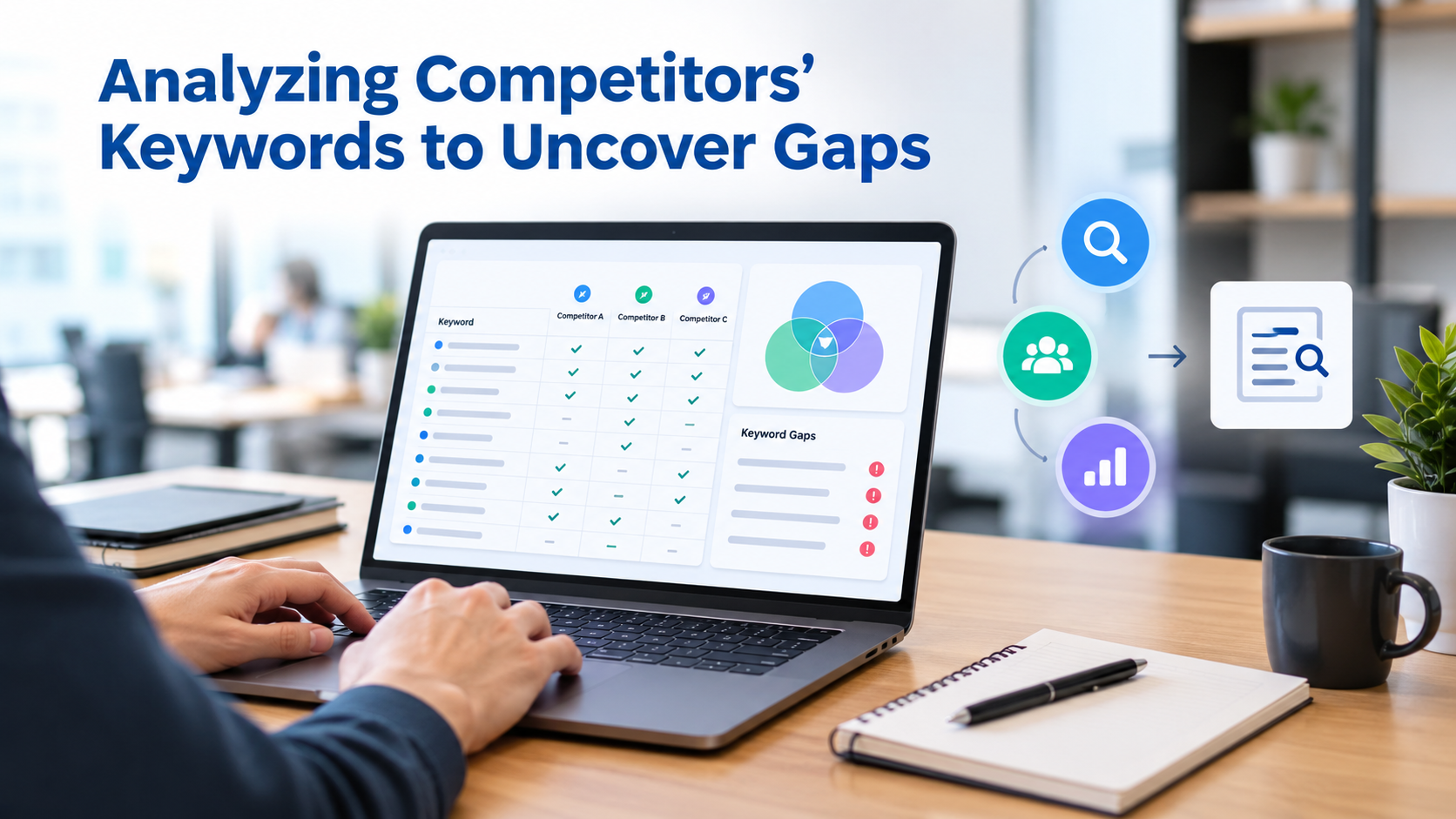
Running Competitor Keyword Gap Analysis
Most DIY SEO tools include competitor-analysis modules. Enter 2–5 competitor domains and the tool pulls a list of keywords where each competitor ranks. Sort by volume to see which competitors capture the highest-value keywords; this shows where the market opportunity is concentrated. Next, pull your own keyword target list (or manually enter 20–30 keywords you plan to target) and compare the two. Any keyword in the competitor list but not in yours is a “gap keyword”, a sign of potential opportunity. These are keywords where searchers actively find your competitor’s content, but you haven’t created content to compete yet.
Sort gap keywords by volume and difficulty; prioritize high-volume, low-difficulty gaps first. These represent the best opportunities: decent traffic potential, lower competitive barriers, and proven demand. When you identify a gap keyword with 500/month search volume and a difficulty score of 25, you know pursuing it will likely drive traffic within 2–4 months of publishing quality content. Gap analysis is one of the highest-confidence keyword-research tactics because you’re following proven demand rather than guessing.
Reverse-Reverse Engineering Your Position
Once you’ve identified gap keywords, analyze the top-ranking pages for each. If competitors rank with basic content and you can create something better (more comprehensive, better-structured, more recent, with better visuals), you have a solid shot at ranking and potentially outranking them. If top-ranking pages are highly authoritative (established brands with hundreds of backlinks) or far more detailed than you can reasonably create, deprioritize that keyword.
DIY SEO tools that show SERP analysis (top-ranking pages, their word count, backlink counts, estimated traffic) help you make this judgment quickly without manually visiting each result. Seeing that the top-ranking article on a gap keyword is 8,000 words and linked by 300 domains tells you something very different than seeing the top result is a 2,000-word blog post with minimal backlinks.
Common Keyword Research Mistakes That Cost You Traffic
Even with a DIY SEO tool, common pitfalls derail keyword strategy. Knowing them in advance keeps you focused on high-impact keywords and prevents months of wasted effort. Practitioners make these mistakes repeatedly; learning from them before you do is priceless.
Mistake 1: Targeting High Volume Without Considering Competition
A keyword with 10,000 monthly searches looks attractive, until you realize it has a difficulty score of 85 and the top 10 results are all from Fortune 500 companies or established authority sites. Your new site will never rank for that keyword without several years of authority building. New sites have limited authority; spending months on unwinnable keywords wastes opportunity cost that you can’t recover. Instead, target keywords with 500–2,000 monthly searches and low-to-moderate difficulty to start.
These keywords have enough traffic potential to be valuable but low enough competition that a newer site has a realistic shot. Once you build authority (3–6 months of ranking success on easier keywords), move toward higher-difficulty, higher-volume keywords. DIY SEO tools let you filter by difficulty; use this filter religiously to avoid unwinnable early battles.
Mistake 2: Ignoring Search Intent and Creating Mismatched Content
You find a keyword with 1,500 monthly searches and moderate difficulty; it seems perfect. But the top 10 results are all buying guides and product comparisons, and you’ve planned a how-to blog post. Your post won’t rank well because it doesn’t match the intent searchers expect. Search engines evaluate page relevance partly by comparing your page to the intent pattern established by top-ranking results.
Before you commit to a keyword, check: what type of content ranks for this keyword? Blog posts, product pages, comparison pages, or something else? Make sure your planned content matches. DIY SEO tools that show top-ranking page types save you from this mistake. Spending an extra five minutes evaluating intent before you start writing prevents weeks of wasted effort on content that will never rank.
Mistake 3: Over-Relying on One Tool’s Data Without Cross-Checking
No DIY SEO tool has perfect data on every keyword. A tool might show a keyword as “1,000 monthly searches,” but a second tool shows “600.” Which is right? You don’t know. The variance reflects different data sources and methodologies. For high-priority keywords- keywords you’ll invest significant content effort in- cross-check volume estimates between two tools or against Google Keyword Planner, which offers free, official search-volume data for many keywords. If estimates vary widely, the keyword is likely either emerging or so niche that data across sources is sparse. Hedge your expectations or deprioritize it. For keywords where you’re making major content commitments, this extra validation step is cheap insurance against bad bets.
Mistake 4: Neglecting Long-Tail Keywords as “Too Small”
A keyword with 30 monthly searches feels too small to matter. But 30 searches × 5% CTR × a 10% conversion rate = 15 potential customers per month from one keyword. If you target 50 such keywords, that’s 750 potential customers per month. Long-tail keywords’ power lies in volume and combined effect, not individual keyword size. Don’t dismiss keywords below 100 monthly searches; they’re often your quickest wins. In fact, many successful small-site strategies are built almost entirely on keywords under 100/month because the competition is so much lower. You can rank for dozens of 30-50 volume keywords faster than one 1,000-volume keyword.
Building a Sustainable Keyword Strategy Over Time
Keyword research isn’t a one-time task; it’s a repeating cycle that evolves as your site grows and the market shifts. The most successful DIY SEO practitioners treat keyword research as an ongoing practice, not a project with a finish line.
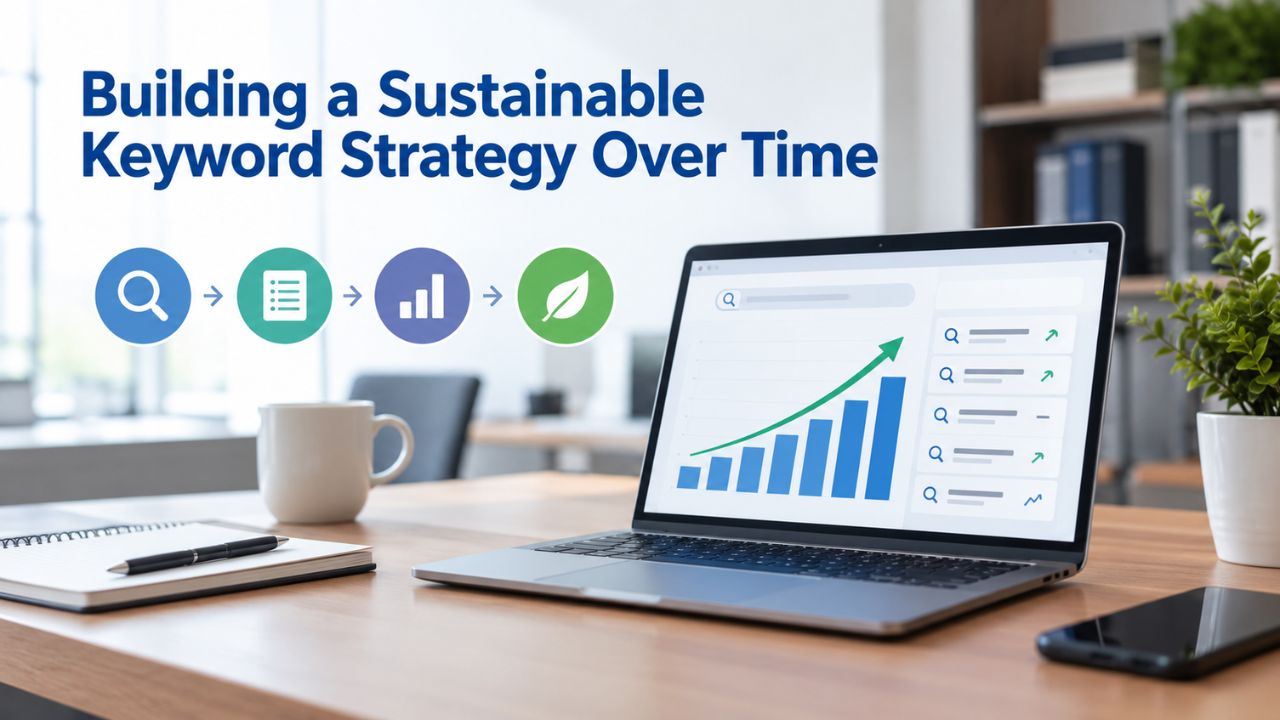
Establishing a Monthly Keyword Research Cadence
Most small-business sites benefit from a monthly keyword-research update. Dedicate 2–4 hours monthly to: run your current keyword list through a DIY SEO tool to check volume and difficulty trends (are keywords you’re targeting becoming more or less competitive?); pull competitor keyword lists to spot new gaps (competitors are constantly publishing; their keyword portfolios shift monthly); search for emerging keywords in your niche (use Google Trends or your tool’s trend feature for signals of new demand); and add 5–10 new target keywords to your content calendar based on findings. This cadence keeps your strategy fresh without overwhelming your team. You’re not re-researching from scratch; you’re monitoring trends and capturing new opportunities as they emerge.
Tracking Keyword Performance Over Time
As you create content, rank-tracking features in DIY SEO tools let you monitor which keywords your pages actually rank for and how positions change over time. After 3–6 months of content publication, analyze the data: which keywords did you rank for quickly (these inform future keyword selection; they represent your site’s natural ranking ease)? Which took longer than expected (these might have higher difficulty than estimated, or stronger competition than the tool suggested)?
Which never ranked (these might have been misaligned with intent, or competition estimates were significantly off)? This feedback loop tunes your future keyword targeting. Over time, you build intuition about which keywords are realistic for your site and which aren’t. You learn your site’s natural competitive position and make smarter bets on future keywords.
When to Pivot or Expand Your Strategy
If a keyword strategy isn’t driving traffic after 6–9 months of consistent content publication, revisit your assumptions. Common reasons: your difficulty estimates were too optimistic; search intent shifted (a keyword’s top-ranking content changed); or a new, well-funded competitor entered the space. Use your DIY SEO tool’s competitor-analysis feature to see if anyone new is ranking for your target keywords.
If yes, analyze their content: are they ranking with significantly better content? If they’re ranking with better content, improve yours. If they’re ranking with equivalent content, you may need to shift to a different keyword cluster. Flexibility and data-driven pivoting separate successful DIY SEO strategies from stalled ones.
Integrating Keyword Research into Your Full DIY SEO Audit
Keyword research is step one; implementation across your site requires technical soundness and ongoing monitoring. Most DIY SEO tools bundle keyword research with technical SEO audits (checking site speed, mobile-friendliness, structured data, indexation), on-page analysis (checking whether your target keyword appears in titles, meta descriptions, and headers), and rank tracking (monitoring your actual rankings for target keywords over time).
Workflow Integration and Speed
When keyword research is separated from technical audits and rank tracking, you create friction in your workflow. You research keywords in one tool, identify optimizations in another, monitor progress in a third. With integrated DIY SEO, keyword research findings immediately inform your technical and on-page optimization priorities. You see a keyword opportunity, pull the page ranking for related keywords, check whether it’s optimized for your new target keyword, and identify technical barriers to ranking if any exist. This closed-loop approach accelerates SEO progress by preventing information silos.
Growing from DIY Keyword Research to Competitive Advantage
Small businesses that master keyword research often build a sustainable competitive advantage. By targeting underserved, high-intent keywords that larger competitors overlook, smaller sites can capture qualified traffic and build authority in specific niches. Large enterprises optimize for high-volume head terms because they need massive scale; smaller sites win by owning niches. This is a fundamental strategic difference: you’re not trying to beat Amazon or Shopify at their game; you’re identifying game variations they haven’t invested in. Keyword research remains the foundation; once you’ve identified the right targets, optimizing content, building backlinks, and earning topical authority come next. DIY SEO tools handle the research. You bring the insight and execution strategy.
Ready to Master DIY SEO and Scale Your Strategy?
You now have the knowledge to run keyword research independently and build a content strategy grounded in data. Whether you’re targeting 50 long-tail keywords to capture niche traffic or building out a comprehensive topic cluster, the process is the same: research, analyze, plan, and execute with confidence. Niya Digital’s DIY SEO platform makes this entire cycle faster and more intuitive, turning keyword data into actionable content priorities and tracking your progress as you climb search rankings. Start your keyword research journey and transform your SEO from guesswork into strategy.
Frequently Asked Questions
What’s the difference between search volume and search intent?
Search volume is how many times a keyword is searched each month; it measures traffic potential. Search intent is why someone searches that keyword, whether they want information, to buy, to compare, or to navigate. A high-volume keyword might have poor intent match for your site. Intent determines whether a keyword is worth targeting for your content goals. Always analyze both dimensions before committing effort to content creation.
How accurate are keyword volume estimates from DIY SEO tools?
DIY SEO tools estimate search volume based on third-party search and keyword-data sources, historical patterns, and clickstream data. For high-volume keywords (1,000+ searches/month), estimates are generally within ±20% of actual volume. For low-volume or emerging keywords, variance can be much higher, sometimes ±50% or more. For high-priority keywords, cross-check volume estimates using multiple tools or Google Keyword Planner.
Can I rank for a keyword in 30 days if I target it with a new page?
Ranking speed depends on your site’s existing authority, the keyword’s difficulty, and content quality, not just targeting the keyword. New sites ranking for established keywords typically need 2–6 months of on-page optimization, backlinks, and content quality to see meaningful movement. Ultra-low-difficulty keywords (under a difficulty score of 10) might rank faster. Avoid keywords with difficulty scores over 50 until your site has built domain authority.
What’s a long-tail keyword, and why do they matter for small sites?
Long-tail keywords are longer, more specific phrases (typically 3+ words) with lower monthly search volume but higher commercial intent. “Keyword research tools” is a head term; “best keyword research tool for ecommerce” is a long-tail keyword. Long-tail keywords have substantially less competition, higher conversion rates, and collectively drive significant traffic. Small sites rank faster for long-tail keywords than competitive head terms.
Should I target competitor keywords or unique keywords?
Target a mix of both. Competitor keywords indicate proven demand and are typically easier to rank for. Unique keywords often have lower competition but carry more uncertainty about demand. Use competitor-analysis features to identify gaps (keywords competitors rank for, but you don’t), then validate gap keywords with volume data before committing effort.
How often should I refresh my keyword research?
Refresh keyword research monthly. Dedicate 2–4 hours to checking volume and difficulty trends for your current targets, spotting new competitor keywords, and identifying emerging keywords in your niche. This keeps your content calendar aligned with evolving search behavior without requiring a full re-research every quarter.
Can I rank for multiple keywords with one piece of content?
Yes, if the keywords are closely related and share similar intent. A page targeting “dog training,” “puppy training,” and “dog obedience” naturally addresses all three because they’re topically related. DIY SEO tools’ keyword-clustering features help you group related keywords. Avoid creating multiple pages for nearly identical keywords (keyword cannibalization).
What’s keyword difficulty, and how should I use it?
Keyword difficulty is a metric (usually 0–100) estimating how competitive it would be to rank for a keyword based on the authority and backlink profiles of pages currently ranking. A score of 10 is very easy; 80 is very hard. Use difficulty to prioritize: target keywords under 40 difficulty early to build authority, then tackle higher-difficulty keywords later. Difficulty is relative to your site authority.
Should I use free or paid DIY SEO tools for keyword research?
Free tools (like Google Keyword Planner and Google Trends) offer foundational data but limited filtering, competitor analysis, and export options. Paid DIY SEO tools provide deeper metrics, faster research, more queries per month, and better competitor insights. For serious keyword research, a paid DIY SEO platform is worth the investment because it saves time and provides richer data.
What should I do if two DIY SEO tools show different volume estimates for the same keyword?
Cross-check using Google Keyword Planner. If estimates still vary widely, the keyword is likely emerging or very niche, and data across sources is sparse. Hedge your expectations: treat the keyword as lower-volume than either tool suggests, or deprioritize it. For high-stakes keywords, expect some variance.
How do I know if a keyword aligns with my business goals?
Ask three questions:
(1) Do searchers using this keyword have a problem my business solves?
(2) Can I create genuinely useful content answering this keyword?
(3) Would someone searching this keyword likely convert (purchase, sign up, book a call)?
If you answer yes to all three, the keyword aligns. If no to any, it’s probably not worth targeting.
Can I ignore keyword research and write content I think is valuable?
You can, but you’ll waste effort. Content without keyword research often addresses topics nobody searches for or ranks poorly because it doesn’t match search intent. Keyword research ensures your content aligns with actual user demand. Even if your instincts are good, keyword data reveals opportunities you’d miss and keeps you from spending weeks on low-traffic content.
How do I choose between keywords with similar volume but different difficulty?
Always prioritize lower difficulty, especially early in your site’s growth. A keyword with 500 searches and difficulty 20 will almost certainly rank faster than one with 600 searches and difficulty 60. Build authority with easy wins first; as your site grows, pursue higher-difficulty targets. Early rankings build domain authority, making subsequent rankings faster.
Should keyword research influence my business strategy, or is it just for content planning?
Keyword research informs both. If research reveals massive, underserved demand for a service or product you don’t offer, it signals a chance to expand your offerings. Conversely, if you identify a niche within your market with high search volume and low competition, it might signal a business opportunity. The best keyword research answers not just “what should I write?” but “what does my market actually need?”
What’s the fastest way to get quick wins with keyword research?
Target low-difficulty keywords (difficulty score under 30) first to build momentum and organic traffic quickly. These keywords rank faster because competition is lighter. Once your site gains authority, move toward higher-difficulty, higher-volume keywords. Most small sites see rankings for easy-win keywords within 4–8 weeks of publishing optimized content, compared to 2–6 months for moderate-difficulty keywords. Use early wins to prove ROI internally.
Glossary
- Keyword Difficulty: A metric (typically on a 0–100 scale) indicating how competitive it would be to rank for a keyword based on the authority and backlink strength of pages currently ranking in the top search results for that keyword.
- Long-Tail Keyword: A longer, more specific keyword phrase (typically 3 or more words) with lower monthly search volume but higher commercial intent and substantially lower competition than shorter, broader keywords. Examples include “best keyword research tool for ecommerce” or “how to train a puppy to sit.”
- Search Intent: The underlying goal or motivation behind a user’s search query, typically categorized as informational (seeking knowledge or explanation), commercial (researching before a purchase), transactional (ready to buy or convert), or navigational (seeking a specific website or page).
- Keyword Clustering: The process of grouping related keywords by topic or theme to inform a unified content strategy and prevent topic overlap across multiple pages on your site. Clustered keywords help you plan pillar content and supporting subtopic pages.
- Search Volume: The estimated average number of times a keyword or phrase is searched within a given period (typically reported as monthly searches) based on aggregated search-engine data and historical trends.
- SERP: Search Engine Results Page; the page displayed by a search engine in response to a user’s search query, showing organic results, paid ads, featured snippets, knowledge panels, and other elements.
- Keyword Gap: Keywords that competitors rank for but your site does not yet target, typically identified through competitor-analysis tools as potential opportunities for content or optimization where demand is proven.