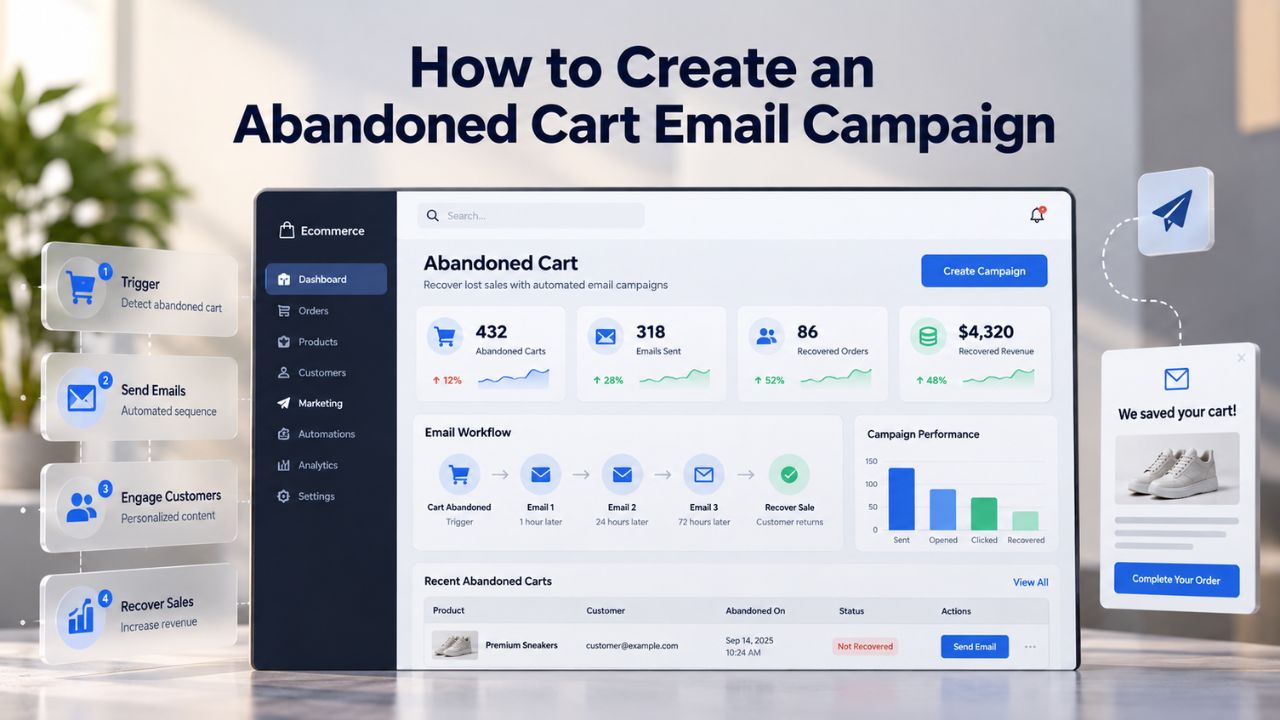
Most online shoppers abandon their shopping carts before completing a purchase. Abandoned cart emails are one of the highest-ROI channels in email marketing, often recovering 15% to 30% of lost sales. Niya Digital’s Email Marketing Service capabilities and our team’s experience building abandoned cart workflows. Email deliverability depends on standard authentication protocols (SPF, DKIM, DMARC) and sending-reputation factors outside any single platform’s control; no platform can guarantee inbox placement or recovery rates.
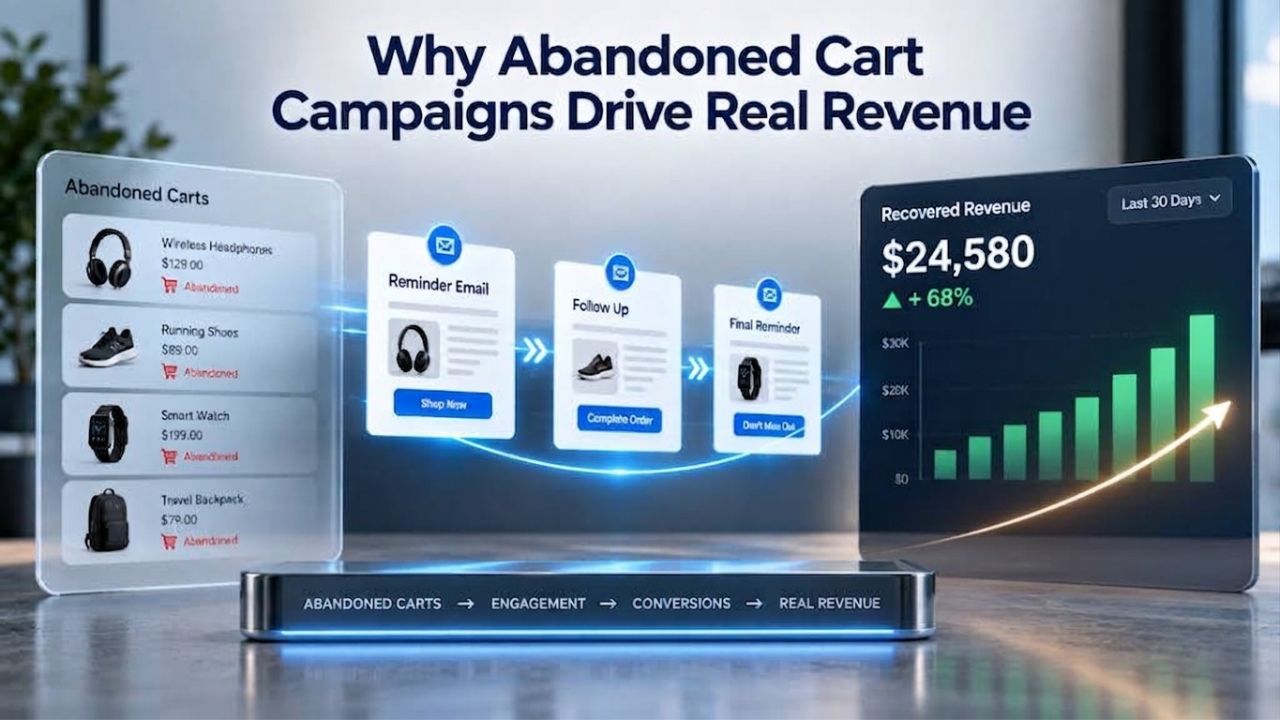
Why Abandoned Cart Campaigns Drive Real Revenue
Abandoned cart emails are triggered messages sent to customers who add items to a shopping cart but don’t complete checkout. They represent one of the highest-performing email marketing automations because they target customers who’ve already shown purchase intent, no cold prospecting required.
Optimization Timeline and Testing Sequence
| Step | What to Test | Typical Outcome | Timeframe |
|---|---|---|---|
| Launch with Single Email (two to three hour delay) | Baseline recovery rate, open rate, complaint rate with a single, generic template. | Establish baseline (e.g., ten to fifteen percent recovery, forty percent open rate). | One to two weeks (one hundred or more carts) |
| Add Follow-Up Email (twenty-four-hour delay) | Whether a second email at twenty-four hours increases total recovery without raising complaints. | Five to ten percent recovery rate increase; complaints stay below 0.3 percent. | Two to three weeks |
| Test Subject Line Variations | Product-mention subject lines versus incentive-mention subject lines; measure the impact on open rate. | Typically a five- to fifteen-percent open-rate lift from the winner; apply to all future emails. | One to two weeks |
| Personalization and Segmentation | Segment by cart value or customer type; assign different templates or incentives. | High-value segments: twenty to thirty percent higher recovery; first-time buyers respond to social proof, repeat buyers to loyalty. | Two to four weeks |
| Incentive A/B Test | Discount versus free shipping versus urgency language; measure recovery rate and profit margin per variant. | Free shipping or loyalty incentives often match discounts with higher average order value and profit. | Two to three weeks |
| Timing Optimization | Test one-hour, two-hour, four-hour delays; segment by time-of-day abandonment. | Often two to three hours wins overall, but afternoon and evening may differ; three to eight percent recovery improvement. | Three to four weeks |
| Add Third Follow-Up (seventy-two hour delay) | Test whether a seventy-two-hour email to non-converters increases recovery or raises complaints. | Typically three to five percent additional recovery, with below 0.2 percent complaints if messaging is soft. | Two to three weeks |
| Full-Scale Rollout with Winners | Deploy optimized template, timing, segmentation, and incentive across all abandoned carts. | Twenty-five to thirty-five percent recovery rate (versus fifteen to twenty percent baseline), fifteen to twenty times return on investment typical. | Ongoing |
The Business Case for Cart Recovery
A typical e-commerce site experiences a seventy percent or higher cart abandonment rate. Unlike unsubscribes or bounces, an abandoned cart is a recoverable missed sale: the customer intended to buy, has payment details ready, and needs one reminder. Research shows that abandoned cart emails achieve forty to fifty percent open rates and five to fifteen percent click-through rates, significantly outperforming standard promotional emails.
Each recovered cart also signals to your email marketing platform that your subscribers engage with your content at high intent. When customers respond to a cart-recovery message, mailbox providers observe strong engagement patterns- opens, clicks, and conversions- which improves your sending reputation and strengthens inbox placement for all future campaigns. This reputation benefit extends beyond the recovery email itself; it becomes part of your domain’s overall email quality score, making all subsequent campaigns more likely to reach the inbox.
How Cart Recovery Fits Into Lifecycle Email Marketing
Abandoned cart campaigns are a behavioral automation workflow within a broader lifecycle email marketing approach. While welcome series engage new subscribers and promotional campaigns drive seasonal sales, abandoned cart emails target customers at a specific moment, right after cart abandonment, when motivation and purchase intent are highest. This timing advantage is why recovery emails outperform batch-and-blast campaigns sent to your entire list.
Abandoned cart recovery also feeds your email list quality in measurable ways. Customers who respond to a cart-recovery message are proven high-intent subscribers; they’re more likely to engage with future campaigns, making them valuable for segmentation and retention strategies. Niya Digital’s team has observed that customers who respond to a cart-recovery message are among the most valuable list segments; they’re more likely to engage with future campaigns and have higher lifetime value than average subscribers. Over time, tracking which customers respond to cart recovery and which don’t helps you identify loyal, price-sensitive, or at-risk segments that can be nurtured with targeted follow-up campaigns.
Email Marketing Plans
Email Marketing Beginner
For anyone getting started with email marketing.
- Up to 500 Contacts
- Add more anytime
- Send up to 5,000 Emails/Month
- Single Signup Form
- Basic Image Storage
- Unsubscribe Handling
- Works with Facebook, Etsy & More

Email Marketing Up & Running
Already have clients? This plan’s for you.
- Up to 2,500 Contacts
- Add more anytime
- Send up to 25,000 Emails/Month
- Unlimited Signup Forms
- Unlimited Image Storage
- Unsubscribe Handling
- Works with Facebook, Etsy & More
- Automated Welcome Email
- Converts Blog Posts to Email
- Unsubscribe Options
- Hot Leads List
Email Marketing Pro
For savvy marketers with growing mailing lists.
- Up to 5,000 Contacts
- Add more anytime
- Send up to 50,000 Emails/Month
- Unlimited Signup Forms
- Unlimited Image Storage
- Unsubscribe Handling
- Works with Facebook, Etsy & More
- Automated Welcome Email
- Converts Blog Posts to Email
- Unsubscribe Options
- Hot Leads List
- Auto-sends Event Emails
- Automated Email Campaigns
- Record Signup IPs
- Share Statistics w/Others
The Core Architecture of an Abandoned Cart Campaign
An abandoned cart campaign isn’t a single email; it’s a triggered automation workflow made up of multiple interdependent pieces. Understanding how triggers, delays, and sequences work together is essential before you build your first recovery campaign.
How Triggers and Delays Work
A trigger is an action that automatically initiates an email. In an abandoned cart workflow, the trigger is the abandonment itself: a customer adds items to a shopping cart, closes the browser or leaves the site, and never returns to complete checkout within a specified timeframe. Your e-commerce platform detects this abandonment and sends a signal (via API, webhook, or CSV import) to your email marketing platform. The platform receives this signal and sets a timer.
Once the trigger fires, a time-based delay gives the customer a grace period, typically one to four hours, before the first email arrives. This delay balances two competing goals: reaching the customer. At the same time, purchase intent is fresh, but waiting long enough that they don’t receive the recovery email while still actively deciding whether to proceed with checkout. Niya Digital’s Email Marketing Service supports configurable delays for each step of an abandoned cart automation, so you can test whether one hour, two hours, or four hours performs best for your specific audience and product category.
Building a Multi-Step Cart Recovery Sequence
A simple abandoned cart campaign consists of a single email sent hours after abandonment. A more sophisticated sequence includes two or three follow-ups at increasing intervals, each designed to catch customers who weren’t persuaded by the previous message. A typical multi-step flow looks like this: Email one arrives one to two hours after abandonment with a reminder, product details, and basic incentive; Email two arrives twenty-four hours later with increased urgency, social proof, and a stronger incentive; Email three arrives seventy-two hours later with a final reminder and the highest incentive or alternative offer.
This spacing strategy accomplishes two important things. First, it lets mailbox providers see strong engagement signals (opens, clicks) on the first email before the follow-ups arrive, protecting your sending reputation and helping ensure the follow-ups don’t get caught in spam filters. Second, it respects customer preferences by offering multiple chances to convert without overwhelming subscribers with too many emails. You can personalize and segment each email in the sequence, targeting different customer groups with different messages; a high-value cart might receive a premium offer. In contrast, a lower-value cart might emphasize free shipping. Niya Digital’s automation feature allows you to set up these multi-step sequences visually, assign each email its own template and timing, and monitor performance at each stage in real time.
Choosing Your First Email Timing and Frequency
The timing of your first abandoned cart email is one of the highest-impact decisions you’ll make. Get it right, and you recover more sales while signaling strong engagement to mailbox providers. Get it wrong, and you either miss the sale window entirely or annoy subscribers with untimely messages that feel intrusive.
Optimal Timing: One to Four Hours After Abandonment
Industry best practice converges on one to four hours as the optimal window for the first abandoned cart email. Send within one hour, and you catch customers while they’re still thinking about the purchase, but you also risk emailing while they’re actively reconsidering, which leads to quick deletes or spam complaints. Send after four hours, and you risk losing the customer to distraction, competing priorities, or a competitor’s offer that appeared while they were away.
Most platforms recommend two to three hours as a balanced starting point because it’s quick enough to feel like a timely reminder but not so immediate that it feels pushy. To find your audience’s optimal timing, run your first campaign with a single delay (e.g., two hours), then measure your recovery rate, open rate, and complaint rate after collecting at least 100 to 200 abandoned carts. Once you have baseline data, segment your results by the time of day the abandonment occurred and compare recovery rates for morning, afternoon, and evening abandonments. You may find that afternoon abandonments recover better if your first email arrives before dinner, while evening abandonments convert better if the email arrives the next morning. Niya Digital’s Email Marketing Service tracks these metrics by campaign and segment, so you can compare performance across delays and identify your audience’s true optimal window.
Frequency Strategy: One, Two, or Three Emails?
A single-email abandoned cart campaign is simpler to set up and carries minimal risk: one message, lower complaint risk, and a straightforward ROI calculation. But a multi-email sequence almost always recovers more abandoned carts overall because it reaches different customer segments at different points in their decision-making process. The question is how aggressive your follow-up strategy should be without causing subscriber fatigue.
Most e-commerce brands send a second email twenty-four hours after the first and a third seventy-two hours later. This cadence gives the first email time to perform (open, click, convert), while the follow-ups catch customers who need a second or third reminder. Watch your unsubscribe and complaint rates closely when testing follow-ups; if your complaint rate jumps above industry averages, reduce the frequency or soften the messaging. Niya Digital’s Email Marketing Service shows you complaint rates and unsubscribe clicks at each step, helping you optimize frequency without guessing. Start conservatively with one email, measure performance for two weeks, then test adding a second email at twenty-four hours and measure again before deciding whether a third email makes sense for your business.
Personalizing and Segmenting Your Cart Recovery Messages
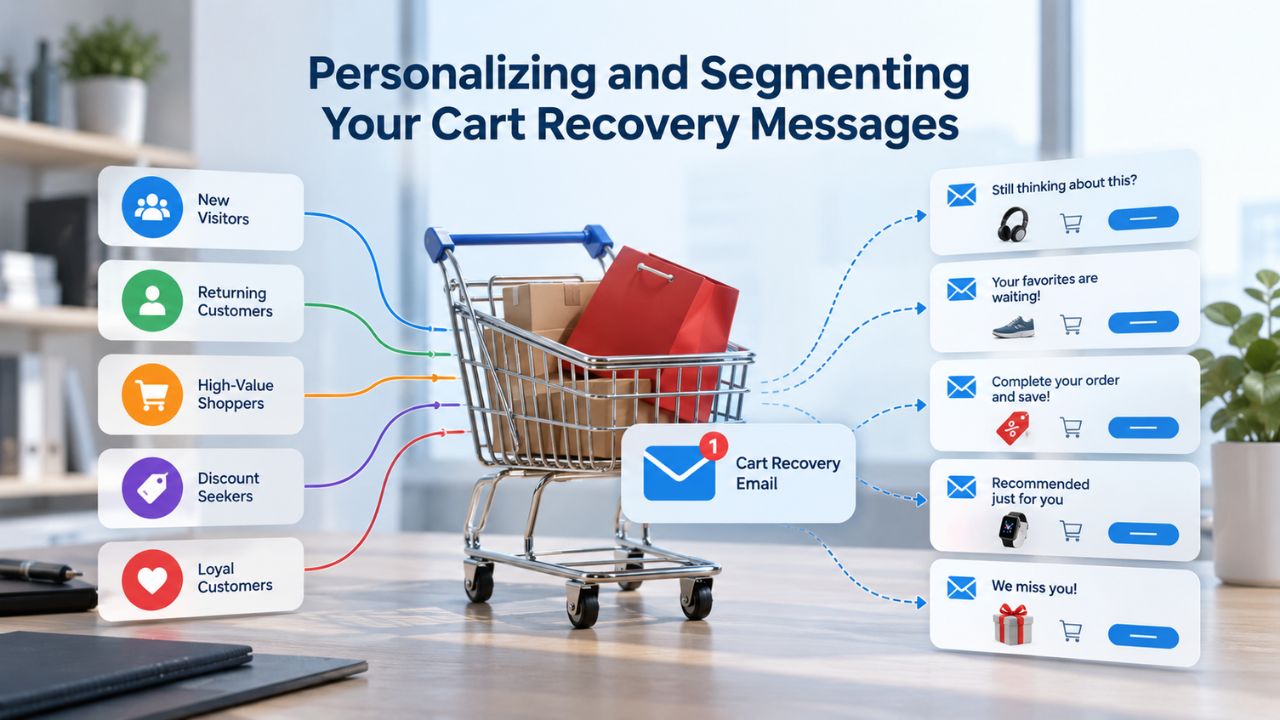
A generic “complete your purchase” email underperforms a dynamic, personalized message by 30% to 50% or more. Segmentation, dividing your abandoned carts into groups based on customer characteristics or cart contents, lets you tailor messaging and incentives to what each segment values most, dramatically improving recovery rates.
Dynamic Content: Show the Exact Products Left Behind
The single most powerful element in an abandoned cart email is the product image, name, and price the customer abandoned. Include these details in every cart recovery message. A dynamic email template pulls the product information directly from your e-commerce platform’s data feed, so every email shows the exact items in that customer’s cart, no manual list-building required and no risk of showing the wrong products.
Beyond product details, dynamic content can include the customer’s first name, their purchase history (e.g., “You bought this related product last month”), and personalized incentives tailored to their segment. An incentive could be a percentage discount, free shipping, a gift with purchase, or simply urgency copy (“Only two left in stock”). A/B test whether your audience responds better to discount incentives or non-discount incentives like free shipping or social proof (“Joined by five hundred plus customers this week”). Testing different incentive approaches reveals what resonates most with your specific customer base, and you can deploy the winner across future campaigns.
Segmentation by Cart Value, Customer Segment, or Product Category
Not all abandoned carts are equal in value or recovery potential. A high-value cart (five hundred dollars or more) deserves a premium recovery offer and messaging that emphasizes exclusivity or VIP treatment because the lost revenue is substantial. A low-value cart (ten to thirty dollars) might recover better with free-shipping offers or urgency language because the incentive needs to match the order size. A returning customer might respond to a loyalty incentive (“fifteen percent off, as always”). At the same time, a first-time cart abandoner might need social proof or a satisfaction guarantee to overcome purchase anxiety.
Segment your abandoned carts by customer type (first-time versus repeat), cart value (high, medium, low), product category, or customer lifetime value. Assign each segment a distinct email template, timing, or incentive based on what research and testing show works best for that group. Over time, you’ll discover which segments convert fastest, which need more follow-ups, and which segments are most profitable per email sent. This insight feeds back into your broader email marketing strategy, helping you allocate resources to the highest-ROI segments and refine your list-building efforts to attract more customers matching your most valuable segments.
Building Effective Abandoned Cart Email Templates
Your template design directly impacts recovery rates and determines whether subscribers engage or delete. A cluttered, slow-loading, or unclear email template loses sales; a clean, fast, mobile-optimized template with a clear call to action wins consistently.
Subject Lines That Drive Opens
An abandoned cart email’s subject line must balance urgency with specificity. Generic subject lines (“Complete Your Purchase,” “Your Cart is Waiting”) are forgettable and rarely stand out in a crowded inbox. Specific subject lines that reference the product or a time-sensitive incentive perform significantly better: “You left Product Name behind, here’s fifteen percent off,” “Your Product is still available (limited stock),” or “One-hour flash: finish your order, save money.” The best subject lines are short (under fifty characters on mobile), personalized with the customer’s name or a product detail, and create mild urgency without being spammy or using excessive punctuation.
Systematically test subject line variations across your audience. Send half your abandoned carts a subject line that emphasizes the specific product (“Your leather jacket is waiting”), and half that emphasizes the incentive (“Recover your order with free shipping”). Track open rates after one week. If product-specific subject lines win, next test whether including the price (“You left the leather jacket at eighty-nine dollars behind”) performs better still. Use your email marketing platform’s A/B testing capability to run these tests systematically and apply winners to future campaigns. Niya Digital’s Email Marketing Service supports subject line A/B testing for automation workflows, so you can refine your templates based on real data rather than guessing what your audience prefers.
Email Body: Clarity, Urgency, and Social Proof
Your email body should follow this proven structure:
(1) greeting and reason for the email,
(2) product image and details,
(3) incentive or urgency call-out,
(4) clear call-to-action button linking back to the cart or product page,
(5) optional social proof or guarantee.
Keep the email short; abandoned cart emails are often read on mobile, where long copy gets scrolled past. Use short sentences, plenty of white space, and a prominent, contrasting call-to-action button.
Urgency signals work exceptionally well in abandoned cart emails because the purchase intent is already there; you’re simply reminding customers. Phrases like “Complete your order in the next twenty-four hours to lock in this price,” “Only two left in stock,” or “Free shipping ends tonight” create gentle pressure without being aggressive or deceptive. Avoid all-caps text, multiple exclamation marks, or spam trigger words like “guarantee,” “click here,” or “limited time” used excessively; these reduce deliverability and look unprofessional. Test your email templates for spam compliance using your email marketing platform’s built-in spam checker before sending to your full list.
Ready to Launch Your Abandoned Cart Campaign?
Abandoned cart emails recover real sales while strengthening your overall email marketing performance and sender reputation. Niya Digital’s Email Marketing Service includes automation workflows, dynamic personalization, and performance tracking so you can build and refine your cart recovery strategy without manual work or technical complexity.
Integrating Your E-Commerce Platform with Email Marketing
Your abandoned cart campaign lives at the intersection of two systems: your e-commerce platform (which detects abandonment and holds product and customer data) and your email marketing platform (which sends triggered emails and tracks engagement). A successful integration requires understanding how data flows between these systems and testing each connection point thoroughly before going live.
How Data Flows: APIs, Webhooks, and CSV Imports
When a customer abandons a cart, your e-commerce platform detects the event and must communicate it to your email platform to trigger the automated response. Three methods enable this communication:
(1) a direct API connection that sends real-time abandonment signals within seconds;
(2) a webhook that triggers an action in your email platform instantly when an abandonment occurs; or
(3) a scheduled CSV or data feed import that syncs abandoned carts once or twice daily.
An API or webhook connection is fastest because the email platform receives the abandonment signal in seconds, allowing the first email to arrive within your target window (one to four hours). A scheduled import is simpler to set up and requires less technical expertise but is slower; the first email might not arrive until several hours after abandonment, reducing recovery rates significantly.
Niya Digital’s Email Marketing Service integrates with major e-commerce platforms and supports both real-time and scheduled data syncs, giving you flexibility based on your technical capabilities. Before connecting your e-commerce platform to your email system, map out what data needs to flow:
(1) abandonment event and timestamp,
(2) customer email and name,
(3) cart contents (product IDs, names, prices, images),
(4) cart total value, and
(5) any customer attributes (loyalty status, past purchase history, geographic location).
Work with your e-commerce developer to confirm all these fields are available in the data feed and properly formatted for transmission to the email platform.
Testing Your Integration End-to-End
Before your real abandoned cart emails go out, run a comprehensive end-to-end test of the entire workflow. Add test products to your e-commerce site’s cart, deliberately abandon the cart, and verify that an abandonment record appears correctly in your email marketing platform within the expected timeframe. Create a test email template and send it to your own email address to review the design, personalization, and functionality. Review the template carefully for design issues (images not loading, formatting broken on mobile, links pointing to wrong URLs). Time how long the email takes to arrive after the abandonment event; if it’s longer than expected, investigate the integration timing and identify bottlenecks.
Check that dynamic content (product names, prices, images, customer name) populates correctly in the test email and matches what was in the cart. Verify that the call-to-action link correctly re-opens the abandoned cart or points to the product page. Review the email header to confirm your sender name and reply-to address are set correctly and match your domain’s authentication records. Niya Digital’s Email Marketing Service includes a template preview and test-send feature that shows your automation workflow step by step, so you can verify timing and personalization before sending to real customers. Send multiple test carts at different times of day to confirm the delay logic works correctly.
Setting Up Compliance and Authentication to Reach the Inbox
An abandoned cart email that lands in spam recovers zero sales and further damages your sender reputation. Email deliverability, the ability of your emails to reach the inbox instead of spam folders, depends on technical setup, list quality, and compliance with anti-spam regulations. No email platform can guarantee inbox placement, but proper authentication and compliance setup significantly improve your odds of reaching the inbox consistently.
SPF, DKIM, and DMARC: The Authentication Foundation
Email authentication protocols verify that an email genuinely came from your domain, not a spoofer or cybercriminal. Three protocols work together: SPF (Sender Policy Framework), DKIM (DomainKeys Identified Mail), and DMARC (Domain-based Message Authentication, Reporting and Conformance). SPF is a DNS record that specifies which servers can send email for your domain. When a mailbox provider receives an email claiming to be from your domain, it checks your SPF record to confirm the sending server’s IP address is on the approved list. DKIM adds a cryptographic signature to your email headers, proving the message hasn’t been altered in transit and genuinely originated from your domain.
DMARC ties SPF and DKIM together and tells mailbox providers what to do if authentication fails: quarantine the email, reject it, or allow it with warnings anyway. Setting up SPF, DKIM, and DMARC is a one-time configuration task that takes 30 to 60 minutes if you’re comfortable with DNS, or 1 to 2 hours if you need your web host’s help. Niya Digital’s Email Marketing Service provides step-by-step setup guides and auto-generates the DNS records you need; you copy them into your domain’s DNS settings. Once authentication is active, your abandoned cart emails are cryptographically verified, improving inbox placement and reducing the risk of phishing filters blocking your mail. This authentication setup extends benefits to all emails you send from your domain, not just abandoned cart campaigns.
List Hygiene: Removing Invalid and Unengaged Addresses
Authentication is necessary but not sufficient for reliable inbox placement. Your sending reputation, a score calculated by mailbox providers based on how subscribers engage with your emails, also determines inbox versus spam placement. Subscribers who never open your emails, mark them as spam, or bounce back harm your reputation significantly. Subscribers who open, click, and convert improve your reputation and make mailbox providers more likely to deliver your future emails to the inbox. Before sending your abandoned cart campaign, audit your email list for invalid addresses (typos, old domains, role-based addresses like “noreply@company.com”), hard bounces (addresses that don’t exist), and chronically unengaged subscribers (never opened an email in six or more months). Remove or re-engage these segments before launching your abandoned cart automation.
During your abandoned cart campaign, monitor your complaint rate (spam clicks) closely and adjust if needed. If your complaint rate rises above 0.3% of sends, review your template for spam trigger words, reduce your follow-up frequency, or soften your incentive language. A high complaint rate signals to mailbox providers that your list is unhealthy, which damages your reputation for future campaigns and makes all your emails less likely to reach the inbox. Niya Digital’s Email Marketing Service tracks complaint rates and bounce rates by campaign, so you can identify and clean unengaged segments easily before they harm your sender reputation.
Measuring and Optimizing Your Abandoned Cart Campaign Performance
It illustrates how recovery metrics, effort, and performance outcomes evolve as you move from initial campaign launch through optimization, segmentation, and long-term scaling. Each phase builds on the last, and the metrics you prioritize shift as your sophistication increases.
Recovery Performance Across Customer Segments and Testing Phases
| Factor | Why It Matters | How Niya Digital Supports It |
|---|---|---|
| Trigger Detection | Captures abandonment in real time (one to two seconds) versus delayed sync (hours later), determining whether your first email arrives in your optimal window. | Real-time API and webhook integration with e-commerce platforms; automated trigger configuration for abandoned-cart events. |
| Dynamic Personalization | Shows the exact products, prices, and customer name; generic templates underperform by thirty to fifty percent. | Template variables, segment-based logic, and product-data merge to pull customer and cart details automatically into each email. |
| Multi-Step Sequencing | One to three emails at staggered intervals (one to four hours, twenty-four hours, seventy-two hours) recover twenty to thirty percent of abandoned carts; single emails recover ten to fifteen percent. | Automation builder lets you configure three or more emails with distinct delays, templates, and rules per sequence. |
| Segmentation and Rules | Different customer segments (VIP, first-time, repeat) respond to different messaging and incentives; one-size-fits-all misses forty percent or more of potential recoveries. | Conditional logic and audience filters segment by cart value, customer type, purchase history, or product category. |
| Compliance and Authentication | SPF, DKIM, DMARC, and CAN-SPAM and GDPR setup reduce spam complaints and improve inbox placement by fifteen to twenty-five percent. | One-click authentication setup, compliance templates, and built-in unsubscribe and preference-center tools. |
| Performance Tracking | Measuring recovery rate, open rate, click rate, and ROI identifies what works; guessing leaves fifty percent or more of upside on the table. | Real-time analytics dashboard shows recovery rate, open rate, click-through rate, and revenue impact by campaign and segment. |
The numbers tell the story: which emails recover sales, which don’t, and where to invest your next optimization effort. Track the right metrics, and you’ll double or triple your recovery rate within two to three months. Your primary metric is recovery rate, the percentage of abandoned carts that convert to completed purchases. Calculate it as: recovered carts divided by total abandoned carts, times one hundred. If you send abandoned cart emails to 1,000 carts and recover 200, your recovery rate is 20%. This metric matters most to your business.
Key Metrics: Recovery Rate, Open Rate, and ROI
Supporting metrics include open rate (opens divided by sends), click-through rate (clicks divided by sends or clicks divided by opens), and conversion rate (purchases divided by sends). Open rates for abandoned cart emails typically range from forty to fifty percent; click-through rates from five to fifteen percent; and conversion rates from five to twenty percent, depending on industry and incentive. Use these as benchmarks to evaluate whether your campaign performs on par with, above, or below average for your business category.
Calculate ROI by dividing revenue recovered by the cost of sending emails. If you send one thousand abandoned cart emails and recover two hundred orders at an average cart value of fifty dollars, your revenue is ten thousand dollars, and ROI is substantial. Abandoned cart email ROI is typically among the highest of any marketing channel, often thirty to one hundred times or higher depending on your average order value and recovery rate. Track this metric monthly and watch for trends; if ROI is declining, investigate whether your segmentation, personalization, or incentive strategy needs adjustment.
Testing and Optimization: A Systematic Approach
Optimization follows a proven sequence of tests, each building on the last. Start by launching a single email at your best-guess timing, collect baseline metrics over one to two weeks with at least 100 abandoned carts, then add follow-ups, test subject lines, refine personalization, experiment with incentives, and gradually build toward a sophisticated, multi-segment strategy. Each test should run long enough to collect meaningful data (typically two to four weeks) and should isolate one variable at a time so you can determine what caused any performance change.
Document your results from each test in a spreadsheet: the test variable, the number of carts tested, the recovery rate, the open rate, and any other relevant metrics. Compare winners to your baseline and decide whether the improvement justifies rolling out the change to all future campaigns. Some tests will show clear winners; others will show no meaningful difference, which is valuable information because it tells you where not to waste effort. Use your email marketing platform’s built-in A/B testing tools to run these experiments automatically and gather statistical confidence that changes are real, not random variation.
Scaling Your Abandoned Cart Strategy Across Segments and Products
Once your initial abandoned cart campaign works reliably and hits your recovery-rate target, scaling means testing new segments, products, and messaging variations to find additional revenue and market-share gains. A segmentation strategy that doubles your starting recovery rate compounds over time and becomes a significant revenue contributor.
Testing by Customer Segment and Cart Value
Your first campaign likely uses a single email template, timing, and incentive for all abandoned carts, regardless of circumstances. To scale, introduce segmentation: test different messaging for high-value versus low-value carts; first-time customers versus repeat buyers; or different product categories (clothing, electronics, home goods). High-value customers often respond better to VIP language and exclusive offers (“As a valued customer, here’s early access to our clearance sale”) rather than generic discounts. Repeat customers might respond to loyalty incentives (“Your fifteen percent loyalty discount is applied”) better than first-time buyers, who need social proof (“Joined by five hundred plus customers”) or satisfaction guarantees.
Niya Digital’s Email Marketing Service supports conditional logic and segmentation, so you can build automation workflows that detect customer type and send personalized variants automatically without manual intervention. Test one segment at a time over two to four weeks, measure recovery rate and profit-per-email for each segment, then roll out winners to all future campaigns. As you accumulate testing data, you’ll discover that your most valuable segments (highest recovery rate, highest order value, lowest refund rate) deserve premium treatment. In contrast, your lower-value segments might need softer incentives or simpler messaging.
Multi-Product and Category-Specific Campaigns
If your store sells multiple product categories, consider building category-specific abandoned cart templates and workflows. An apparel customer might respond to “Complete your look” messaging with related-product recommendations and styling tips. In contrast, a home-goods customer might prefer “Furnish your space” messaging with interior design inspiration. A customer who abandoned a high-end luxury item might receive premium, concise messaging emphasizing exclusivity; a customer who abandoned a consumable (food, supplies) might receive urgency language (“Restocking soon”) because the perceived scarcity is different.
Test one category-specific variant at a time, measure recovery rate impact, and roll out winners to that category. Over six to twelve months of testing, a portfolio of category-specific or segment-specific abandoned cart campaigns can increase overall recovery rate by fifty percent or more. Niya Digital’s Email Marketing Service allows you to duplicate and customize automation workflows, so you can build these variants efficiently and track performance across all of them simultaneously. As you scale, maintain a master spreadsheet tracking which segments, categories, and messaging approaches drive the highest recovery rate and profit, so you can prioritize future testing and allocate resources where they’ll have the most impact.
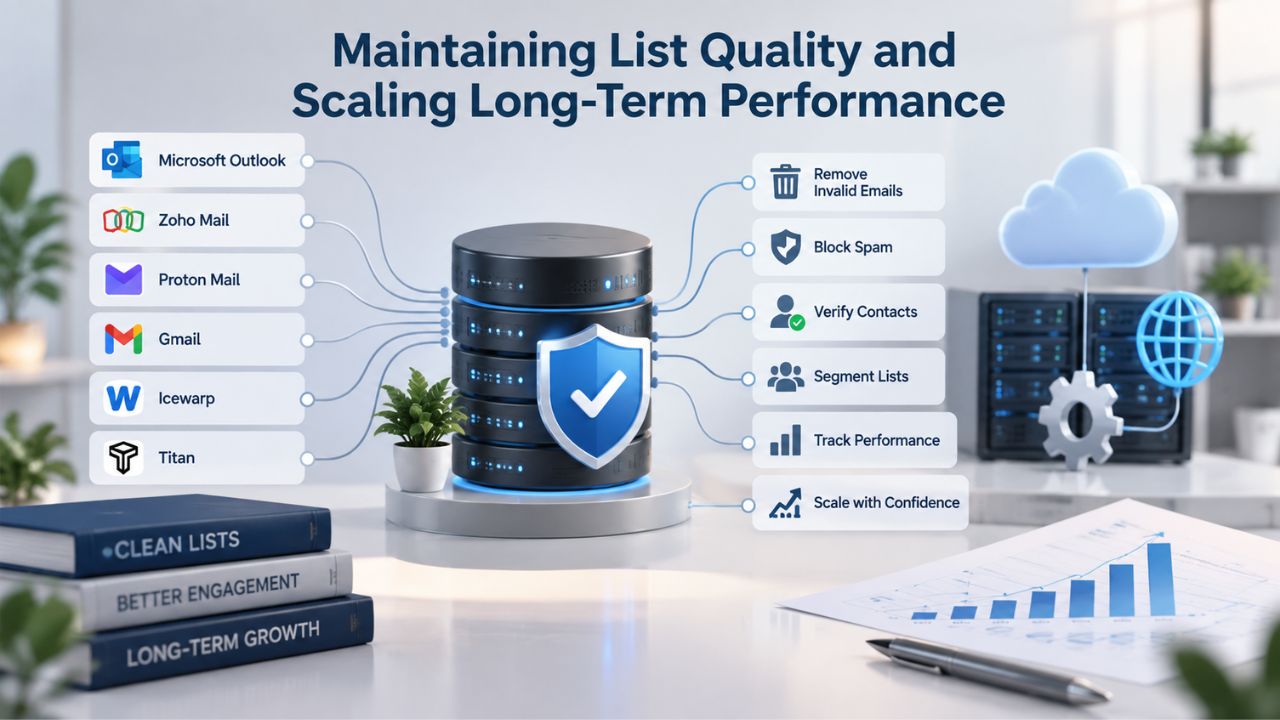
Maintaining List Quality and Scaling Long-Term Performance
As your abandoned cart campaign matures beyond the first optimization cycle, sustainable revenue growth depends on monitoring subscriber health and evolving your strategy as your products and audience expand. A campaign that delivers strong recovery rates in month one can degrade quickly if list quality declines or your messaging becomes stale relative to customer expectations.
Monitoring Engagement and Preventing List Decay
Subscriber engagement naturally declines over time, open rates drop, click rates slow, and inactive segments accumulate. Track your overall list health monthly by segmenting subscribers into tiers: highly engaged (opened at least one email in the last 30 days), moderately engaged (opened in the last 60 days), and inactive (no opens in 60+ days). Inactive segments harm your sender reputation because mailbox providers interpret no engagement as a signal that recipients don’t want your mail. Remove chronically inactive subscribers (no opens in six months) from your abandoned cart automation and your general promotional campaigns. This action seems counterintuitive: you’re deleting potential customers, but inactive subscribers don’t convert and damage your reputation score, reducing inbox placement for the engaged subscribers who actually recover sales. Monitor your complaint rate monthly; if it rises above 0.3% of sends, investigate whether your frequency, incentive language, or list quality has shifted and adjust accordingly.
Niya Digital’s Email Marketing Service provides engagement dashboards that automatically segment your list by recent activity and flag at-risk subscribers before they harm your reputation. Use these insights to run win-back campaigns targeting inactive subscribers (offering a special incentive to re-engage) or to suppress inactive segments from future campaigns until they re-engage. Over time, a clean list with consistently high engagement rates improves your sender reputation, making all your emails more likely to reach the inbox. This compound benefit extends far beyond abandoned cart recovery.
Evolving Your Strategy as Products and Audiences Change
Your initial abandoned cart campaign targets a broad audience with a single template and incentive structure. As your product line grows, your customer base diversifies, and your team becomes comfortable with segmentation, you can build category-specific, seasonal, or audience-specific variants. An apparel brand launching a new product category (say, accessories) might test category-specific abandoned cart messaging for the new line. A home-goods retailer might create seasonal variants in spring (focus on outdoor and garden items) and winter (focus on heating and comfort). A business-to-business software company might segment by customer size (SMB vs. enterprise) and test different incentives for each tier.
Run one new test per quarter: a new segment, a new product category variant, a seasonal template, or a new incentive approach. Document results (recovery rate, profit margin, customer feedback) and apply winners to all future campaigns. Over twelve to twenty-four months, a portfolio of tested variants can increase your overall recovery rate by fifty percent or more compared to your initial single-template baseline. Niya Digital’s Email Marketing Service supports unlimited automation workflows and templates, so you can maintain multiple variants simultaneously and track performance across all of them. Revisit your top-performing variant every six months and test a small refinement (a subject line change, a new incentive, adjusted timing) to keep your messaging aligned with current customer preferences and shifts in the competitive landscape.
Grow Your Email List and Revenue with Abandoned Cart Automation
Niya Digital’s Email Marketing Service includes list-building tools, automation workflows, and performance tracking that help you launch, optimize, and scale your abandoned cart strategy from day one. Start with a single email, measure results, add complexity as you learn what works, and build toward a sophisticated, multi-segment strategy that recovers the maximum revenue possible while maintaining subscriber satisfaction and low complaint rates.
Frequently Asked Questions
How long should I wait before sending the first abandoned cart email?
Most campaigns send the first email 1 to 4 hours after abandonment, with 2 to 3 hours as a popular starting point. This window catches the customer while purchase intent is fresh but avoids sending while they’re actively reconsidering. Test different delays (one hour, two hours, four hours) and compare recovery rates to find your audience’s optimal timing. Email marketing platforms like Niya Digital track recovery rates by timing so that you can make data-driven decisions. Start with two hours as your baseline, then experiment with one-hour and three-hour delays over subsequent weeks.
Should I offer a discount in my abandoned cart emails?
Discounts boost short-term recovery but can train customers to expect them and reduce profit margins. Test both discount and non-discount approaches systematically. Some audiences respond better to free shipping, social proof, or urgency language (“Only two left”) than to price cuts. Measure recovery rate, average order value, and profit margin for each approach. A non-discount incentive (free shipping, gift with purchase) might recover the same carts with higher profit margins than a ten percent discount. Test one approach for two weeks, measure results, then test the alternative.
How many follow-up emails should I send?
Start with one abandoned cart email. If recovery rate is strong (fifteen percent or higher) and complaint rate is low (below zero point three percent), test adding a second email twenty-four hours later. If that performs well, test a third at seventy-two hours. Most platforms report that two to three emails in a sequence recover more total carts than a single email, but watch your unsubscribe rate. If unsubscribes spike, reduce follow-ups or soften your messaging. Run each test for two to four weeks before deciding whether to proceed to the next step.
What if my cart abandonment data is delayed?
If your e-commerce platform sends abandonment data via scheduled import rather than a real-time API, the first email may not arrive for several hours, noticeably reducing recovery rate. Prioritize setting up a real-time API or webhook connection with your e-commerce platform to trigger faster. If real-time isn’t available, adjust your timing expectations and measure what recovery rate your delayed sends achieve compared to industry benchmarks. Document the delay and factor it into your optimization testing.
Can abandoned cart emails hurt my sending reputation?
Abandoned cart emails have high engagement rates (opens, clicks) and low complaint rates (when well-designed), so they typically improve your reputation. However, aggressive follow-up frequency or poorly targeted incentives can increase complaints. Monitor complaint rate closely and reduce frequency if it exceeds 0.3% of sends. Niya Digital’s Email Marketing Service tracks complaint rates by campaign, so you can catch reputation issues early and adjust strategy before damage occurs.
What if I integrate my e-commerce platform incorrectly?
Test the integration thoroughly before going live to any real customers. Add a test product to your cart, abandon it, verify the abandonment record appears in your email platform, send a test email, and confirm dynamic content populates correctly. Check that images load and links work. If the integration fails, contact your e-commerce platform’s support and your email platform’s integration team. Niya Digital provides integration guides and support for major e-commerce platforms, with step-by-step instructions for common platforms.
How do I know if my recovery rate is good?
Typical abandoned cart recovery rates range from fifteen to thirty percent, depending on industry, incentive, and audience. Compare your recovery rate to these benchmarks and to your own performance over time. A twenty percent recovery rate that grows to twenty-five percent after optimizations is progress worth tracking. Use your email marketing platform’s analytics to measure recovery rate monthly and identify trends. If your rate is significantly below fifteen percent, investigate whether your timing, personalization, or incentive needs adjustment.
Should I segment by geographic location in my abandoned cart campaigns?
Yes, if you operate internationally or across multiple time zones. Test whether customers in different regions respond better to different incentives, languages, or timing. A US customer might prefer dollar-off incentives, while a UK customer might prefer free-shipping offers. Use your email marketing platform’s segmentation features to test geography-specific variants and measure the impact on recovery rate. Geographic differences often emerge after testing two to four weeks of data per location.
How do I handle cart abandonment from guest (non-registered) customers?
Guest checkout carts are harder to target because the customer isn’t in your subscriber list yet. Capture email at checkout with an option to “send me reminders about this order”; this converts a guest checkout into a consented email subscriber. If a guest abandons without providing email, you’ve lost the recovery opportunity. Encourage registered checkout with loyalty benefits or streamlined login to maximize email capture and future marketing opportunities.
What’s the best incentive to offer in an abandoned cart email?
Test multiple incentives: percentage discounts (ten percent, fifteen percent), flat-dollar offers (ten dollars off fifty dollars or more), free shipping, gift with purchase, or non-monetary incentives like extended return windows or loyalty points. Measure recovery rate for each. You may find that a five percent discount recovers carts with higher profit margin than a fifteen percent discount, or that free shipping outperforms discounts entirely for your audience. Let your data guide decisions, not assumptions.
Can I use abandoned cart emails to build my email list?
Yes, with consent. When a customer abandons a cart and you send a recovery email, they’re now on your list (if they aren’t already). If they don’t respond to cart recovery, segment them for re-engagement campaigns or nurture sequences. Over time, abandoned cart interactions help you identify engaged versus unengaged subscribers, improving your list quality. Repeat customers who respond to abandoned cart emails should receive additional promotional and educational content based on their demonstrated interests.
How do I test my abandoned cart email template for spam filters?
Most email marketing platforms include a spam-check tool that scans your template for spam trigger words, authentication issues, and formatting problems. Before sending, run your template through this check. Niya Digital’s Email Marketing Service includes template checks that flag common deliverability issues. Test-send the email to your own inbox (using multiple email providers like Gmail, Outlook, and Yahoo) and check whether it lands in your primary inbox or spam folder, which shows how mailbox providers treat your messages.
What’s the difference between abandoned cart and browse abandonment campaigns?
An abandoned cart email targets customers who added items and started checkout. A browse abandonment email targets customers who viewed products but didn’t add to cart. Browse emails have lower conversion rates because intent is lower; they work best with social proof, product reviews, or personalized recommendations. Start with abandoned carts (higher ROI), then test browse abandonment as you scale and your team becomes comfortable with segmentation and automation.
Should I resend abandoned cart emails to customers who didn’t open the first one?
Yes, non-openers represent untapped recovery potential. In a multi-email sequence, the second and third emails automatically reach anyone who didn’t open the first. Track open rate separately for each email in the sequence; if your first email has a 40% open rate, 60% of recipients haven’t opened it yet. The follow-up emails are your chance to reach them and convert the sale.
How long should an abandoned cart stay in my automation before it exits?
Most campaigns run three emails over seventy-two hours (one to two hours, twenty-four hours, seventy-two hours). After the third email, the cart is typically too old to recover (most recovered carts convert within twenty-four hours of the first email). Remove carts from the automation if the customer completes the purchase, unsubscribes, or marks the email as spam. Niya Digital’s automation feature removes carts automatically when it detects a purchase, ensuring you don’t send recovery emails to customers who’ve already completed their order.
Glossary
- Abandoned Cart: Items added to a shopping cart but checkout not completed.
- Cart Abandonment Rate: Percentage of shopping carts initiated but not completed (calculated as abandoned carts ÷ total carts initiated).
- Cart Recovery Rate: Percentage of abandoned carts recovered via email (calculated as recovered carts ÷ total abandoned carts).
- Trigger-Based Email: An email automatically sent in response to a specific user action (e.g., cart abandonment, signup, purchase).
- Segmentation: Division of an email list into smaller groups based on shared characteristics (e.g., cart value, product category, customer lifetime value).
- Sending Reputation: A score assigned by mailbox providers (Gmail, Outlook) based on engagement and authentication, determining likelihood of inbox versus spam-folder placement.
- Open Rate: Percentage of recipients who opened an email (calculated as opens ÷ sends).
- Click-Through Rate (CTR): Percentage of recipients who clicked a link in an email (calculated as clicks ÷ opens).