Why Your Domain Name Shapes Brand Perception
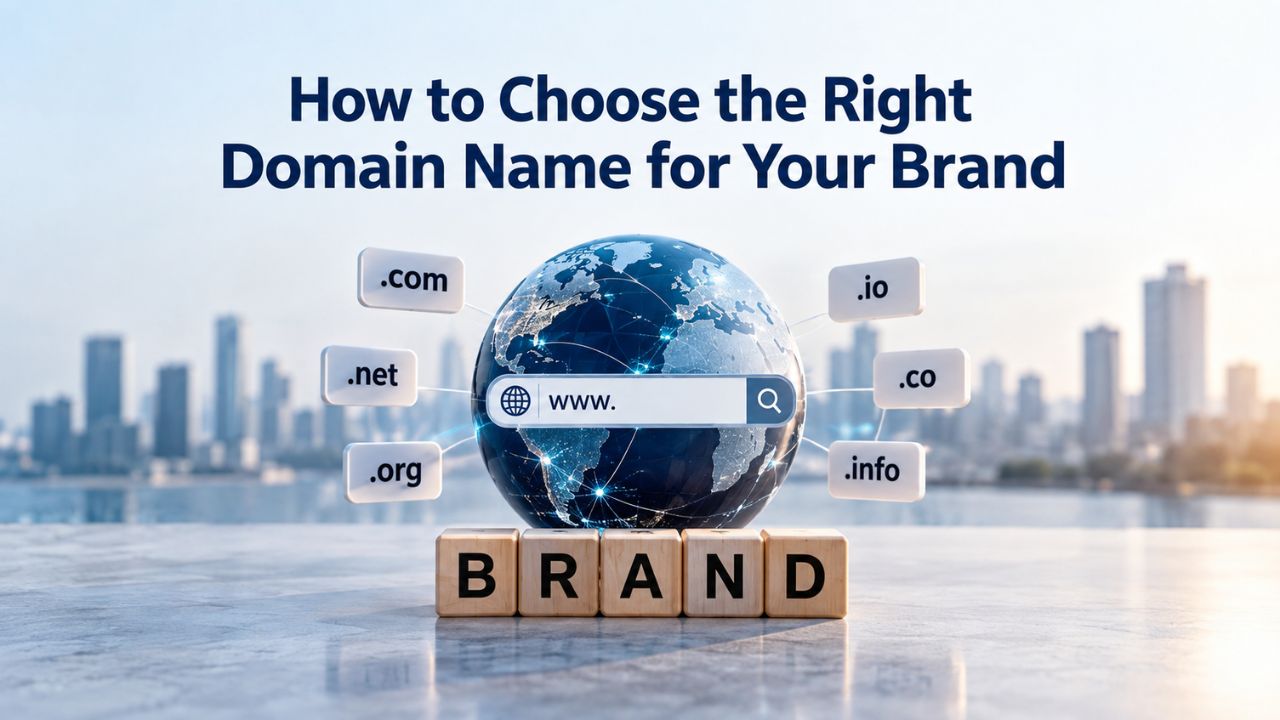
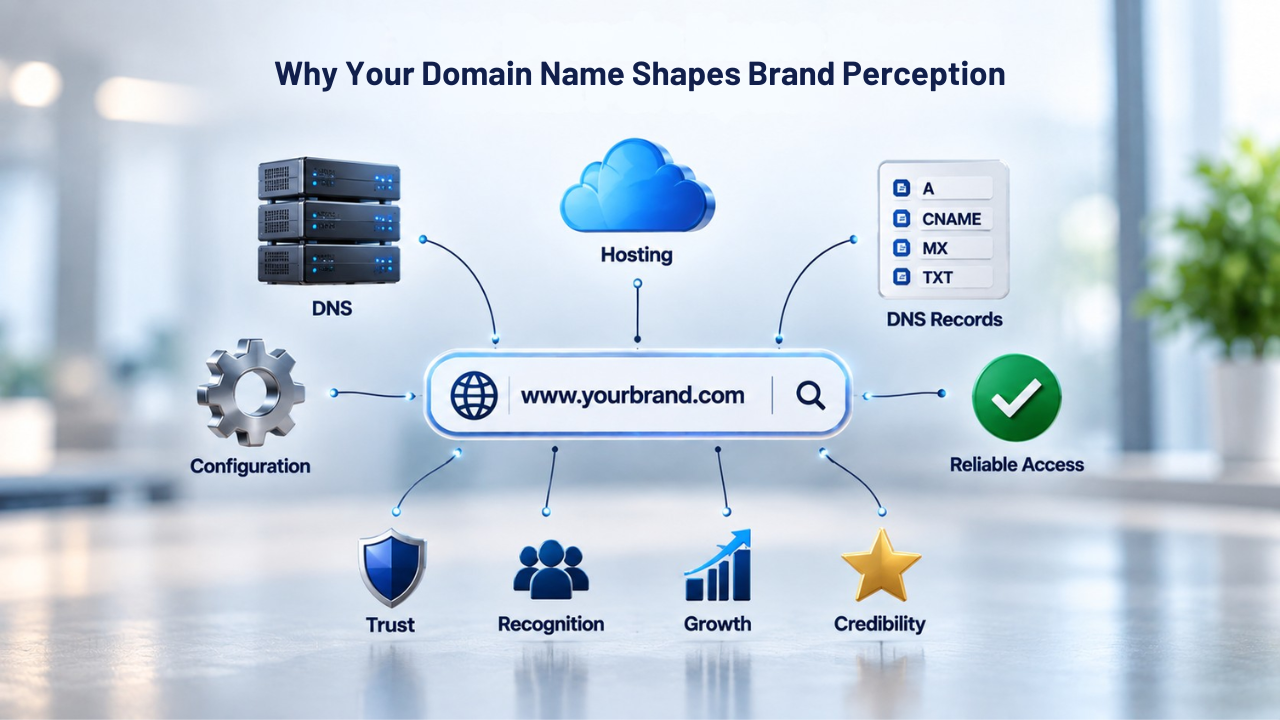
Your domain is one of the first touchpoints customers encounter when discovering your business online. The name communicates your industry, professionalism, and commitment to your brand identity. Unlike social media handles, which depend on platform algorithms and can change at any time, a domain is your own, a permanent digital asset backed by ICANN oversight and globally recognized through DNS infrastructure. This permanence matters because it signals ownership and stability in ways that no rented platform ever can.
The Role of First Impressions in Digital Trust
The relationship between your domain, your website, and your brand identity shapes how customers perceive your legitimacy. Research shows people view a brand as more professional and credible when it operates from a custom domain rather than a generic email or free platform.
When a potential customer searches for your business or clicks a link to visit you, the domain name they see either reinforces professionalism or raises doubts. A well-chosen domain signals that you’re serious about your business and willing to invest in your online presence. At the same time, a poorly chosen one can undermine your credibility before anyone even reads your first paragraph.
A custom business domain carries legal and technical weight that platforms cannot offer. Your domain is registered through an official system, managed by your registrar, and protected by global policies. This structure provides protection and authenticity that customers subconsciously recognize. When combined with a professional website and consistent branding, a strong domain name becomes the cornerstone of your entire digital identity, the one asset you fully control and own.
How Domain Names Influence Customer Behavior
Customer behavior studies reveal that domain names directly affect decision-making at the critical moment of first contact. A short, memorable domain makes sharing easier, whether through email, word-of-mouth, or printed materials, which increases the likelihood that people will remember and return to your site. Conversely, a long, confusing domain creates friction at the moment of recommendation, causing potential customers to forget, mistype, or lose interest before they even arrive at your website.
The psychological impact extends beyond memorability into trust and brand association. When a domain name clearly reflects your business or brand, customers immediately understand what you offer and feel more confident exploring your site. An obscure, generic, or misaligned domain creates confusion and doubt. This is why choosing carefully at the start matters far more than trying to rebrand later; your domain is the anchor point around which all other branding elements revolve.

Domain Name Registration
Each and every domain name comes with all you need to get online.
- Domain Forwarding and Masking: Direct any domain name you own to your website. Anyone who types that domain name into their browser is taken directly to your website.
- Domain Locking: Domain locking prevents accidental or intentional transfers of domain ownership and stops anyone from redirecting your nameservers.
- Total DNS Control: Manage your domain nameserver (DNS) records and set your email, FTP, sub-domains and website location all from one control panel.
- Change of Registration: Assign your domain name to someone else or change the contacts for your domain online anytime.
- Status Alerts: Monitor the status of your domain and get instant alerts if there's been a change.
- Auto Renew Protection: No need to watch expiration dates to make sure you renew on time! Auto renew keeps your domains, hosting, website builders, and other products in your name and under your control.
Domain Disclaimers:
- Special savings apply only to first year of registration. You must purchase entire section to qualify for special savings.
- The final price may differ because of additional sales, fees, and promotions.
- Products will automatically renew until cancelled. You may turn off the auto-renewal feature by visiting your account.
- Change of registration may require a fee for certain domains.
Choose Names That Are Short and Memorable
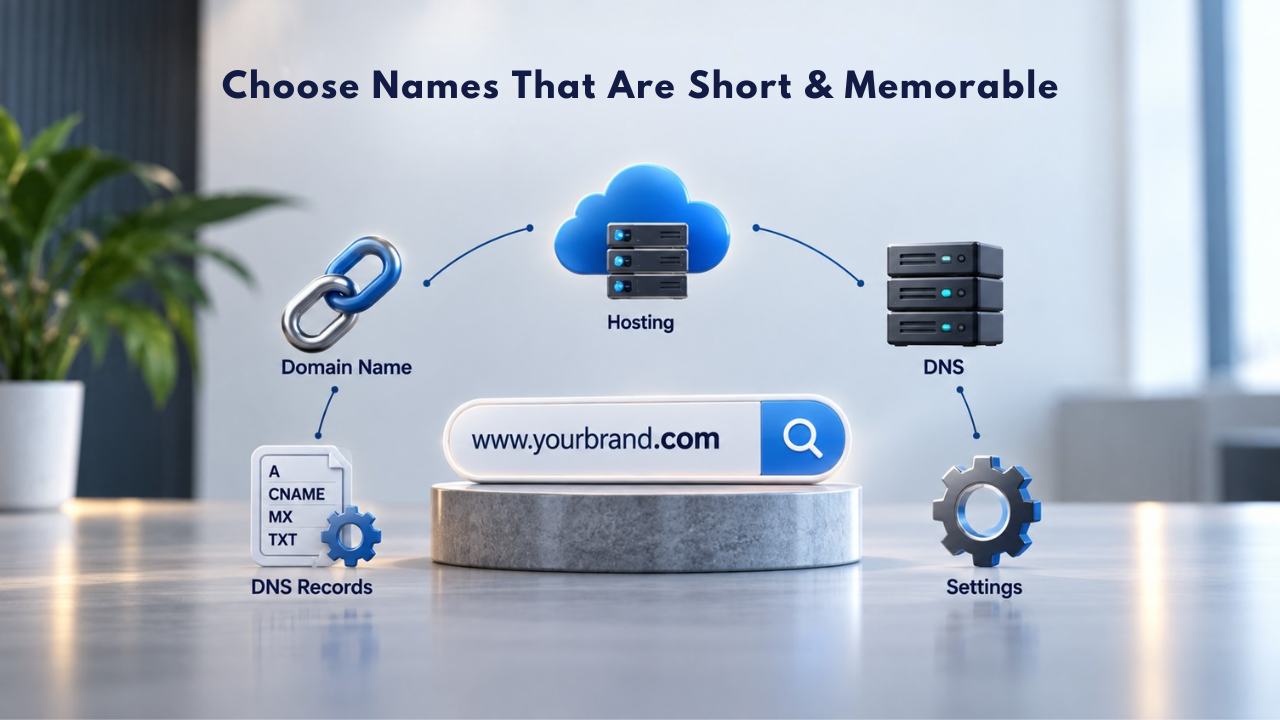
Simplicity wins in domain naming. The best domain names are short enough to type without errors, pronounce without confusion, and remember without effort. Industry research consistently shows that shorter domains (typically 6–15 characters) are easier to recall and share through word of mouth, which directly increases direct traffic to your site. When users type your domain directly into their browser without searching for you, that direct traffic signals to search engines that your site is popular and trustworthy, which can improve your overall visibility.
Keep Names Between Six and Fifteen Characters
ICANN technical standards allow individual labels (sections separated by dots) up to 63 characters each, and the full domain including the TLD cannot exceed 253 characters total. For branding purposes, however, much shorter is better. A 10-character domain is far more memorable than a 30-character one, even if the longer name is more descriptive. Keep three practical limits in mind: avoid numbers and hyphens wherever possible, ensure each character serves a purpose, and test your domain by saying it aloud and typing it on a mobile phone.
Avoid numbers and hyphens because they create confusion when shared verbally and significantly increase the risk of typos and misremembering. When you say your domain name to someone, they should be able to write it down correctly without asking for clarification. Hyphens, in particular, are easy to forget because most people communicate domain names by speaking them, not typing them, and few people spontaneously insert hyphens when writing something they’ve only heard.
Niya Digital’s team has found that brands with concise, one- or two-word domains see higher click-through rates and less customer-acquisition friction than those with longer, descriptive names. Once you settle on a short name, register it quickly; memorable names are scarce, so desirable domains sell or get reserved fast.
The Mobile Advantage of Short Domains
Short domains offer a significant advantage in mobile-first browsing environments, where typing friction directly impacts user behavior. On mobile devices, every extra character increases the likelihood of errors and conversion drops. A short domain like “yourname.com” takes seconds to type, while a 25-character domain becomes a frustrating exercise that many users will abandon halfway through. Short domains also look better in mobile search results, email signatures, and social media bios, where character limits are tight and visibility is limited.
The simplicity of a short domain also boosts memorability in ways research has consistently validated. People remember patterns, rhymes, and short sequences far better than long strings of words. A domain that feels natural and fits in a single thought, like “brandname.com”, becomes part of your brand’s identity without feeling like a technical requirement. This effortless memorability translates into stronger word-of-mouth marketing, more accurate email referrals, and fewer customer service tickets where people ask, “How do I spell your domain again?”
Domain Selection Decision Framework
| Selection Factor | Why It Matters | Practical Application |
|---|---|---|
| Name Length | Shorter names reduce typing errors and increase recall; longer names may offer clarity in niche markets. | Aim for 6–15 characters; test for typing ease on mobile devices. |
| Pronounceability | Easy pronunciation improves word-of-mouth sharing and brand recall (processing fluency). | Say the name aloud; ensure it’s clear even when spelled verbally to unfamiliar listeners. |
| Trademark Conflicts | Using a name similar to a registered trademark can lead to costly disputes and forced rebranding. | Search USPTO, WIPO, national registries, and Google before committing to a domain. |
| Social Media Consistency | Fragmented handles across platforms create brand confusion and reduce searchability. | Check handle availability on major platforms before registering the domain. |
| Domain History | Inherited penalties from previous spam, malware, or manual actions suppress rankings for 6–12+ months. | Use Wayback Machine, backlink checkers, and Google Safe Browsing before purchase. |
| Extension Choice | .com carries the highest trust and recognition; alternative TLDs align with industry positioning. | Select based on audience expectations and business positioning, not just availability. |
| Future Scalability | Brand-focused names remain relevant as business evolves; keyword-heavy names feel dated quickly. | Choose a name that works for your brand 5–10 years ahead, not just today. |
| Availability Window | Competition for short and memorable names is intense; desirable names sell or reserve quickly. | Register preferred name and relevant alternatives immediately upon selection. |
Prioritize Branding Over Keyword Optimization
A decade ago, keyword-packed domain names like “affordable-web-design-services.com” ranked well in search engines because Google weighted exact matches heavily. That era has ended. Modern search algorithms now de-emphasize exact-match domain keywords and focus instead on content quality, authoritative backlinks, and user experience. Today, the domain name matters far less than your content quality, your expertise, and the number of respected sites linking to you.
The SEO Shift Away from Keyword Domains
The algorithm change reflects a larger truth: search engines have become much better at understanding context and intent. A website about web design doesn’t need “web-design” in the domain name to rank for web design searches; Google’s systems can read your content, your backlinks, and your user behavior to understand what you’re about. Search engines care far more about what your pages say than what your domain name spells out. This shift away from keyword domains was intentional, designed to reward quality and user experience over keyword stuffing and exact-match gaming.
The shift matters for long-term strategy because a keyword-heavy domain can feel dated as your business evolves and expands into adjacent markets. If you start with “cupcake-bakery.com” but later add catering, meal prep, or nutritional consulting services, your domain becomes increasingly misaligned with your business. By contrast, a branded domain, one that mirrors your company name or a memorable brand phrase, remains relevant and adaptable regardless of how your offerings grow. Top global brands including Google, Oreo, and Redbull built massive online presence using brandable names with no keywords, proving that brand authority and content quality drive visibility more than domain naming conventions.
When Keywords Make Sense for Your Domain
If relevant keywords belong in your web address because they genuinely reflect your brand identity, incorporate them naturally without sacrificing memorability. New domain extensions like .tech, .agency, and .shop allow you to include industry signals while maintaining a short, memorable primary name. The goal is balance: choose a domain your target audience recognizes and trusts, and let your content and backlinks do the SEO heavy lifting. For example, instead of registering “digital-marketing-agency.com,” you might register “brandname.agency,” which signals your industry while keeping the focus on your brand and staying memorable.
Never force keywords into your domain simply for SEO benefit; this strategy backfires by making your name longer, harder to remember, and less brandable. The cumulative damage to user experience, recall, and brand identity vastly outweighs the small SEO lift from keyword inclusion. Modern successful businesses win through brand strength and content quality, not domain name optimization.
Select the Right Domain Extension (TLD)
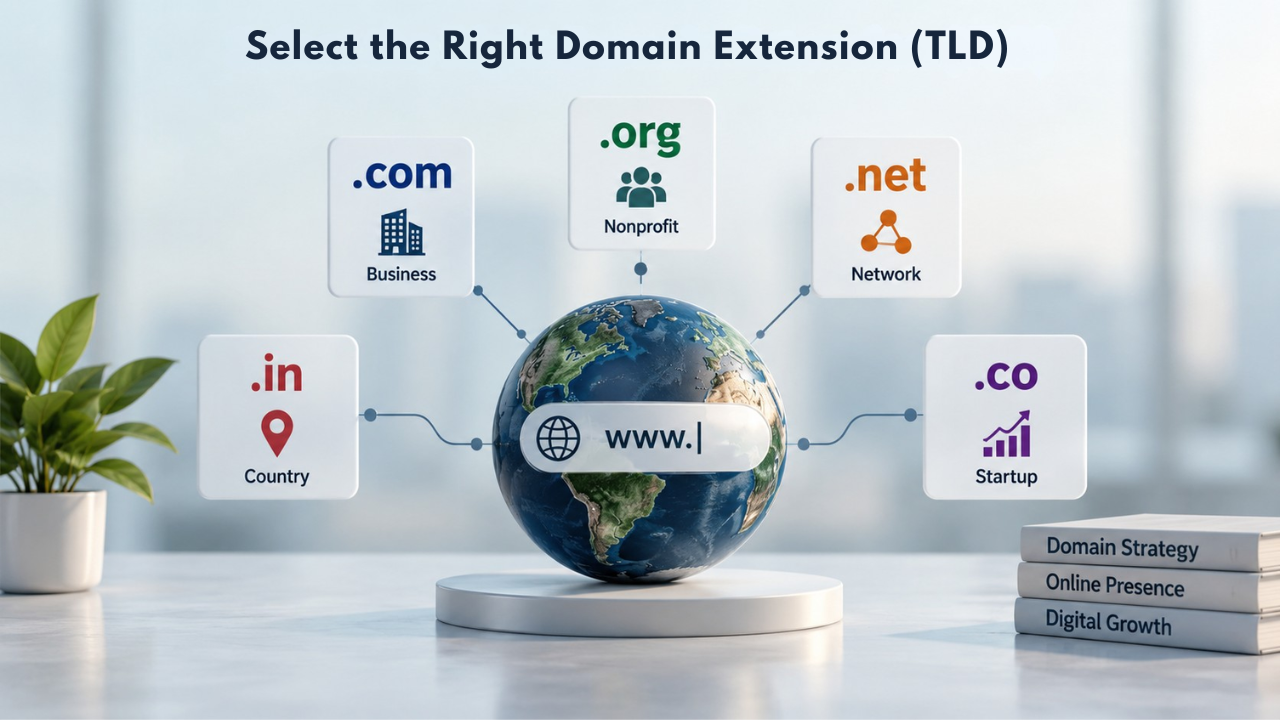
Your domain extension, the suffix after the dot, signals trust and sets audience expectations instantly. .com remains the dominant extension with 157.2 million registrations out of 368.4 million total domain names globally, and this dominance reflects decades of familiarity and user conditioning. Users expect businesses to operate from .com domains, and that expectation is worth respecting. When someone thinks of a business website, they instinctively think “.com”; it’s become synonymous with commercial legitimacy on the internet.
Understanding the Trust Hierarchy of Domain Extensions
Different extensions carry different associations in the minds, whether or not those associations are entirely rational. .com represents commercial ventures and general businesses; .org traditionally signals nonprofit or community intent, and using .org for a commercial site can create brand confusion despite having no actual restrictions. .net historically represented network providers but remains a credible general extension. However, it’s less memorable and carries less weight than .com in most contexts. Country-code extensions like .uk, .de, .au, and .in excel when your audience is geographically concentrated or when you want to emphasize local presence and market relevance.
The trust hierarchy matters because users make split-second judgments based on domain extensions. A .com domain appears more established and professional than the same name under a less common extension. This isn’t because the technology differs; all extensions function identically, but because user psychology and decades of branding have made .com the default expectation for legitimate businesses. When your perfect domain name is available under .com, that advantage compounds over time through every customer interaction, email communication, and word-of-mouth recommendation.
Leveraging New and Specialty TLDs Strategically
New generic top-level domains (gTLDs) like .tech, .app, and .shop have posted 13.5% year-over-year growth and provide creative alternatives when your preferred .com name is taken. These extensions can strengthen your positioning in specific industries and help your domain feel more distinctive and modern. A software company might choose “productname.app” to signal its industry and function immediately, while a digital agency might choose “agencyname.agency” to add clarity and memorability.
However, recognize that new extensions carry less universal recognition than .com. Users may not immediately remember or guess your extension, which can hurt direct traffic and word-of-mouth effectiveness. Choose your extension based on a strategic calculation: Does the industry alignment and availability advantage of a specialty TLD outweigh the trust and memorability advantage of .com? For most general businesses aiming for broad reach, a .com domain, even if the name is slightly longer or modified, will always outperform a perfect name under an unfamiliar extension. The trade-off makes sense only when the specialty extension genuinely enhances your brand positioning and your target audience expects or appreciates it.
Top-Level Domain (TLD) Categories and Use Cases
| TLD Category | Examples | Trust Signal & User Perception | Best For |
|---|---|---|---|
| Generic TLDs (gTLDs) | .com, .net, .org | Highest trust; decades of recognition and user familiarity worldwide. | General businesses, nonprofits, educational organizations; maximum audience reach and credibility. |
| Country-Code TLDs (ccTLDs) | .uk, .de, .au, .cn, .in, .ca | Signals local or regional presence; appeals to geographically targeted audiences. | Businesses targeting specific geographies; local market relevance and geographic SEO benefits. |
| Specialty/Industry TLDs | .tech, .agency, .shop, .app, .photography, .restaurant | Niche clarity and emerging adoption; signals industry alignment instantly. | Tech startups, creative agencies, e-commerce shops; industry-specific positioning and innovation positioning. |
| New gTLDs (ngTLDs) | .xyz, .online, .info, .space, .world | Moderate trust; still building recognition; perceived as modern and creative. | Creative naming when classic TLDs are taken; startups seeking distinctive branding; global positioning without geographic focus. |
Research Trademark and Legal Conflicts Early
Before you register, verify that your chosen name doesn’t infringe existing trademarks or registered brands in your industry. Registrants must represent and warrant that their domain use will not infringe the legal rights of third parties, per ICANN Registrar Accreditation Agreements. Trademark disputes are costly; legal fees alone can run into thousands or tens of thousands, and losing a dispute forces you to rebrand entirely, abandon years of marketing investment, and start over with a new domain.
Conducting a Thorough Trademark Search
Search your desired name across multiple sources to ensure you’re not infringing existing marks. Start with national trademark registries; in the U.S., the USPTO database, and continue with the World Intellectual Property Organization (WIPO) database for international marks that might have claims in your industry. Also search Google and social media platforms to see how the name is already in use and whether any similar businesses operate under that name. Pay attention to similar-sounding or visually similar names, not just exact matches, because these can also trigger trademark disputes if they confuse customers.
If your research raises concerns, consider small adjustments like adding a brand modifier or adapting for a specific market to differentiate your name while maintaining its core identity. For example, if “brandname.com” is taken by someone else, “brandnamestudio.com” or “brandname-co.com” might be available and legally distinct. A trademark attorney can review your final choice and advise on risk level before you commit significant marketing budget to a domain that might face legal challenges.
Long-Term Protection Through Trademark Registration
For long-term protection, consult a legal professional about trademarking your chosen name once you’ve secured the domain. Trademark registration is separate from domain registration, but both reinforce your exclusive claim to the name and protect against competitors using confusingly similar alternatives. A registered trademark covers your brand across products and services, not just the domain, and provides legal grounds to pursue anyone using a similar name in your industry. Without trademark registration, your rights are weaker, and disputes become more expensive to defend.
The investment in trademark clearance and registration upfront is far smaller than the cost of discovering years later that someone else has a prior claim to your name. This is especially true if you’re building substantial brand equity and market presence under your chosen domain.
Secure Your Domain and Build Your Brand Today
Selecting and securing the right domain is the first major investment in your business’s digital future. Niya Digital, working in partnership with an ICANN-accredited registrar, makes domain registration simple, affordable, and backed by professional support. Whether you’re launching a startup, expanding an existing brand, or building your first online presence, we help you find and manage the perfect domain that grows with your business.
Verify Domain History Before Purchasing
If you’re registering a completely new domain, this step is less critical; new domains carry no history. However, if you’re acquiring an aged or previously owned domain, checking its history is essential. Domains carry forward signals from previous owners, including inherited penalties that can suppress rankings for 6–12 months or longer. A domain previously used for spam, malware, or adult content may appear “clean” on the surface but still carry hidden penalties that will damage your visibility and credibility.
Using the Wayback Machine to Uncover Past Content
Start with the Wayback Machine (Internet Archive), which stores snapshots of websites over time spanning decades. Enter the domain and review past versions to see how it was used over time. Watch for red flags: adult content, pharmaceutical spam, gambling operations, or scraped and thin affiliate pages. A legitimate business that closed cleanly looks entirely different from a domain cycled through multiple spam campaigns. Review multiple snapshots across different years to understand the full trajectory of the domain’s use.
Sudden content changes, spam sites flipping overnight, or a pattern of different owners frequently changing the domain’s purpose are all warning signs. A domain with consistent, legitimate content under a single or few owners that gradually evolves over years suggests a clean history. Frequent shifts, sudden spikes in questionable content, or evidence of multiple spam operations suggest significant risk that inherited penalties may persist.
Checking WHOIS History and Backlink Profile
Next, review the domain’s WHOIS history to understand ownership patterns over time. Sudden ownership changes, privacy spikes that hide previous ownership, or multiple registrar changes in short periods suggest problematic activity or frequent domain flipping for profit. Additionally, use backlink analyzers and Google Safe Browsing to check whether the domain was flagged for malware or accumulated low-quality, spammy links from other sites. If you inherit a penalized domain, recovery requires sustained high-quality content, legitimate link-earning, and demonstrated trustworthiness, a process that can take many months or longer.
| Domain History Verification Factor | What to Look For | Tool/Method |
|---|---|---|
| Past website content | Spam, adult content, malware, thin affiliate pages | Wayback Machine (web.archive.org) |
| Ownership changes | Sudden shifts, frequent transfers, privacy spikes | WHOIS history lookup |
| Backlink profile | Low-quality links, PBN indicators, spam patterns | SEMrush, Ahrefs, Backlink checkers |
| Malware/phishing flags | Google Safe Browsing warnings, Norton warnings | Google Safe Browsing tool, Norton Safe Web |
| Manual actions | Prior Google penalties for spam or manipulation | Google Search Console (if accessible) |
| Registrar changes | Frequent registrar hops suggest instability | WHOIS history |
Check Availability Across Social Media Platforms
Your domain is your digital headquarters, but your social media presence amplifies your reach and reinforces your brand identity. Consistency across platforms, where your domain name matches or closely mirrors your social media handles, is critical for discovery and brand trust. Cross-platform branding reduces consumer confusion and strengthens perceived credibility, because when someone finds you on Instagram, they should be able to intuitively guess your handle on LinkedIn or Twitter without confusion or multiple attempts.
Testing Handle Availability Before Domain Registration
Before committing to a domain, check whether your desired name or a close variant is available on major platforms: Facebook, Instagram, Twitter/X, LinkedIn, TikTok, and YouTube. Tools like Namechk scan dozens of platforms at once, showing green or red indicators in seconds. This saves you from discovering after registration that your perfect domain name is already claimed on the platform where your audience is most active, forcing you to choose a confusing modifier or rebrand your online presence.
If your first choice is taken on one platform, decide early whether a consistent modifier (like adding “official,” your location, your role, or your company’s industry descriptor) works across all channels. The key is to use the same modifier everywhere; consistency matters more than perfection. For example, if “yourname” is taken on Instagram but available elsewhere, use “yourname-official” or “yournamestudio” consistently across all platforms rather than improvising different variations for different sites.
Securing Your Brand Identity Across Channels
Securing consistent handles now prevents costly rebranding later and makes it easier for customers to find you online. When your domain and social handles match, customers see a unified brand, whether they find you through search, social media, or word of mouth. This consistency signals that you’re an established, professional entity. Fragmented handles across platforms, by contrast, create confusion and make you harder to find, which suppresses your overall online visibility and growth.
Create your social media accounts on all major platforms using your consistent identifier as soon as you’ve selected your domain, even if you don’t immediately plan to use every platform. This protects your brand identity and prevents someone else from claiming similar handles and potentially benefiting from your future reputation and marketing efforts.
Test for Pronounceability and Spelling Ease
Pronounceability and ease of spelling improve “processing fluency”, a cognitive trait where people more readily remember and share words they can easily pronounce in their mind. A domain you can say aloud without confusion wins customers through word-of-mouth far more effectively than one that requires careful spelling out letter by letter. This is a measurable factor in domain value and business success; customers will naturally share and recommend memorable, easy-to-say names far more often than awkward or complicated ones.
Speaking Your Domain Aloud to Test Clarity
Say your candidate names aloud to test how they land in conversation. Can a customer repeat it correctly after hearing it once? Does it sound professional or awkward? Avoid uncommon letter combinations, double letters without purpose, and ambiguous phonetics where people might mishear your domain for something similar. Names that rhyme with common words or have intuitive pronunciation spread faster through word of mouth and create fewer customer service errors.
For example, a domain like “bluebirdmedia.com” is immediately clear and natural to pronounce, while “berdmedia.com” or “blubrd.com” creates confusion and requires clarification. Every time a customer has to stop you mid-conversation to verify the spelling, you’ve lost an opportunity for effortless brand recognition. Test your candidates by asking friends, family, or colleagues who haven’t heard them before to spell and remember them correctly.
Mobile Typing and Processing Speed
Mobile typing also tests pronounceability indirectly: if your domain is hard to say, it’s likely hard to type on a phone, and every typo costs you a visitor. In mobile-first environments where users expect frictionless interactions, friction in domain typing directly reduces conversions. That is why hyphens and numbers remain problematic, even though they’re technically allowed. They break the flow of natural speech and create typing friction that suppresses engagement. A domain that’s easy to say is almost always easy to type, and vice versa, making pronounceability a reliable proxy for mobile usability.
Plan for Long-Term Business Growth
Your domain should feel relevant five to ten years from now, not just today. A name too narrowly tied to a specific product, location, or trend can become a liability as your business evolves and expands. Choosing a domain that supports long-term growth means selecting a name that works as your brand expands into adjacent markets, rather than one that pigeonholes you into a single offering. Think carefully about where your business might head, not just where it is today.

Anticipating Business Evolution and Market Expansion
Consider where your business might go. If you start as a local service provider but aim to go regional or national, a location-specific domain like “brooklynplumbing.com” may eventually limit your growth and feel outdated once you expand beyond Brooklyn. If you launch in one product category but plan to expand, a single-product name like “cupcakebakery.com” can feel restrictive as you add new revenue streams.
Generic, brandable names age well; they stay credible and flexible through business shifts, market evolution, and new opportunities. This forward-thinking approach protects your investment in your domain and brand. A domain chosen for long-term scalability and brand fit, rather than keyword optimization or trendy elements, will outperform one locked into today’s strategies. Your domain should work for your brand’s vision, not just its current business model.
Building Flexibility Into Your Domain Choice
Generic brand names allow for unlimited growth and evolution. “Acme Inc.” sounds just as professional and relevant whether Acme sells software, consulting, hardware, or a combination of services. By contrast, “AcmeSoftware.com” creates immediate restrictions and requires rebranding if your business pivots. This isn’t just a theoretical concern; many businesses grow or change over time, and a domain that felt perfect at launch can become a growth constraint years later.
When you’re evaluating potential domains, ask yourself: “Will this name still make sense for my business in 5 and 10 years, even if our offerings expand or shift?” If the answer is uncertain, the name is too specific. Build your digital identity around who you are as a brand, not just what you do today.
Secure Alternative Extensions and Common Misspellings
Once you’ve registered your primary domain, protect your brand by acquiring the same name under alternative extensions (.org, .net, or industry-specific TLDs) and registering common misspellings. This prevents competitors from capturing variations and diverts typo-driven traffic directly to your primary site. Many successful brands register alternative domain extensions and common misspellings to protect their brand and prevent competitors from using similar domain names.
Building a Defensive Portfolio of Related Domains
This strategy matters most for short, valuable names; competitors actively hunt for them to profit from your brand visibility. Registering a portfolio of related domains costs minimal resources but saves far more in brand-recovery expenses later. For example, if you register “brandname.com,” also secure “brandname.net,” “brandname.org,” “brandname.io,” and any obvious spelling variations like “branname.com” (missing a letter). Set these to redirect to your primary domain to consolidate traffic and reinforce a single, unified brand presence.
This defensive approach is not just about competing with others; it’s also about controlling customer behavior. When someone vaguely remembers your domain but gets the extension wrong, they should still land on your site, not on a competitor’s site or a parked page. Every variation you control is an opportunity to reinforce your brand and capture customers who might otherwise be lost through minor errors.
Redirecting Secondary Domains to Strengthen Your Primary Brand
Set up redirects from alternative domains to your primary site to consolidate traffic and prevent confusion. Customers who mistype your domain or remember a different extension still land on your site, improving overall conversion rates and reinforcing your single, unified brand presence. These redirects also help protect your brand reputation. If you don’t own a domain variation, someone else could register it and either redirect it to a competitor or use it to confuse your customers.
Ready to Secure Your Domain Name and Launch Your Online Presence?
Choosing the right domain is one of the highest-leverage decisions you’ll make for your business. The foundation you build today will support years of growth, marketing, and customer trust. Niya Digital partners with an ICANN-accredited registrar to help you secure the perfect name and manage it efficiently across your entire digital presence. Start your search today and claim the digital identity your brand deserves.
Frequently Asked Questions
What is the difference between a domain registrar and a domain registry?
A registry maintains the authoritative, master database of all registrations for a specific TLD (like .com or .org). A registrar is an ICANN-accredited entity authorized to sell registrations on behalf of registrants and acts as the intermediary between you and the registry. When you register a domain, you do so through a registrar, who then submits your information to the registry. The registry ensures no two people own the same domain within that TLD, and your registrar handles customer service and administrative updates.
Can I register a domain name if someone else has already used or currently owns that name?
No. Domain names are unique within each TLD. Once registered, you can’t register a domain again until it expires and becomes available. However, if the domain has expired and entered a redemption grace period, you may be able to acquire it through auction or by waiting for it to return to general availability. If the registrant actively owns and renews the domain, you can attempt to negotiate a purchase through a domain broker, though this is often expensive for valuable names.
How long does domain registration take after I submit my application?
Domain registration is typically instant or completes within 24 hours, depending on your registrar and the specific TLD. Once registered, your domain is immediately live and resolvable via DNS, meaning people can access your website using it. Some registrars may require additional verification steps, especially for certain country-code or specialty TLDs, which can extend the timeline slightly, but the core registration usually processes very quickly.
Does the length of my domain name directly affect my search engine ranking?
No. Domain length does not directly influence Google’s search rankings. Modern SEO relies far more on content quality, authoritative backlinks, technical performance, and user experience than on domain naming. However, shorter names improve user experience and recall, which indirectly boosts visibility through more direct traffic and stronger brand searches that drive traffic to your site.
Should I choose .com, .org, .net, or a specialty TLD like .tech or .agency?
Choose based on your audience’s expectations and business positioning. .com carries the highest trust and recognition, making it the safest default for general businesses seeking maximum credibility. .org signals nonprofit or educational intent. Specialty TLDs like .tech, .agency, or .shop strengthen positioning in specific industries but carry less universal recognition than .com. For most businesses, a slightly longer name with .com will outperform a perfect name under an unfamiliar extension.
What should I check before buying an expired or previously owned domain?
Use the Wayback Machine to view past versions of the website and spot red flags like spam, adult content, or malware. Check for Google Safe Browsing flags and review WHOIS history for ownership patterns and suspicious activity. Analyze the domain’s backlink profile for spam or low-quality links that might persist as penalties. Inherited penalties from previous spam or malware use persist across ownership changes and can suppress your rankings for 6–12+ months, making thorough due diligence essential.
Can I change my domain name later if my business direction changes?
Technically yes, but rebranding is expensive and disruptive. You must redirect all traffic from your old domain to the new one, update all marketing materials and printed collateral, notify every customer and contact, and rebuild search engine visibility from scratch. You will largely lose years of accumulated authority and brand recognition. Choosing the first time carefully saves far more in brand recovery costs and lost opportunity than changing later ever could.
Are there legal restrictions on what I can name my domain?
Yes. You cannot use names already registered by someone else, reserved names like “example,” or certain country-code TLDs with local presence requirements. You also can’t register names that infringe existing trademarks or registered brands. Some TLDs block offensive or inappropriate strings, and registries may reserve certain names for their own use or for future release through special processes.
Should I force keywords into my domain name to improve SEO?
Only if they fit naturally with your brand identity. Keywords in domains no longer provide significant SEO benefit; search engines now emphasize content quality and authoritative links over domain naming conventions.
Prioritize branding and memorability over keywords. If relevant keywords strengthen your brand identity, include them; otherwise, don’t force them. Modern successful businesses win through brand strength and content quality, not domain optimization alone.
What is a redemption grace period, and why does it matter for domain acquisition?
The redemption grace period is a 30-day window after a domain expires during which the registrant can restore it at an additional cost, per ICANN policy. After this window closes, the domain enters general availability. Understanding this timeline helps you recover an accidentally expired domain or strategically acquire a desirable expired domain from someone else.
How do I protect my domain from being stolen or hijacked by unauthorized parties?
Use a strong, unique password for your registrar account that no one else knows. Enable two-factor authentication, if your registrar offers it, for added security. Keep your contact information current with your registrar, so you receive renewal notices and alerts. Consider a registrar lock feature if available, which prevents unauthorized transfers of your domain. For high-value domains, choose a registrar with a reputation for strong security practices.
Can I use a single domain for multiple purposes like e-commerce, blogging, and support?
Yes. A single domain can point to different content via subdomains or subdirectories. You can run www.yourdomain.com as your primary site, blog.yourdomain.com for your blog, shop.yourdomain.com for e-commerce, or organize by path like yourdomain.com/shop and yourdomain.com/support. DNS management and subdomains allow unlimited flexibility in how you structure and organize your online presence.
What is DNSSEC and should I enable it on my domain?
DNSSEC (Domain Name System Security Extension) adds a cryptographic layer to DNS lookups, helping prevent DNS spoofing, cache poisoning, and man-in-the-middle attacks. It’s optional for most businesses but valuable if you operate in high-security industries or manage sensitive transactions. Your registrar can enable it if available for your TLD, and most modern registrars support it for common extensions.
Should I register my domain for longer than one year to lock in costs and reduce management burden?
Most registrars allow registration from 1–10 years in single increments. Longer terms like 3–5 years lock in current rates and reduce administrative burden and renewal reminders. Shorter terms like 1–2 years provide flexibility if your business direction changes or you want to test a domain before committing long-term. Choose based on your confidence in the name and your budget.
Does domain age affect SEO rankings, or is a new domain always disadvantaged against older ones?
Domain age is not a direct SEO ranking factor. However, older domains with clean histories often outperform newer domains because they carry established authority signals from years of legitimate content, backlinks, and user trust. Don’t avoid registering a new domain, but recognize that building authority takes time regardless of age. A new domain with strong content will eventually outrank an old domain with weak content.
Glossary
- Domain: A unique web address (e.g., yourbusiness.com) that serves as the entry point to your website. A domain is your permanent digital property, registered and owned by you, and backed by global ICANN policies.
- TLD (Top-Level Domain): The suffix appearing after the final dot in a domain name (e.g., .com, .org, .net, .tech). Can be generic (gTLD), country-code (ccTLD), or specialty. ICANN coordinates global TLD policy and accredits registrars.
- Registrar: An entity accredited by ICANN to register domain names on behalf of registrants. The registrar acts as an intermediary between you and the registry, handling payment, administrative updates, and customer service.
- Registry: The organization maintaining the authoritative master database for a specific TLD. Registrars submit registration data to the registry, which propagates it across the global DNS system, enabling worldwide access to your domain.
- Processing Fluency: A cognitive phenomenon where people more easily remember, pronounce, and share words that feel natural and uncomplicated. Domain names with high processing fluency see better word-of-mouth adoption and customer recall.
- ICANN (Internet Corporation for Assigned Names and Numbers): The global nonprofit organization coordinating domain name policies, accrediting registrars, and overseeing the stability and integrity of the Domain Name System.
- Domain History: The record of a domain’s previous ownership, content, use, and search engine treatment. Inherited penalties or spam flags from previous owners can persist across transfers and suppress new owner rankings, making pre-purchase verification essential.