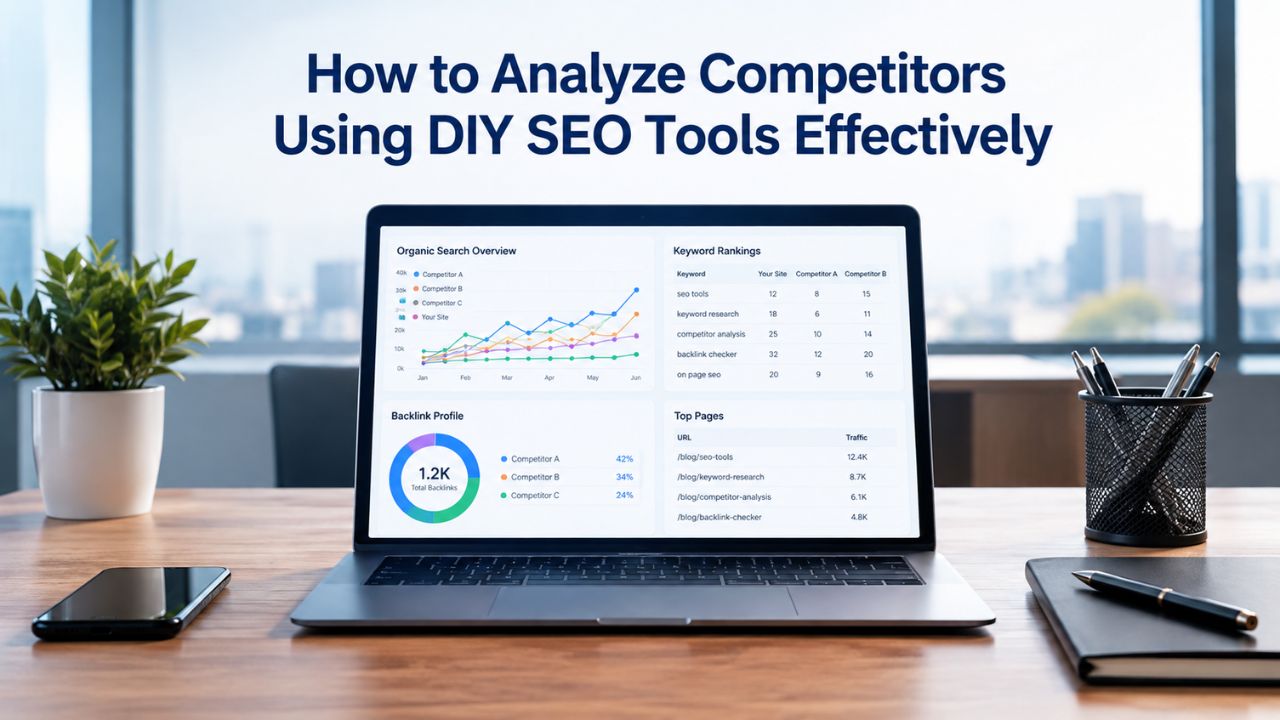
Your competitors publish content, attract links, and capture search traffic. Meanwhile, you’re trying to figure out which keywords to target. Without a clear picture of how they’re succeeding, you’re optimizing in the dark. Competitor analysis using DIY SEO tools lets you reverse-engineer their strategy, identify gaps in your own SEO, and move faster than trial-and-error alone. Niya Digital’s DIY SEO tool draws on third-party search and keyword-data sources to generate competitor-analysis metrics and is refreshed periodically. These estimates support strategic decision-making and should be validated against Google Search Console for critical decisions.
Why Competitor Analysis Is Essential for DIY SEO Success
Competitive analysis isn’t about copying what others do; it’s about understanding the landscape so you can stake your own claim. When you know which keywords your competitors rank for, how they structure their content, and where their authority comes from, you gain a roadmap for your own SEO strategy. DIY SEO tools make this intelligence accessible without agency retainers or guesswork.
Understanding What Competitor Data Reveals
Analyzing competitors through DIY SEO tools shows you the keywords driving their visibility, the topics they prioritize, and the backlink sources boosting their authority. You’ll see which pages generate the most estimated organic traffic, how they optimize on-page elements like titles and meta descriptions, and where they lag in technical performance. This combination of signals- keyword rankings, content depth, backlink patterns, and page-level metrics- paints a complete picture of their approach and helps you identify your competitive advantage.
The key insight is straightforward: if a competitor ranks for a keyword and you don’t, that keyword represents an opportunity. If they rank for 500 keywords and you rank for 150, you’ve identified a significant gap in your keyword strategy and content portfolio. DIY SEO tools surface these patterns quickly, allowing you to prioritize opportunities by search volume, ranking difficulty, and market demand. Without this data, you’re guessing about which keywords matter to your audience and how much competition you’ll face.
Why DIY Tools Democratize Competitive Intelligence
Competitor analysis historically required expensive agency engagements that lasted weeks and cost thousands of dollars. DIY SEO tools have made this capability available to any business willing to invest time in setup and interpretation. This shift has leveled the playing field: small businesses can now do the same strategic analysis that once sat behind consultant retainers. A one-person team can gather competitive insights in hours that might have taken an external firm days to coordinate, giving smaller organizations the agility once reserved for enterprises with large marketing budgets.
Niya Digital’s team has found that small-business owners who run their own competitive analysis, even imperfectly at first, adapt their SEO strategy faster than those waiting for quarterly agency updates. The speed of iteration beats the perfection of a quarterly report. Moreover, the learning that comes from running your own analysis often reveals patterns you wouldn’t have noticed in a consultant’s slide deck, because you’re directly engaging with the data and making decisions based on it.
Search Engine Optimization Plans & Pricing
Choose the right SEO plan for your website. Improve search engine visibility, discover relevant keywords, monitor rankings, and access customized optimization services to support your business growth.
Search Engine Optimization (SEO)
Bring more traffic to your website with Search Engine Optimization.
- Search Optimization: Improve search engine rankings with keyword and suggested topics tool
- Keyword suggestions: Get personalized phrases and words to add to increase traffic to your website and help it rank better.
- Tracking your ranking: Track the progress of your website’s rank on Google over time
- Create your sitemap: Customize, create and submit a site map to aid search engines in crawling your site.

Customized SEO Plan
Get Customized Plan For your Business Website SEO (Search Engine Optimization)
- On-Page & Off-Page Optimization: Update Meta Tags, Titles, Descriptions, Alt Tags, Schema / JSON-LD / Microdata Format, HTML + TXT + XML Sitemap, Robots.TXT, Google Analytics & Google Search Console integration
- Keyword Research & Analysis: Improve Keyword Effectiveness Index (KEI) with main heading & sub-heading tags, Content Review by professional content editor
- Competitor Research & Analysis: Compare and Compete with competitors search engine ranking positions, Track and analyse competitor trends
- Diversify Back Link Profile: Relevant Business Directory Submission, Article Submission, Blog Creation, Web 2.0 asset creations, Author Profile Links, Social Book Marking links
- Monthly Task Review & Progress Reporting: Get Monthly SERP Reports and Task Performance Reports
Identifying the Right Competitors to Analyze
Not all competitors matter equally, and analyzing 50 rivals wastes time and muddies your insights. Start by defining a focused competitive set of 5–10 direct competitors and a second tier of 3–5 indirect or adjacent-market competitors. Your analysis will be sharper, faster, and more actionable. This discipline is what separates successful competitor research from analysis paralysis.

Defining Direct vs. Indirect Competitors
Direct competitors offer similar products or services to the same audience and target overlapping keywords. They’re your primary competitive set, the businesses whose keyword rankings and content you need to understand best. Indirect or adjacent competitors operate in related spaces: a plumbing service’s indirect competitor might be a general home-repair contractor, or a SaaS platform’s competitor might be a different solution solving the same customer problem differently.
DIY SEO competitor analysis starts with direct competitors because the keyword overlap is highest and the strategic lessons transfer directly to your roadmap. Use a keyword research tool to run 10–15 of your target keywords and see which domains consistently appear in the top 10 results; those are your direct competitors. List them, then repeat the process with your second-tier keywords to identify secondary rivals. Finally, review indirect competitors quarterly to catch emerging threats or market shifts.
Why Scope Matters: Avoiding Analysis Paralysis
Analyzing too many competitors creates noise instead of clarity. If you track 30 competitors, you’ll spend 80% of your time on insights that don’t move the needle. Instead, cap your primary analysis to your top 5–10 direct competitors, the ones whose market share and keyword overlap matter most to your business. Set aside a secondary list of 3–5 indirect competitors to monitor quarterly, but don’t make them your primary focus.
This discipline is what separates one-off competitive audits from lasting strategic leverage. Niya Digital’s customers report that this focused approach, treating analysis as an ongoing discipline, not a one-time event, is the single biggest factor in sustained SEO growth. Revisit your competitive set annually, and adjust as your market position or business focus shifts. New entrants may emerge as threats, older rivals may lose relevance, and your own growth may take you into adjacent markets where you need to monitor different competitors.
Mapping Competitor Keywords and Search Visibility
Once you’ve identified your competitive set, map their keyword strategy. DIY SEO rank-tracking tools aggregate search data from third-party sources to show which keywords each competitor ranks for, at what position, and with estimated search volume. This reveals their keyword prioritization and helps you spot high-value gaps where you can compete effectively.
Which Keywords Competitors Rank For
Use a rank-tracking tool or competitor analysis feature in your DIY SEO platform to pull the keyword rankings for each rival. You’ll see a list of keywords, positions (estimated from third-party search data, updated weekly or monthly), and search volume (estimated volume per keyword). Look for patterns: which topics dominate their strategy? Are they targeting high-volume keywords, long-tail niches, or a mix? Which content pages drive the most keyword visibility?
High-ranking keyword lists also reveal opportunities. If a competitor ranks on page two (positions 11–20) for a keyword that matches your target audience, you may be able to outrank them with focused optimization. If they own the top keywords in a category and you’re targeting something adjacent, that suggests a gap in your content portfolio. Rank tracking updated weekly or monthly (depending on your DIY tool) lets you track these shifts over time and spot emerging patterns. A competitor gaining 20 new keywords in a quarter signals they’re adding content or building authority fast; time for you to accelerate too.
Measuring Ranking Volume as a Competitive Signal
Ranking volume, the total number of keywords a competitor ranks for across all positions, signals their overall SEO maturity and keyword breadth. A competitor ranking for significantly more keywords shows a more mature, established content strategy than one with narrow keyword focus. Most DIY SEO tools consider 500+ keywords a strong signal of SEO maturity, while 100–150 keywords suggests a newer or narrowly focused approach. This signal helps you set realistic targets.
If a direct competitor ranks for 500 keywords and you rank for 150, you’ve identified a significant gap in your on-page optimization and content strategy. Conversely, if you rank for more keywords than they do but at lower average positions, it signals that your content breadth is fine but your domain authority or on-page optimization needs work. This kind of ranking-volume comparison is straightforward to run in DIY SEO tools and often reveals the fastest path to improvement, whether you need more content, better authority, or better on-page optimization.
Analyzing Competitor Content Strategy and Topics
Beyond keywords and rankings, understanding how competitors organize their content reveals strategic patterns you can learn from or differentiate against. DIY SEO tools let you audit their top-performing pages, topic clusters, and content depth, information that directly informs your own content roadmap and helps you avoid duplicating their efforts.
Identifying Topic Clusters and High-Performing Content
A topic cluster is a group of related keywords linked through a pillar page (a comprehensive guide) and cluster pages (detailed posts on subtopics). Successful competitors often organize content this way, giving search engines a clear signal of topical authority. Review your competitors’ most-visited pages (pull this from rank tracking and content audits in DIY tools) and look for patterns in how they organize related content.
For example, a competitor might have a pillar page on “DIY SEO for beginners,” with cluster pages on “keyword research tools,” “DIY SEO audits,” and “rank tracking.” This structure tells search engines they’re an authority on DIY SEO as a whole. If you find gaps in their cluster- a missing guide on a subtopic they should cover- that’s an opportunity for you. Content audit features in DIY SEO tools pull competitor page-level metrics (word count, linking patterns, estimated traffic) so you can see which structure works and what audience segments they’re targeting.
Spotting Underserved Content Angles You Can Own
Competitors rarely own every angle on a topic. Review their top-performing content and ask: what are they not covering? Which audience segments are they skipping? Which formats are missing? A competitor’s “SEO for ecommerce” guide might skip the small-store angle, the retail-specific pain points, or the budget-constrained approach. That’s your opening. DIY SEO tools show you competitor content through keyword visibility and page-level rankings; use this data to find the gap, then plan content that goes deeper or serves an underserved audience segment.
This is where your workflow and strategic thinking matter more than any single tool feature. A DIY SEO tool provides visibility data and shows you competitor content; you decide which gaps are worth pursuing and how to position your content differently. One competitor’s gap might be your highest-value opportunity, while another gap might not fit your business at all. The tool gives you the raw material; you make the strategic decision.
Understanding Competitor Backlink Profiles
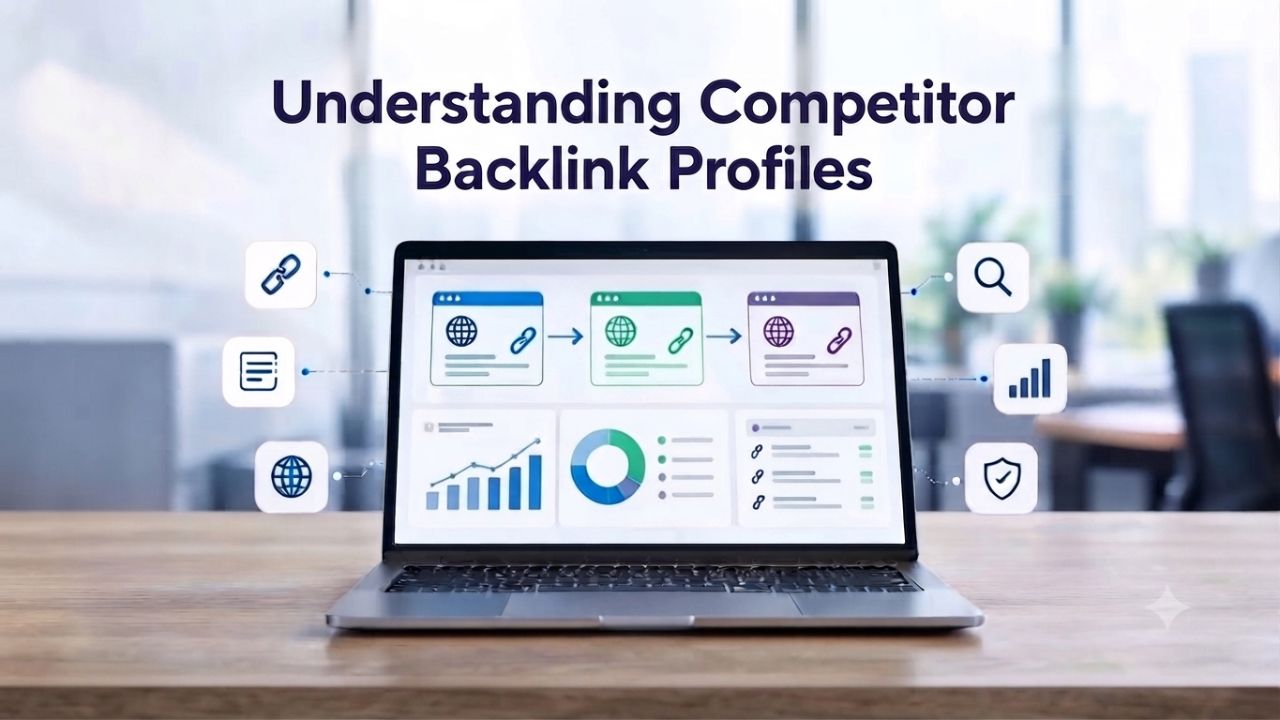
Backlinks, inbound links from other websites, are a core ranking factor. Analyzing competitor backlink profiles reveals where they’re building authority, which sources link to them, and where you might find linking opportunities. DIY SEO tools pull third-party backlink data to surface these patterns and help you understand the link-building landscape you’re competing in.
Decoding Backlink Quantity, Quality, and Link Sources
Backlink analysis shows three key metrics: the number of linking domains (quantity), the authority of those domains (quality), and the anchor text (the linked text itself). A competitor with 500 linking domains is likely more authoritative than one with 50. However, a competitor with 50 links from major publications might be stronger than another with 500 links from low-quality directories.
DIY SEO tools surface these patterns at a glance. You’ll see competitor backlink sources, anchor text distributions, and trending link patterns (new links vs. old ones). This data comes from third-party backlink aggregators and is refreshed periodically, so treat it as a strategic guide rather than a precise inventory. Use it to spot which types of sources link to successful competitors; those become your link-building targets. A competitor might have links from industry blogs, trade publications, educational institutions, or customer partnerships. Each pattern suggests a link-building avenue you should explore.
Reverse-Engineering Link-Building Opportunities
Once you’ve mapped competitor backlinks, ask: which link sources are they using that I’m not? A competitor might have links from industry blogs, trade publications, or educational partnerships that are relevant to your business too. Backlink analysis in DIY SEO tools often includes a “link-gap” analysis that shows links pointing to competitors but not to you; these are immediate opportunities.
If a competitor’s main link-building pattern comes from guest posts on industry websites, that’s your signal to pursue guest-posting opportunities in the same publications. If they’ve secured links from a trade association or directory relevant to your industry, you should apply for inclusion or seek a partnership. This reverse-engineering approach converts competitor data into a concrete link-building roadmap. Instead of guessing where to pitch for links, you follow the path your competitors have already proven works.
Ready to Benchmark Your Competition
Competitor analysis reveals the keywords driving visibility, the content strategies that work, and the gaps you can exploit. Niya Digital’s DIY SEO platform combines rank tracking, competitor analysis, keyword research, and technical audits so you can run a complete competitive audit whenever you need it. Start benchmarking your competitors today and build a strategy based on real market data, not guesswork.
Spotting Competitive Vulnerabilities and Gaps
Every competitor has weaknesses, pages that rank despite weak optimization, keyword opportunities they’ve missed, or technical issues slowing their load times. Identifying these vulnerabilities creates opportunities to compete without reacting to or defending against their strengths. The goal is to find the leverage points where your optimization efforts will yield the biggest gains.
Competitor Analysis Decision Factors
| Factor | Why It Matters | What to Measure | Red Flag |
|---|---|---|---|
| Keyword Overlap | Shows direct competition and shared audience targets | Percentage of your target keywords where competitor also ranks | Competitor dominates 80%+ of your target keywords; limited differentiation opportunity |
| Content Depth | Indicates investment in topic authority and expertise | Average article word count, number of internal links per page, multimedia elements | Competitor’s average article is 3x yours; they appear more authoritative |
| Backlink Profile | Reflects domain authority and link-building strategy maturity | Number of linking domains, authority score, link source diversity | Competitor has 10x more backlinks from established domains; significant authority gap |
| On-Page Optimization | Shows attention to SEO fundamentals and quality standards | Title/meta optimization completeness, heading hierarchy correctness, image alt text presence | Competitor’s top-ranking page lacks basic optimization; quick win opportunity |
| Content Update Cadence | Signals content freshness, investment, and market responsiveness | How frequently competitor publishes new content and updates existing pages | Competitor hasn’t updated top-ranking content in 2+ years; content may be stale |
| Technical Foundation | Affects crawlability, indexing, page speed, and user experience signals | Page load speed, mobile responsiveness, Core Web Vitals scores, schema markup implementation | Competitor’s site lacks mobile optimization or fails Core Web Vitals; technical vulnerability |
Finding Weak On-Page Optimization and Technical Issues
Run an on-page audit of your competitor’s top-ranking pages in a DIY SEO tool or manually using Google’s tools. You may find missing or thin meta descriptions, broken heading hierarchies, unoptimized images, or slow page speeds (as shown in Core Web Vitals data). These aren’t fatal flaws; pages can still rank because of domain authority and backlinks, but they’re quick wins for you.
If a competitor ranks for your target keyword with a page missing image alt text or lacking proper heading structure, that page is vulnerable to a well-optimized alternative. You don’t need to outrank them on pure authority; better on-page optimization and faster load times can level the playing field. Technical issues like slow mobile performance or missing structured data represent similar opportunities. DIY SEO audit tools flag these specific issues, giving you a concrete optimization checklist you can work through systematically.
Spotting Missed Long-Tail Keywords and Emerging Opportunities
Competitors often focus on high-volume keywords and miss long-tail opportunities in their category. A long-tail keyword like “best DIY SEO tool for local plumbers” has lower search volume than “DIY SEO tool,” but less competition and higher conversion intent. If competitors aren’t targeting these specific phrases, you can claim them faster and often convert them better because they match specific customer needs.
Use DIY SEO keyword research tools to find long-tail variants your competitors rank for at low positions (page 2–3) and that you don’t rank for at all. These represent easier wins than battling for top-three positions on their primary keywords. Emerging keywords, new searches gaining volume but with few ranking pages, are even better opportunities. This ties back to having a clear process: systematic long-tail analysis beats random keyword guessing every time. Build a monthly habit of scanning for new long-tail opportunities in your space, and you’ll consistently find quick wins.
Building a Repeatable Competitor-Analysis Workflow
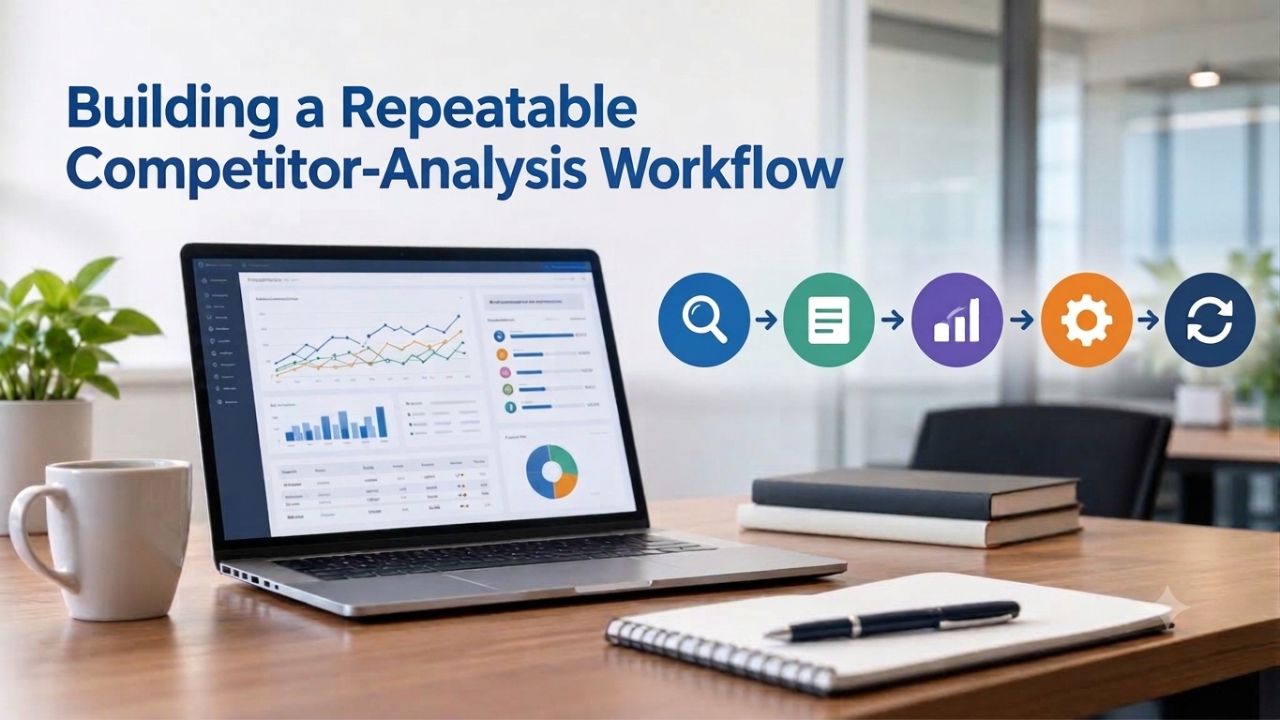
Competitor analysis that happens once and never again provides outdated insights. Successful DIY SEO requires a documented workflow run on a regular cadence, quarterly or monthly, so you catch shifting competitive dynamics and adapt proactively. This consistency, more than any tool feature, is what drives lasting competitive advantage.
Setting Up Monthly or Quarterly Monitoring
Document your competitive-analysis process:
Which 5–10 competitors will you track?
Which 20–30 keywords will you monitor?
Which metrics matter most (ranking position, ranking volume, new backlinks, content updates)?
Create a template or checklist, then run the same analysis on a fixed cadence; the first week of each quarter or month works well. Consistency matters more than frequency; monthly reviews are often sufficient unless you’re in a fast-moving, highly competitive space.
DIY SEO tools with rank-tracking features make this repeatable. Many platforms store historical ranking data and alert you to significant changes (new top-10 rankings, lost positions, new backlinks). Set up these alerts and review them monthly or quarterly. A simple spreadsheet tracking competitor metrics over time reveals trends: Are they growing in keyword volume while you’re flat? Are new backlinks accelerating their authority? Is their content output increasing? Use these trends to adjust your strategy.
Documenting Findings and Creating Actionable Insights
Raw data isn’t a strategy. After running your competitive analysis, synthesize findings into a brief: “Competitor A gained 50 new keywords this quarter, mostly in long-tail variants we haven’t targeted. Competitor B’s top 10 content is aging, last updated 18 months ago, and lacks Core Web Vitals optimization. Here’s our plan to capitalize on these gaps.” Tie insights to concrete next steps: new keywords to target, content gaps to fill, technical improvements to prioritize, link-building opportunities to pursue.
This discipline of regular review and documented insights is the one-two punch that separates successful DIY SEO operators from those who run one analysis and then wonder why their rankings don’t improve. As the workflow section highlights, consistency beats any tool feature or flashy dashboard. Businesses that win at competitive analysis treat it like a system, not a one-time project.
Common Mistakes in DIY Competitor Analysis
Most businesses make predictable errors when analyzing competitors, leading to wasted effort or misguided strategy. Understanding these pitfalls helps you avoid them and use your competitive data more effectively. These mistakes are often subtle, not obvious errors, but strategic missteps that waste time or lead you down the wrong path.
Copying Competitors Instead of Finding Your Angle
The biggest mistake is assuming that copying competitor keywords, content structure, or backlink strategy will work for you. It won’t. Competitors have existing authority, audience relationships, and brand recognition that you don’t. If you target the exact keywords they target and write similar content, you’re competing on their terms, where they’ve built an advantage over months or years.
Instead, use competitive data as inspiration for your own differentiated angle. If a competitor’s guide is 2,000 words and covers a broad audience, write a 3,000-word deep dive for a specific audience segment they skipped. If they’ve built authority through guest posts on Industry Publication X, pursue a different but equally relevant publication where you can stake your claim first. If they’re targeting high-volume keywords, dominate the long-tail variants and own a specific niche. Tool capability only matters if you use it: DIY SEO tools surface keyword opportunities; your research and audience understanding create the differentiated content angle.
Overweighting Single Metrics and Ignoring Indirect Competitors
Some teams fixate on ranking position, “Competitor A is #1 for this keyword, so we must be too,” without asking whether that keyword matches their audience or budget. Others ignore indirect competitors and miss emerging threats. A competitor offering a cheaper solution, a fresher angle, or a different product format might be stealing market share without appearing in your top-10 keyword rankings.
Balanced competitive analysis weighs multiple signals: keyword volume, ranking position, content depth, backlink authority, page-update frequency, and audience fit. No single metric tells the whole story. DIY SEO tools provide the data; your judgment determines which signals matter most to your business. A keyword with high search volume might have terrible conversion intent for your audience. A competitor’s high ranking might come from brand authority rather than SEO best practices, making their approach less replicable for a smaller player. Stay strategic and balanced in your interpretation.
Integrating Competitor Insights Into Your SEO Strategy
Data alone doesn’t drive results. The final step is translating competitive insights into a prioritized roadmap that guides content creation, link building, and technical optimization. The transition from “we know what competitors are doing” to “here’s what we’re doing differently” is where competitive analysis delivers business value.

From Competitive Gaps to Keyword Prioritization
After mapping competitor keywords, identify three priority tiers: quick wins (keywords competitors rank for at position 6+ where you rank 11+, or keywords nobody ranks for yet but have search volume), medium-term targets (keywords with higher competition or lower search volume requiring more work), and long-term authority plays (head keywords requiring months of content and links to rank for).
Assign these to your roadmap: Quick wins get content in the next month. Medium-term targets get distributed across the next two quarters. Authority plays anchor your 6–12 month plan. This tiered approach keeps your content strategy from feeling random; it’s built on competitive reality and your realistic capacity. DIY SEO keyword research and rank-tracking tools help you track progress against these tiers and celebrate wins as you move up the ranking positions.
Balancing Competitor Data with Brand Positioning and Audience Fit
Competitive analysis reveals opportunity, but it shouldn’t override your brand positioning or core audience. If data says there’s demand for a keyword your brand doesn’t serve well, don’t force it just because a competitor ranks there. Instead, ask: Is this a market I should enter, or should I double down on keywords where I have a natural edge?
The strongest SEO strategies aren’t reactive to competition; they’re proactive and rooted in audience demand, business capability, and brand fit. Competitive data helps you avoid huge gaps and find overlooked niches, but it’s one input, not the whole story. Use it to shape priorities and validate decisions, not to dictate them. A keyword might be popular with competitors but misaligned with your product roadmap or brand voice. Stay true to your positioning, and use competitive data to guide where you can win fastest.
Scaling Competitive Intelligence as Your Business Grows
As your SEO matures and your business scales, your competitive-analysis process should evolve too. What starts as a monthly manual review can become semi-automated, and your competitive set itself will expand and shift. The principles stay the same, but the execution scales.
DIY SEO Competitor Analysis Capabilities
| Capability | What It Reveals About Competitors | Typical DIY Tool Approach | How It Helps Your Strategy |
|---|---|---|---|
| Rank Tracking | Which keywords competitors rank for and at what position | Aggregates search result data from third-party sources updated weekly or monthly | Identifies your priority keywords, gaps in your rankings, and quick-win opportunities |
| Keyword Volume & Difficulty | Search demand for each keyword and competitive intensity | Estimates based on third-party search and keyword-data sources | Helps prioritize easy wins vs. long-term targets; aligns effort with opportunity |
| Backlink Analysis | Competitor link sources, anchor text patterns, and domain authority | Crawls public backlink data from third-party backlink databases | Reveals linking patterns, partnership opportunities, and link-building sources to pursue |
| Content Audit | Competitor’s top-performing pages by topic, word count, and visibility | Indexes competitor URLs and analyzes on-page elements (titles, headings, content length) | Benchmarks your content quality, length, and structure; identifies gaps you can fill |
| On-Page Comparison | How competitors optimize titles, meta descriptions, headings, and schema | Extracts and compares page elements side-by-side across competitor pages | Shows quick wins like missing meta descriptions, broken H1 tags, or weak optimization |
| Traffic Estimation | Estimated organic traffic to competitor’s top-performing pages | Inferred from keyword rankings, ranking positions, and estimated search volume | Signals which content topics and keywords drive the most business value and demand |
Automating Monitoring and Adjusting Your Competitive Set
DIY SEO platforms with rank-tracking and alert features significantly reduce manual work. Set up automated alerts for ranking changes, new top-10 keywords, new backlinks, and content updates for your core competitors. Review these alerts weekly, and run a deeper analysis quarterly. As your business scales and enters new markets or product categories, expand your competitive set accordingly.
A growing SaaS company might start by tracking 8 direct competitors in its core product space, then expand to 5 competitors as it enters an adjacent market. Older competitors may become irrelevant as the market shifts; new entrants may emerge as threats. Revisit your competitive set annually to ensure you’re tracking the rivals that matter today, not yesterday. This annual audit takes a few hours but prevents you from tracking zombie competitors or missing new threats.
Using Competitor Trends to Forecast and Shape Your SEO Roadmap
Competitive monitoring isn’t just reactive; it’s predictive. If three competitors suddenly start publishing on emerging keywords or technologies, that signals demand is building. If competitor content on a topic doubles in the last six months, the market is expanding. Use these trend signals to forecast where the market is heading and shape your roadmap preemptively.
This ongoing discipline is what separates one-off audits from lasting SEO gains. Regular competitive monitoring, paired with a clear strategy and consistent execution, compounds over time. Quarterly reviews show incremental progress; annual retrospectives reveal how much ground you’ve covered and where the market is moving. When you’re tracking trends instead of reacting to them, you stay ahead instead of catching up.
Maximize Your Competitive Edge With Structured Analysis
Competitor analysis powers growth when it’s systematic and integrated into your broader SEO strategy. Niya Digital’s DIY SEO platform provides the rank tracking, competitor research, keyword analysis, and audit capabilities you need to run competitive intelligence in-house. Start your structured competitor analysis today and transform market insights into ranked keywords and organic traffic.
Frequently Asked Questions
What is competitor analysis in SEO, and why does it matter?
Competitor analysis in SEO is a review of rivals’ keyword targeting, content strategy, backlink profile, and on-page optimization to identify gaps and opportunities in your own strategy. It matters because it reveals which keywords have demand and competitive intensity, which content topics drive visibility, and where your site lags.
Understanding your competitive landscape helps you prioritize SEO efforts on high-leverage opportunities rather than guessing. DIY SEO tools automate this analysis, making it accessible to businesses without agency budgets or large marketing teams. Instead of paying consultants to analyze competitors, you can run the analysis yourself on your own schedule and stay current with market shifts.
How many competitors should I analyze?
Start with 5–10 direct competitors, businesses offering similar solutions to your audience. Add a secondary tier of 3–5 indirect competitors (related solutions, adjacent markets) for quarterly review. Analyzing more than 10 direct competitors spreads your attention too thin and creates noise instead of clarity.
Pick the competitors whose market share and keyword overlap matter most to your business, and revisit your competitive set annually as markets shift. This focused approach lets you track each competitor in depth rather than shallowly monitoring dozens. Quality analysis of a few key rivals beats surface-level monitoring of many.
How often should I run competitor analysis?
Run a focused competitive analysis quarterly or monthly, depending on your market’s pace. A fast-moving competitive space (new entrants, frequent product launches, high acquisition activity) warrants monthly review. Most businesses find quarterly deep analysis plus weekly rank-tracking alerts sufficient to stay current.
Set up automated alerts for ranking changes and new backlinks, then do a manual quarterly analysis to adjust strategy. This discipline is the key to translating competitive data into lasting gains. Annual reviews help you step back and see long-term trends you might miss in month-to-month noise.
What if my main competitor ranks for thousands of keywords and I rank for hundreds?
A large ranking-volume gap signals a maturity or scope gap in your SEO effort. Your competitor likely has more content pages, stronger backlinks, broader topic authority, or a longer SEO history. This gap is addressable, not permanent. Prioritize: identify their highest-traffic keywords (estimated from ranking position and search volume), then create new content or update existing content to target those keywords.
Focus on long-tail variants and underserved angles where you can win faster than head-to-head competition. A gap this large often indicates you should shift from trying to compete everywhere to dominating a specific niche or audience segment first.
How do I find link-building opportunities from competitor analysis?
Review your competitors’ backlink sources using a DIY SEO backlink tool. Look for publications, directories, resource pages, and industry associations linking to them but not to you. These represent your link-building targets. Common sources include guest-post opportunities in publications linking to competitors, resource-page placements, and partnership link exchanges.
Backlink analysis in DIY tools often includes a “link gap” report showing competitor links you’re missing; use this as your link-building roadmap. Contact each potential link source with a personalized pitch explaining why they should link to you instead of (or in addition to) your competitor.
Can I use competitor data to improve my content strategy?
Absolutely. Competitor analysis reveals which topics drive visibility, how content is organized (pillar pages vs. cluster pages), typical word counts for ranking pages, and multimedia patterns. Use this data to plan your content: which topics should you cover first, which content gaps exist, how deep should posts be, and which content formats work.
Don’t copy; use competitive content as a benchmark and a source of ideas for your own differentiated angle. The best competitive insights lead to “we do this better,” not “we’ll do what they do.”
What if I’m in a new or niche market with few competitors?
In emerging or niche markets, a smaller competitive set is normal. Analyze every competitor you can find (even 2–3), and expand your view to adjacent markets or more-general versions of your topic. Google Trends, industry forums, and customer feedback often reveal what customers search for better than competitors do in niche spaces.
DIY SEO keyword research tools will help you find search demand independent of competitor activity. New markets are often the best place to establish leadership because competition is lower and first-mover advantage is real.
How do I know if my DIY SEO tool’s competitor data is accurate?
DIY SEO tools estimate metrics from third-party search and keyword-data sources, so absolute precision isn’t guaranteed. Rankings are estimated from aggregated search results; keyword volume is estimated from search activity. Verify critical findings against Google Search Console (your own ranking data) and Google Analytics (your own traffic).
Use DIY tool data for prioritization and direction, not as a source of truth; it’s a strategic guide, not a precise measurement. Most businesses find the directional accuracy is sufficient for strategy; don’t treat estimated metrics as gospel.
What’s the difference between ranking position and ranking volume?
Ranking position is where a keyword ranks for a specific domain (e.g., position #3 for “DIY SEO tool”). Ranking volume is the total count of keywords a domain ranks for across all positions. A competitor might rank at position #1 for 100 keywords and position 6–10 for 500 keywords.
Position shows competitive intensity for a specific keyword; volume shows topical breadth and SEO maturity. Both matter: high-volume, low-position rankings suggest underperformance; high-volume, high-position rankings suggest strong authority and a well-executed content strategy.
Should I analyze indirect competitors or just direct competitors?
Analyze direct competitors deeply (your main focus), but monitor indirect competitors quarterly. Indirect competitors- solutions solving the same problem differently, or adjacent-market players- represent emerging threats and alternative customer choices.
A plumber’s indirect competitor might be a handyperson service; a keyword-research tool’s indirect competitor might be an all-in-one SEO platform. Monitoring these helps prevent market shifts from blindsiding you. Sometimes the biggest threat isn’t your direct competitor; it’s someone from an adjacent space who suddenly enters your market with a different approach.
How do I prioritize which competitor keywords to target first?
Prioritize using three tiers: quick wins (competitors rank for these, you don’t; position 6+ with search volume 100+), medium-term targets (some competition but attainable with content and authority), and long-term authority plays (head keywords requiring months of work).
Start with quick wins; they deliver SEO progress fast and build momentum. Build medium-term targets into your quarterly plan. Long-term keywords anchor your 12-month strategy. This tiered approach beats random keyword pursuit. Quick wins also build internal momentum and prove that your SEO strategy is working, making it easier to justify continued effort.
Can DIY SEO tools track competitor algorithm updates and ranking volatility?
DIY SEO rank-tracking tools show keyword ranking changes (position movement week-to-week or month-to-month), which can signal Google algorithm updates affecting your competitors. If all competitors drop for a set of keywords simultaneously, an algorithm update likely hit.
If one competitor gains 50 keywords while others are stable, they’ve likely published new content or acquired backlinks. Rank tracking alerts you to trends; analyzing the cause requires investigation, but data-driven alerts beat manual monitoring. Many platforms highlight unusual activity, making it easy to spot when something significant has shifted in the rankings.
How should I report competitor analysis findings to my team or leadership?
Synthesize raw data into a brief: What changed since last quarter? Which competitors gained or lost rankings? What keyword opportunities did we identify? What content gaps exist? Which technical improvements would help? Translate findings into priorities: Which keywords will we target next quarter?
Which content will we create? This structured reporting moves competitive analysis from data gathering to strategy, making it clear to your team and leadership how you’ll spend your effort. One-page summaries are often more effective than detailed spreadsheets for communicating findings and getting buy-in for next steps.
What are common mistakes to avoid in competitor analysis?
Avoid copying competitors, overweighting a single metric (like ranking position), ignoring indirect competitors, and running an analysis once and never revisiting it. Instead, use competitor data to find your angle, balance multiple signals, monitor indirect threats, and build competitor analysis into your regular rhythm.
Another mistake is confusing data collection with strategy: gathering competitor keywords is step one; deciding which to target, why, and in what order is strategy. The best competitive analysts spend more time thinking about what the data means than collecting it.
How do I translate competitor backlink patterns into my link-building strategy?
Study where your competitors’ backlinks come from and identify patterns. Are they getting links from industry blogs, trade publications, educational institutions, news outlets, or partner websites? Which link sources appear most frequently? These represent your highest-probability link-building targets.
Reach out to those publications or resource sites with content ideas, guest-post pitches, or partnership proposals. A competitor’s backlink profile is a roadmap showing which link sources actively link to businesses in your space. Follow that map, and you’ll build links faster than guessing.
Glossary
- Backlink: An inbound hyperlink from another website to your own. Backlinks are a key ranking factor; quantity and quality of linking domains affect domain authority and ranking potential.
- Competitive Gap: A keyword, topic, or content type where competitors rank or publish but your website does not, representing an opportunity to gain visibility.
- Domain Authority: A score reflecting a website’s overall link strength and ranking potential based on its backlink profile and SEO maturity.
- Keyword Ranking Position: A website’s placement in search results for a given keyword, numbered from 1 (top result) onwards through subsequent pages.
- Keyword Volume: Estimated number of monthly searches for a term, derived from third-party search-data sources; a signal of demand and opportunity size.
- Long-Tail Keyword: A lower-volume, more specific search phrase (e.g., “best DIY SEO tool for local plumbers”) compared to broad, high-volume terms.
- SERP (Search Engine Results Page): The list of results Google displays in response to a search query, typically showing 10 organic results per page.
- Topic Cluster: A content structure where a pillar page (comprehensive guide on a broad topic) links to multiple cluster pages (detailed posts on subtopics), signaling topical authority to search engines.