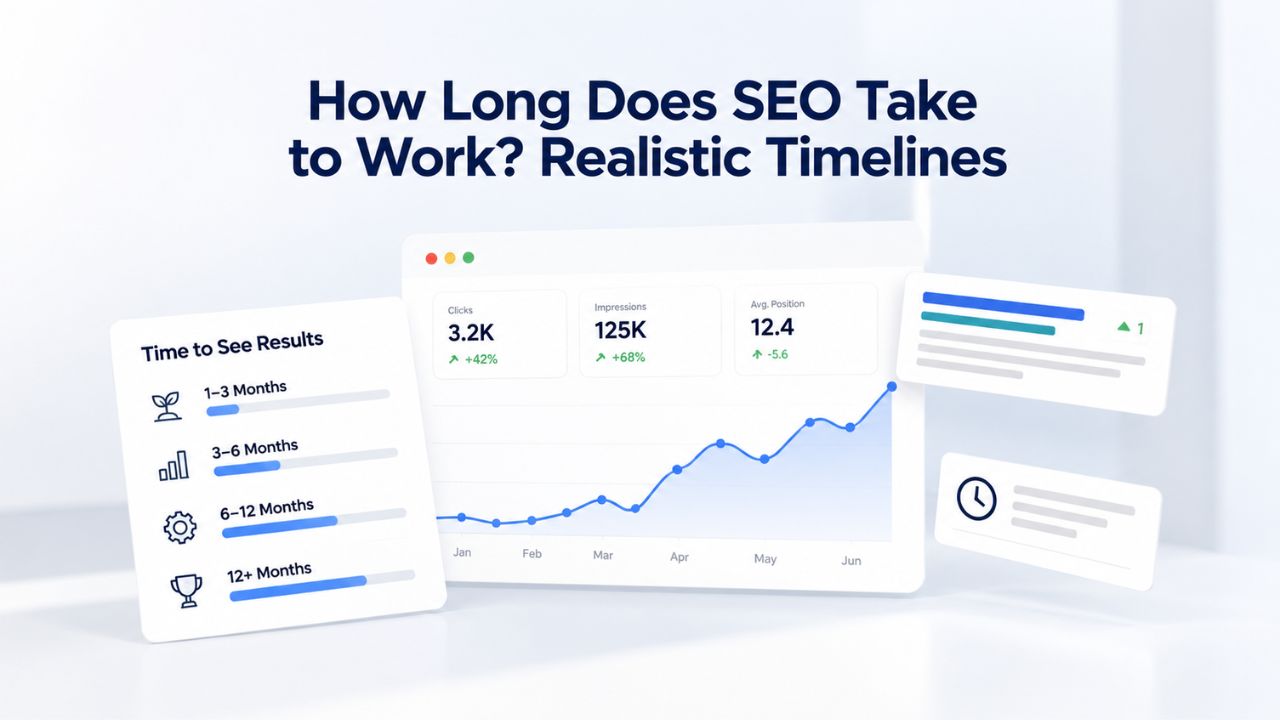
Most business owners launching SEO expect fast results. The truth: meaningful search visibility takes months of consistent effort. You’ll learn what to expect at each stage and how to monitor progress with confidence. Niya Digital, GoDaddy’s authorized reseller for DIY SEO, draws on third-party search and keyword-data sources to help small businesses track these milestones without hiring an agency.
The Reality: Why SEO Takes Months, Not Weeks
Search engine optimization differs fundamentally from paid advertising and other marketing channels. Understanding why timelines are longer than most expect is the first step to building realistic expectations and staying committed through the process.
Why Google Needs Time to Evaluate Your Site
Google assesses some 200 factors when deciding which pages should rank for which search terms, and the two main factors are links and content. This complexity means Google must gather substantial evidence before trusting your site enough to rank it prominently. Most SEO experts agree it takes three to six months to start seeing results. Results vary widely: you might not reach the top position in three months, but you should rank higher than before.
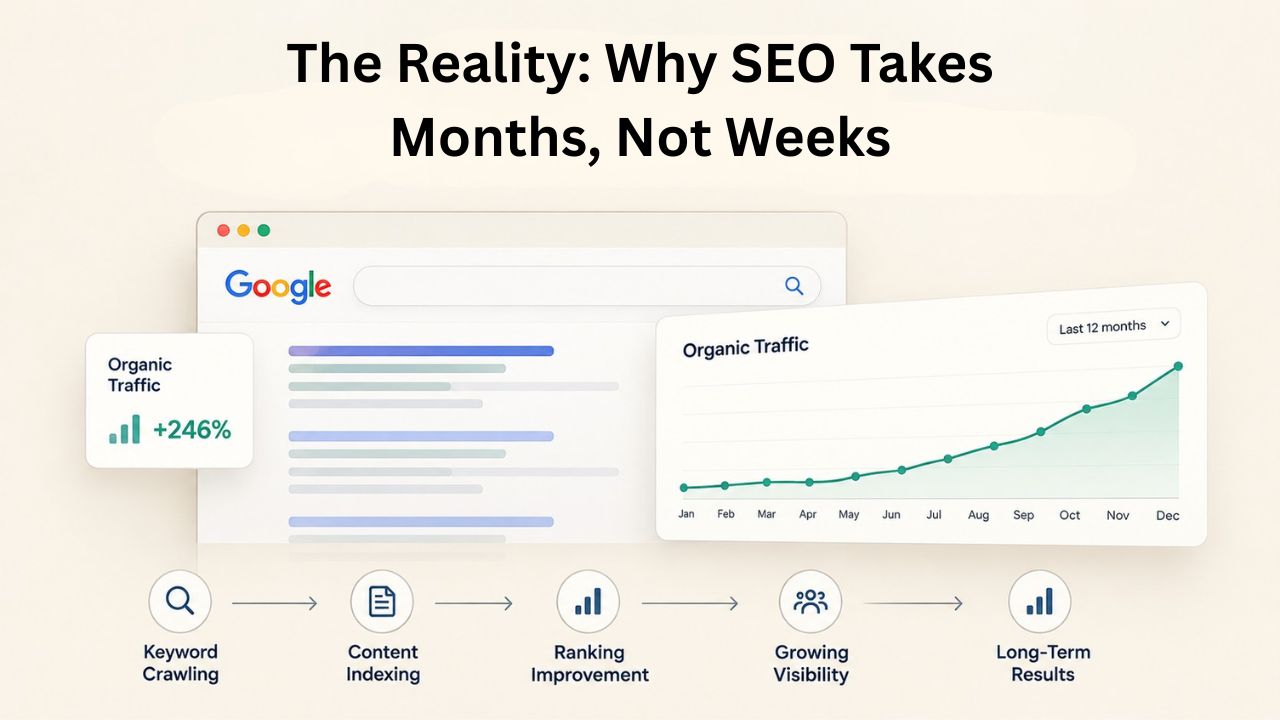
Search engines don’t instantly rank new pages. Instead, Google’s algorithms crawl your content, index it into their systems, and then monitor user behavior signals, clicks, time on page, bounce rate, and more, to understand whether your content genuinely answers the search query better than existing results. Google needs hours or weeks to find, crawl, and index new content, and implementing best practices consistently across all pages takes time to prove your site’s reputation to search engines. This evaluation period is essential to Google’s mission of delivering the most relevant results to searchers.
How SEO Differs from Paid Channels
SEO is not advertising; your page must align with what the searcher actually wants, and Google’s crawlers need to discover, index, and test it against existing rankings, a phase alone that can take weeks or months. When you run a paid search campaign, your ads appear immediately because you’re paying for placement. When you stop paying, the traffic stops. SEO operates under different rules.
Organic search traffic builds gradually, compounds over time, and persists even when you pause your optimization efforts. Google indicated it typically takes 4-12 months for SEO to work, but that doesn’t mean nothing happens during months 1–3. Early-stage SEO establishes the foundation, technical fixes, initial content, and authority signals that enable faster progress in later months. This front-loaded effort often makes the timeline steeper at the start but accelerates as your domain builds credibility.
Long-Tail Keywords Provide Early Wins
Not all keywords take the same amount of time to rank. A new domain targeting low-competition long-tail keywords (e.g., “how to fix a leaky faucet in a rental apartment”) can rank in 4 to 8 weeks, while high-authority sites like Wirecutter leverage decades of domain history and millions of backlinks to dominate competitive terms almost instantly. This difference matters because it shows SEO progress doesn’t have to wait three to six months to show up.
Smart SEO strategy begins with targeting specific, lower-competition keywords that match your niche or customer base precisely. These “quick wins” serve two purposes: they drive early traffic and demonstrate proof of concept, and they build domain authority that later enables ranking for more competitive terms. A new business targeting “best CRM software for nonprofits” will rank faster than one targeting just “CRM software,” even though the latter has higher search volume. The specificity works in your favor early on.
Search Engine Optimization (SEO) Plans & Pricing
Choose an SEO plan designed to support your website’s search visibility and growth goals. Whether you need keyword research, technical SEO audits, competitor analysis, rank tracking, or ongoing optimization support, our flexible plans provide the tools and insights you need to build a stronger SEO strategy and improve your online presence.
Search Engine Optimization (SEO)
Bring more traffic to your website with Search Engine Optimization.
- Search Optimization: Improve search engine rankings with keyword and suggested topics tool
- Keyword suggestions: Get personalized phrases and words to add to increase traffic to your website and help it rank better.
- Tracking your ranking: Track the progress of your website’s rank on Google over time
- Create your sitemap: Customize, create and submit a site map to aid search engines in crawling your site.

Search Engine Optimization (SEO)
- Search Optimization: Improve search engine rankings with keyword and suggested topics tool
- Keyword suggestions: Get personalized phrases and words to add to increase traffic to your website and help it rank better.
- Tracking your ranking: Track the progress of your website’s rank on Google over time
- Create your sitemap: Customize, create and submit a site map to aid search engines in crawling your site.
Customized SEO Plan
Get Customized Plan For your Business Website SEO (Search Engine Optimization)
- On-Page & Off-Page Optimization: Update Meta Tags, Titles, Descriptions, Alt Tags, Schema / JSON-LD / Microdata Format, HTML + TXT + XML Sitemap, Robots.TXT, Google Analytics & Google Search Console integration
- Keyword Research & Analysis: Improve Keyword Effectiveness Index (KEI) with main heading & sub-heading tags, Content Review by professional content editor
- Competitor Research & Analysis: Compare and Compete with competitors search engine ranking positions, Track and analyse competitor trends
- Diversify Back Link Profile: Relevant Business Directory Submission, Article Submission, Blog Creation, Web 2.0 asset creations, Author Profile Links, Social Book Marking links
- Monthly Task Review & Progress Reporting: Get Monthly SERP Reports and Task Performance Reports
Domain Age & Authority: How Your Website’s History Affects Speed
Your website’s history with search engines operates like a credit score. Newer domains start with zero reputation; older domains with established backlink profiles and content depth benefit from years of accumulated trust signals.
How New Domains Build Authority from Scratch
Google’s John Mueller has said it can take up to a year for Google to figure out where a new site should rank. This doesn’t mean your site is invisible for 12 months. Rather, Google needs time to collect enough data, crawl history, backlink signals, user engagement patterns, and content quality indicators to confidently determine your site’s relevance and authority in your industry or niche.
New domains start at zero domain authority, meaning they carry no accumulated credibility signals. You must earn Google’s trust through consistent action: publish high-quality content aligned with search intent, acquire backlinks from relevant external sites, ensure technical SEO is sound, and generate user engagement signals. A new site targeting low-competition long-tail keywords can see results within weeks. But competing for high-volume, competitive terms requires 6–12+ months of sustained effort because you’re competing against established domains with years of backlink history and topical depth. The gap between new and established sites competing for the same keywords can be measured in months of additional effort.
Why Established Sites Rank Faster for Everything
Search engines often trust older domains more because they have had more time to build authority and credibility, and higher-authority sites tend to rank better. An established site isn’t just older; it carries tangible ranking signals. It likely has hundreds or thousands of indexed pages, backlinks from multiple quality sources, years of fresh content updates, and a proven history of user engagement.
As your content attracts more clicks and engagement, Google trusts your domain more, making it easier for new content to be indexed and ranked. If your content has earned backlinks, the domain authority from those links benefits your entire site, boosting the performance of all your pages. This compounding effect means established sites enjoy exponential advantages. A new article on an established site often ranks within weeks because Google trusts the domain’s expertise and quality threshold. The same article on a brand-new domain might take months. Established websites can rank for medium-difficulty keywords in 1–3 months, while new sites targeting identical keywords need 3–6 months or more, simply because domain authority compounds your efforts.
Keyword Competition: Why Your Timeline Depends on What You’re Targeting
Every keyword sits at a specific point on a competition spectrum. Some keywords are easy to rank for; others are nearly impossible for new sites. Understanding where your target keywords fall determines whether your timeline will be measured in weeks, months, or years.
SEO Timeline by Keyword Type & Domain Age
| Scenario | Typical Timeline | Key Factors |
|---|---|---|
| New domain, low-competition long-tail keywords | 4–8 weeks | Low difficulty, no domain authority required, clear intent |
| New domain, medium-competition keywords | 3–6 months | Moderate difficulty, initial authority building required, some competitive pressure |
| New domain, competitive head terms | 12–18+ months | High difficulty, extensive authority and backlink profile needed, strong competitive presence |
| Established domain (2+ years), low-competition keywords | 2–4 weeks | Domain authority accelerates results, immediate trust signals, rapid indexing |
| Established domain, medium-competition keywords | 1–3 months | Authority compounds, faster evaluation, existing topical coverage helps |
| Established domain, competitive keywords | 4–8 months | Still longer but significantly faster than new sites, authority advantage substantial |
Low-Competition Keywords Deliver Quick Initial Traction
Low-difficulty keywords, often long-tail phrases with highly specific intent, rank fastest and are the most accessible to new sites. New sites and pages with limited authority can rank for long-tail keywords within weeks or months, while broad terms require years of authority building. These early wins matter psychologically because they show your SEO strategy is working, building confidence and motivation to keep going.
For example, “best running shoes for flat feet” is far easier to rank for than “running shoes” because fewer pages target that specific combination of factors. The search volume is lower, but so is the competition. Starting with specific long-tail keywords is a proven strategy to accelerate early traction and build domain authority. Long-tail keywords are usually easier to rank for than short-tail keywords, and ranking quickly for several long-tail keywords often brings more consistent traffic and a better conversion rate than chasing one short, highly competitive term for months. A strategy that builds 20 long-tail rankings accelerates authority faster than chasing a single competitive term.
High-Competition Keywords Require Sustained Investment
Medium-competition keywords typically require 4-6 months of consistent SEO effort to see significant movement, while highly competitive terms demand even longer. In saturated markets where established players have 10+ years of domain authority and thousands of backlinks, SEO can take 2–3 years of sustained effort to produce competitive rankings. Finance, insurance, real estate, and ecommerce are hypercompetitive industries where ranking for primary keywords requires extensive preparation.
Before pursuing high-competition keywords, you must establish domain authority through earlier wins. The typical progression is to build 5–10 long-tail rankings first, acquire 20–50 quality backlinks, and publish 30–50 targeted articles. Only then do you have enough authority to compete for medium-difficulty keywords. High-competition keywords come last, after your domain has proven itself across multiple fronts. Attempting this sequence in reverse, targeting competitive keywords first, wastes months of effort with no visible ranking progress.
New Website vs. Established Site: What to Expect on Each Timeline
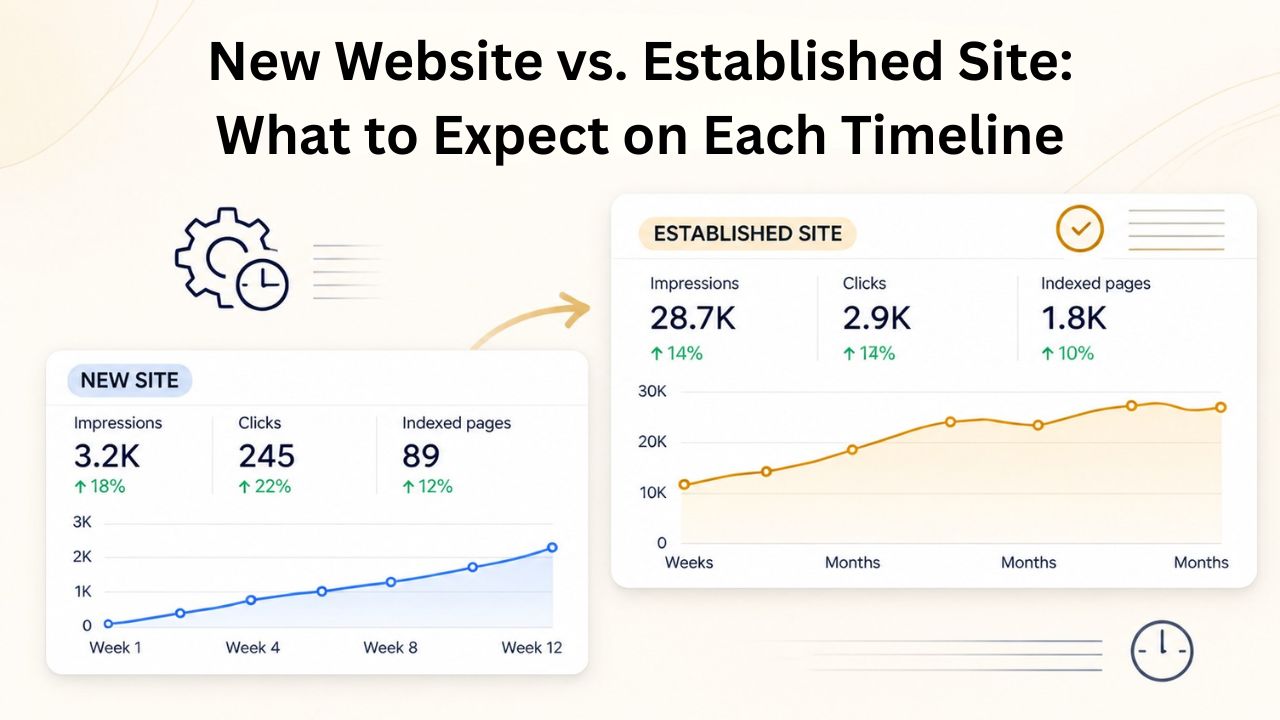
The starting point shapes the entire trajectory. A brand-new website and a five-year-old site with existing traffic will follow completely different paths, even if both invest identical effort.
The New Website Journey: Building Foundation, Then Momentum
A new domain typically progresses through predictable phases. Months 1–3 (Crawlability & Indexing): Google discovers your site and begins indexing pages. You may see rankings for ultra-low-competition keywords or branded searches. Organic traffic is minimal, but you’re building the foundation. Months 3–6 (Early Traction & Authority Building): Long-tail keywords begin ranking in positions 11–20. Organic traffic starts to rise noticeably. Backlinks accumulate, and domain authority grows. Months 6–12 (Competitive Keywords Emerge): More competitive keywords rank in the top 10. Traffic accelerates as content compounds. The site begins establishing itself as a resource in its niche.
Patience is absolutely critical during the first 6 months. Many site owners see no movement by month three and abandon sound strategies prematurely. This premature abandonment is the single biggest reason DIY SEO fails, not because the strategy is flawed, but because the timeline didn’t align with expectations. The months 1–3 period is nearly invisible in terms of organic traffic but essential for building the technical foundation, initial content library, and crawlability. Surviving this period intact is half the battle.
The Established Website Advantage: Speed Without Startup Cost
Established websites with existing authority can rank for medium-difficulty keywords in 1–3 months because Google already trusts the domain. Targeting higher-competition terms requires sustained effort, but given the site’s established history, there is potential for noticeable growth in search visibility, including for more competitive keywords, reflecting the advantage of having an already recognized presence on Google. An established site undergoing its first professional SEO optimization often sees meaningful improvements within the first month.
The advantage isn’t magical; it’s mathematical. Existing backlinks, prior topical content, established crawl history, and proven user engagement all apply immediately to any new optimization efforts. When an established site publishes new content, Google crawls it faster, gives it credibility sooner, and tests it more thoroughly because the domain has already proven its quality. A new article on an established site often reaches the top 10 within weeks. The same article on a new site might take months. This acceleration is why businesses with an existing online presence often invest in SEO earlier; they see faster returns.
Content Quality, Technical SEO & Backlinks: The Three-Pillar Timeline
SEO success rests on three interconnected pillars, each with its own maturation timeline. Neglecting any one pillar significantly slows progress.
Content: The Longest-Term Asset Requiring Strategic Depth
Content remains one of the strongest drivers of SEO success. If your content is thin, outdated, or misaligned with search intent, your timeline will suffer. Quality content creation takes substantial time. Writing comprehensive, research-backed articles targeted to real search intent requires days of research, writing, editing, and optimization per article. Building a meaningful content library, 20–50+ articles focused on your niche, takes weeks to months of sustained effort.
However, each piece becomes a long-term asset that generates returns indefinitely. Content published six months ago still ranks and drives traffic today. Content published a year ago still attracts organic visitors. This compounding asset creation means the effort you invest today pays dividends for years. Unlike paid advertising, where each dollar spent ends when the campaign stops, content compounds. Each new article you publish supports your site’s authority and topical coverage, helping new content rank faster and existing content rank better.
Technical Foundation: The Enabler of All SEO Efforts
Technical optimization is one of the biggest factors that influence how long SEO takes. Issues like slow page speed, poor mobile optimization, crawlability problems (broken links, blocked resources), or XML sitemap errors can undermine all content and link-building efforts. A slow site that takes 5 seconds to load will never rank as well as a competitor’s 2-second site, regardless of content quality or backlink count.
The good news is that technical foundation work happens once. Fixing page speed, ensuring mobile responsiveness, resolving crawlability issues, and implementing proper site structure takes concentrated effort upfront- days or weeks- but then stays fixed. Future content launches on a clean, fast, crawlable site, accelerating time to ranking. Conversely, ignoring technical SEO is like building on sand; every content and link effort is less effective than it should be. Smart SEO practitioners fix technical issues first, then invest in content and links.
Backlinks: The Slowest Pillar to Build, but Essential at Scale
Backlinks signal votes of confidence from other websites, and building quality backlinks takes time. Earning backlinks from relevant, authoritative sites is the slowest SEO pillar to build. Guest posting, partnership development, PR outreach, and strategic content promotion all require relationship-building and sustained effort over months. You cannot buy legitimate backlinks quickly without risking Google penalties.
The investment pays off compoundingly. A domain with 100 quality backlinks ranks faster than a domain with five backlinks, even if both publish identical content today. Backlinks signal to Google that your content is trusted and referenced across the web. Early-stage sites often focus on content and technical foundation, then layer in backlink building after 3–6 months of content accumulation. This sequencing works better than trying all three pillars at once, which dilutes effort and extends timelines for everyone.
Take Control of Your SEO Strategy Today
Understanding when to adjust versus when to abandon is the difference between eventual success and wasted effort. Niya Digital provides tools and guidance to help you monitor SEO progress objectively, identify what’s working, and pivot strategy confidently. Stop guessing whether your SEO is working, track real metrics, make data-driven adjustments, and build sustainable organic traffic growth.
DIY SEO Timeline: How Much Time You’ll Need to Invest
Doing SEO yourself saves money but costs time, and time has real value. Understanding the time commitment upfront prevents the disappointment that leads most DIY practitioners to quit around month four or five.
Understanding the True Time Commitment
DIY SEO requires learning SEO mechanics, implementing changes across your website, tracking progress, troubleshooting problems when rankings don’t move, and staying current with algorithm changes. Depending on your business model and site complexity, DIY SEO typically demands 10–30 hours per week to execute competently.
For comparison, this commitment is equivalent to a part-time job. The business owner or marketing person running DIY SEO cannot dedicate this time to core business activities. Most DIY owners give up at month 4–6 because rankings don’t move on the timeline they expected; that is not a failure of effort, but the result of SEO’s real lag. The typical abandonment point comes just as rankings begin to shift from invisible to visible. Owners who stick with it seetimeline see their first top-10 rankings by month six or seven, but they give up before reaching that inflection point.
When DIY Makes Business Sense
DIY works best for small local businesses with straightforward SEO needs, niche bloggers, or founders with real time and interest in SEO. For small businesses with limited budgets, DIY SEO can be an attractive option, and many successful companies use a hybrid model, handling in-house tasks while outsourcing complex work. A hybrid approach, managing keyword research, content creation, and basic on-page optimization yourself while outsourcing technical audits or link building, often balances cost and timeline effectively.
Local businesses have an inherent DIY advantage because local SEO is simpler than competitive national SEO. Optimizing for “plumber near me” or “coffee shop in [city]” is more achievable for internal teams than competing nationally for “best plumber” or “premium coffee beans.” Similarly, niche sites with engaged owners often succeed with DIY because the owner understands the topic deeply, knows the audience intimately, and can create genuinely helpful content faster than hiring writers. The key is honest self-assessment: Do you have the time? Do you have genuine interest in learning SEO? Is your competitive landscape realistic for a resource-constrained team?
Realistic SEO Milestones: What Month-by-Month Progress Actually Looks Like
Understanding what progress looks like at each stage prevents panic during quiet periods and helps you stay the course through the difficult middle months.
SEO Milestones & Progress Phases Through Month 12+
| Timeline | Phase Name | Primary Activities | Observable Progress |
|---|---|---|---|
| Months 1–3 | Technical Foundation & Indexing | Site audit, technical fixes, initial content published, sitemap submission | Minimal traffic; early keywords appear in Search Console with low impressions |
| Months 3–4 | Early Traction Building | Content library expansion, backlink outreach begins, internal linking optimized | Long-tail keywords rank in positions 11–20; organic traffic starts rising visibly |
| Months 4–6 | Foundation Strengthening | More content published, quality backlinks accumulated, domain authority growing | Low-difficulty keywords reach top 10; traffic multiplies from month-one baseline |
| Months 6–9 | Competitive Keywords Emerge | Topical authority deepens, backlink profile expands, new content ranks faster | Medium-difficulty keywords begin ranking; site establishes industry credibility |
| Months 9–12 | Authority Maturity | Consistent content production, strong backlink velocity, compounding effect visible | Competitive keywords possible; traffic accelerates; new articles rank within weeks |
| 12+ months | Established Authority | Ongoing optimization, scalable content production, authority consolidation | Reliable traffic from dozens of keywords; SEO becomes predictable revenue driver |
Months 1–6: Foundation, Indexing, and Early Traction
What Happens: You publish initial optimized content and submit your site to Google Search Console, which gives you direct data on how Google sees your site, including clicks, impressions, and average position for every keyword you rank for. Google crawls your pages, builds an index of your content, and begins testing your pages against existing rankings. Early backlinks arrive, perhaps from business directories, local listings, or initial outreach. Domain authority begins accumulating.
What to Expect: Months 1–3 show minimal organic traffic. Some branded or ultra-specific keywords appear in Search Console with very low impressions. By months 3–6, long-tail keywords start ranking in positions 11–20, which sounds invisible but signals progress. Organic traffic increases noticeably, sometimes 2–3x month-one levels. You see your first top-10 rankings for low-difficulty keywords. Confidence that SEO actually works builds at this stage, which is psychologically critical for staying committed through the harder months ahead.
Months 6–12: Compounding Growth and Competitive Keyword Emergence
What Happens: Your content library expands with additional articles, case studies, or resource pages. Backlink profile strengthens as your content gets discovered and referenced. Content published earlier gains ranking authority from domain-wide improvements. Google increasingly trusts your site and evaluates your pages more seriously against competitive results. New content starts ranking faster than earlier content did, proving the compounding effect.
What to Expect: Medium-difficulty keywords begin ranking in the top 10. Organic traffic accelerates beyond early gains. The domain starts establishing itself as a credible resource in its niche. This stage is when most SEO programs prove themselves and justify continued investment. Traffic may have doubled or tripled since month 3. New content ranks significantly faster than it did in months 1–2, taking weeks instead of months. By month 12, you’re likely seeing rankings across dozens of keywords, each generating some organic traffic. SEO becomes a reliable part of your traffic reports.
Year Two and Beyond: Established Authority and Consistent Scaling
What Happens: Your site is recognized as an authority in your niche. New content benefits from accumulated domain trust, often ranking within days instead of weeks. Competitive keywords that were unreachable in month 6 now rank. Link velocity accelerates as more sites discover and reference your content. Topical depth compounds as you’ve now covered your niche extensively.
What to Expect: Competitive keyword rankings become possible, especially for long-tail variations of high-volume terms. Organic traffic from dozens or hundreds of keywords. Each new article ranks for related terms faster than early content did. SEO becomes a reliable, predictable traffic engine contributing consistently to business metrics. At this stage, the question shifts from “Will SEO work?” to “How do we scale SEO further?”, which is a very different and more optimistic conversation.
Tracking Your Progress: Tools and Metrics That Actually Show SEO Works
Not all metrics matter equally. Vanity metrics distract from actionable signals; real metrics tie SEO directly to business outcomes.
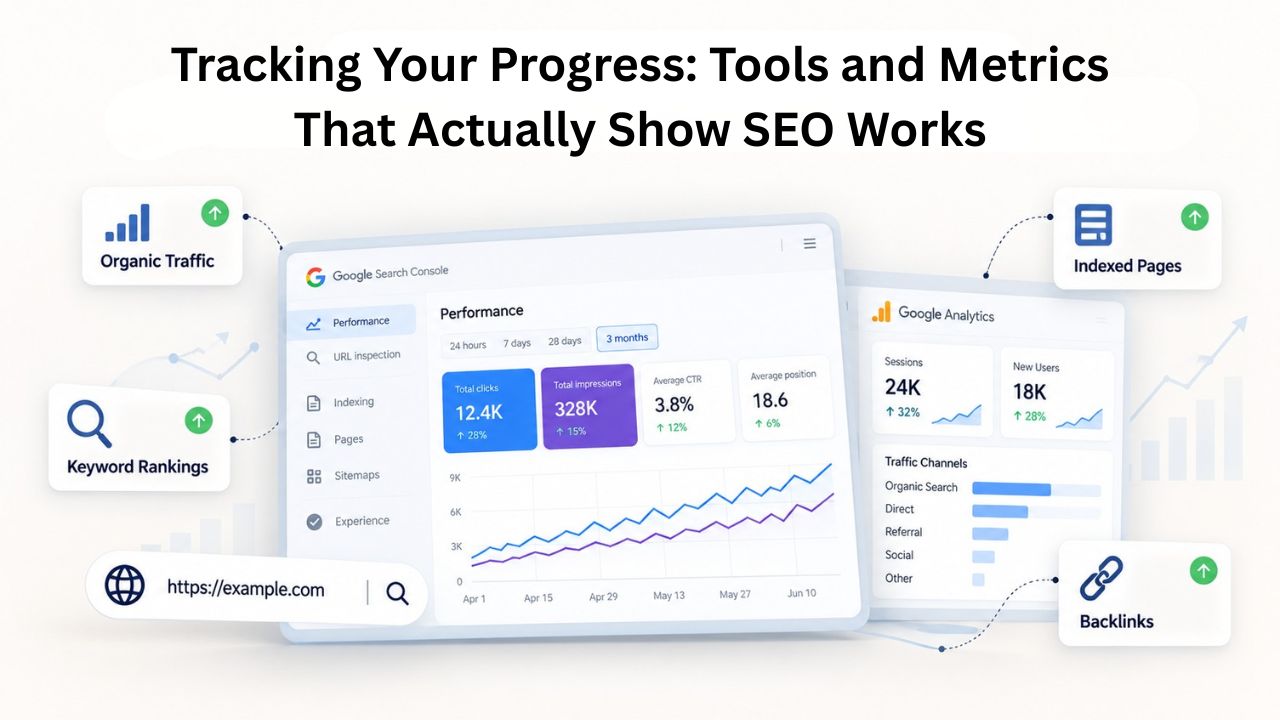
Google Search Console: Your Ground Truth for Rankings
Google Search Console is one of the most actionable free tools available for measuring SEO success, yet most site owners ignore it or only check it when something breaks. Search Console shows your average ranking position, clicks, and impressions for every keyword query that drives traffic to your site, updated with a 2–3 day lag. It’s your direct line to Google’s data about how your site appears in search results.
Use the Performance report to identify pages closest to top-10 rankings (those ranking in positions 11–20 often represent your biggest near-term opportunity) and prioritize optimization efforts on those pages specifically. Track which keywords gained or lost impressions month to month to reveal what’s working and what needs adjustment. Set up monthly Search Console reports to compare trends. A keyword gaining impressions consistently month over month signals genuine progress, even if it hasn’t reached the top 10 yet.
Organic Traffic and Conversions: The Ultimate Business Metric
Monitoring search rankings is important, but bottom-line metrics- organic search traffic via Google Analytics and conversions- are really the most important indicators of SEO progress. A keyword ranking #5 with zero clicks and zero conversions isn’t progress; it’s just a ranking statistic. Traffic and conversions, leads, phone calls, purchases, and form submissions are the metrics that matter to your business.
Set up Google Analytics goals to track conversions from organic search specifically. Compare organic traffic month to month to identify growth trends. Calculate your organic customer acquisition value by dividing total conversions from organic search by your organic traffic volume. This metric ties SEO directly to business outcomes and justifies further investment. A business generating 50 qualified leads monthly from organic search has proven ROI; one generating 50 clicks but zero leads needs to fix landing page conversion, intent alignment, or audience match.
Frequency and Monitoring Rhythm
Building a consistent monitoring routine for ongoing SEO optimization means treating Search Console as a recurring workflow rather than a one-time setup. Check Search Console monthly to track trends and identify opportunities. Don’t obsess over daily ranking fluctuations; rankings naturally vary day to day as Google tests pages. Monthly and quarterly trends matter far more than daily changes. Set calendar reminders to review Search Console on the first of each month, track metrics in a simple spreadsheet, and use these monthly snapshots to guide your next 30 days of optimization efforts.
How to Accelerate Your SEO Timeline (Within Reason)
While SEO timelines cannot be rushed to zero, Google’s evaluation process takes time; smart strategic choices can speed up results significantly without cutting corners or risking penalties.
Build Authority Strategically with Long-Tail Keywords First
Targeting lower-competition long-tail keywords first generates ranking wins that build domain authority, which then compounds to make harder keywords achievable sooner. Prioritize specificity over search volume early. Blogs ranking for 20 long-tail keywords build authority faster than sites chasing one competitive term. Each long-tail ranking signals to Google that your site covers specific topics with expertise.
Long-tail wins also deliver better conversions than broad competitive terms. Users searching “best CRM software for small nonprofits” are far closer to purchasing than users searching just “CRM software.” Early-stage sites should unapologetically focus on specific niches, narrow audience segments, and clearly defined buyer intent. Attempting to compete broadly wastes months of effort. The strategic reframe, from “We want to rank for everything in our industry” to “We want to rank for everything relevant to [specific customer segment]”, changes the entire timeline from unrealistic to achievable.
Fix Technical Issues and Crawlability Before Publishing Aggressively
Prioritize crawlability and indexing first, target lower-competition long-tail keywords early, and fix technical issues before investing in content. A slow site, broken internal links, poor mobile experience, or crawlability problems undermine all content efforts. Audit your site’s technical foundation before committing to a major content production schedule. Fix page speed, ensure mobile optimization, verify that all important pages are indexable, and implement proper internal linking structure.
Once your technical foundation is solid, it stays fixed and doesn’t need repeated work. You can then invest in content with the confidence that Google can crawl, index, and properly evaluate every page. Conversely, publishing 50 articles to a technically broken site wastes that content investment because Google won’t crawl all pages efficiently and users will abandon pages that load slowly or don’t display properly on mobile.
Publish Consistently and Use Content Clusters to Build Topical Authority
Your site’s crawl budget allocation correlates with how frequently you publish new, indexed content. Consistent publishing signals to Google that your site is active and worth re-crawling regularly. A posting schedule (weekly, biweekly, or monthly; consistency matters more than frequency) outperforms sporadic bursts of content followed by months of silence. Google’s crawlers crawl frequently updated sites more aggressively.
Focus on content clusters: multiple articles around a specific topic or keyword theme, linked internally, to connect them. Strong internal linking helps search engines understand relationships between pages, which can accelerate your SEO timeline and improve your entire domain’s ability to rank. For example, instead of one article about “SEO for small businesses,” create a cluster of related articles: “On-page SEO basics,” “Technical SEO checklist,” “How to find keywords,” and “Building backlinks,” all internally linked. This cluster approach signals broader topic expertise to Google and increases the likelihood that multiple cluster articles rank for related keywords.
When to Give Up or Pivot: Recognizing If Your Strategy Isn’t Working
Not every SEO strategy succeeds. Knowing when to adjust course versus abandoning the effort entirely is the difference between eventual success and wasted time.

Benchmarks That Signal Real Progress
After 6 months of consistent, focused SEO effort, you should observe measurable progress: some keywords ranking in the top 20–30; organic traffic growth (even if modest); at least a few long-tail keyword rankings in the top 10; Search Console showing increased impressions. If you observe none of these after 6 months of genuine effort, something is broken. Either your keyword strategy targets unrealistic terms, your content doesn’t match search intent, or technical issues block indexing.
Niya Digital’s team has found that the most common roadblock for DIY practitioners is targeting keywords that are too competitive too early. New sites attempting to rank for high-volume, competitive terms see no movement and assume SEO doesn’t work. In reality, the strategy was misaligned with their domain authority level. Resetting to low-competition long-tail targets often unblocks progress within weeks, proving that the effort was sound but the keyword strategy was wrong.
When to Adjust Strategy Rather Than Abandon It
If rankings plateau after 12 months despite consistent effort, your strategy needs refinement, not abandonment. Audit your backlink strategy: are you building links from genuinely authoritative sites or just accumulating quantity? If traffic grows but conversions don’t, revisit content relevance to your actual customer; you might be ranking for the right keywords but for the wrong audience segment. If you’re publishing regularly but not ranking at all, check technical health and search-intent alignment by reviewing your top-ranking competitors’ content.
Giving up and restarting from scratch costs far more time than pivoting within an active campaign. A 12-month campaign that needs a strategy adjustment has already built domain authority, backlinks, and content; a fresh start loses all of that. Adjust tactics, keyword targets, content themes, and link-building sources before abandoning the approach entirely. The difference between SEO success and failure is often the willingness to iterate rather than quit.
Ready to Start Tracking Your SEO Progress with Confidence
You now understand realistic timelines: 3–6 months for initial traction, 6–12 months for significant results, and 12+ months for competitive keyword maturity. Domain age, keyword competition, and resource investment determine where your site lands within these ranges. Niya Digital provides access to DIY SEO tools and support, helping small businesses track progress systematically and optimize with direction. Start by auditing your site’s current technical state and identifying low-competition long-tail keywords aligned with your niche.
Frequently Asked Questions
Can I see SEO results in one month?
You may see minor keyword movements and early indexing signals within one month, particularly for ultra-specific branded searches. Significant results, top-10 rankings, and meaningful traffic typically take 3–6 months of consistent effort. Many site owners see their first major wins by month four or five. Patience in the early phase, when nothing seems to be happening, is what separates successful campaigns from abandoned ones.
Why is my competitor’s new site ranking faster than my established site?
Competitor sites may target lower-difficulty keywords, have inherited domain authority from prior business history, or invest more resources in backlinks and content. Ranking speed is not determined by domain age alone; it’s determined by keyword strategy and effort intensity. Audit their keyword targets, content library size, and backlink sources to understand the difference.
How often should I check Google Search Console?
Check Google Search Console monthly to track keyword position changes, impression trends, and emerging ranking opportunities. Weekly checks encourage obsessing over normal ranking fluctuations that don’t reflect real progress. Monthly or quarterly reviews provide actionable insight without noise and help you identify patterns worth acting on strategically.
Is it worth hiring an agency if I’ve been doing DIY SEO for six months?
If you’re seeing steady progress, keywords ranking, traffic growing, continue DIY. If progress has stalled or you’re overwhelmed by the workload, professional help can accelerate results. Many businesses start with DIY, then graduate to hybrid or full-agency models as business needs grow and SEO complexity increases.
What’s the biggest SEO mistake that delays results?
Chasing high-competition keywords from the start. New sites targeting “best software” or “enterprise solutions” won’t rank. Starting with specific long-tail keywords like “best software for small nonprofits” builds authority, traffic, and domain strength needed for competitive terms later. The keyword strategy determines the timeline more than any other factor.
Does site speed really affect SEO timeline?
Yes. Slow sites take longer to crawl, Google skips pages due to crawl budget constraints, and ranking potential suffers. Users abandon slow pages, increasing bounce rate and reducing engagement signals. Improving page load time from 5 seconds to under 2 seconds can accelerate ranking progress by weeks or months.
Should I do SEO or run paid ads instead?
Both strategies have a place in sustainable growth. Paid search delivers traffic immediately; SEO takes time but builds long-term, compound value. Paid traffic stops when you stop paying. Organic search traffic persists and grows even when you pause optimization. For sustainable growth, combine short-term paid performance with long-term SEO investment.
Can I rank without backlinks?
New sites can rank for ultra-specific, very-low-competition keywords without backlinks if the content is genuinely high-quality and precisely targeted. For moderate or competitive keywords, backlinks matter significantly as authority signals. Prioritize content quality and internal linking structure first, then pursue backlinks strategically as your site matures.
How do I know if my keyword research is on target?
If you’re ranking in positions 11–20 for a keyword, Google thinks your page is relevant but not the best match. This signals progress; small optimizations can push you into the top 10. If you’re not ranking at all after three months, the keyword may be too competitive, the content may not match search intent, or technical issues may block indexing.
What’s the best way to accelerate SEO if you have limited resources?
Target long-tail keywords with less competition, fix technical issues systematically, publish consistently, and build internal links strategically between related articles. These tactics cost only time and organization, not additional resources. Once you have momentum and visible traffic, you can invest in additional tools or backlink outreach to compound results faster.
How do I measure whether SEO is actually working?
Track organic traffic via Google Analytics and tie it to business outcomes, leads, phone calls, purchases, or form submissions. If organic traffic grows 50% in six months and generates ten qualified leads monthly, that’s measurable ROI. Compare organic customer acquisition cost to your paid channel CAC. This metric justifies continued SEO investment.
Should I hire an in-house SEO person or use an agency?
Agencies bring immediate expertise and resources; in-house hires provide dedicated attention and long-term continuity. New businesses often start with agency partnerships (faster expertise, lower upfront investment) and transition to hybrid models as SEO becomes core to growth. For most small businesses, agencies are more cost-effective than full-time in-house hiring.
Does Google penalize slow SEO progress?
No. Google doesn’t penalize slow progress; it rewards consistent, quality effort over time. Penalties come only from violating guidelines, black-hat tactics, spammy backlinks, and/or thin content. Following best practices helps avoid penalties, though ranking speed varies by competitive landscape.
Can I rank in multiple countries or languages simultaneously?
Yes, but it takes longer than focusing on a single market. International SEO requires language translation, country-specific domains or subfolders, and localized backlinks. Prioritize one country or language first, build authority and traffic there, then expand. Attempting multiple markets simultaneously dilutes effort and delays results everywhere.
Glossary
- Domain Authority: A metric (0–100) that predicts how well a website will rank in search results based on backlink quality, age, and content history. Higher domain authority means faster ranking potential for new content.
- Keyword Difficulty: A score (typically 0–100) indicating how hard it is to rank for a specific keyword. It reflects how competitive the search results page is and how authoritative top-ranking sites are for that term.
- Long-Tail Keyword: A specific search phrase, typically 3–5+ words, with lower search volume but higher intent clarity and easier ranking potential. Example: “best running shoes for flat feet in Canada.”
- Organic Traffic: Website visitors arriving via unpaid search engine results, rather than paid ads, direct navigation, or referral links from other sites.
- SERP: Search Engine Results Page. The list of web pages Google displays after a user enters a search query.
- Backlink: A link from an external website pointing to your site. Backlinks act as “votes of confidence” and are a key ranking factor.