When you register a domain at a heavily discounted rate, it feels like a bargain until renewal arrives and the cost jumps significantly. This price difference isn’t a surprise or an industry secret; it reflects how domain registrars structure their business models. Understanding the true economics behind domain registration, renewal, and the registrar landscape helps you plan accurately and make informed decisions about where and how to register your domains.
How Registrars Use First-Year Pricing for Customer Acquisition
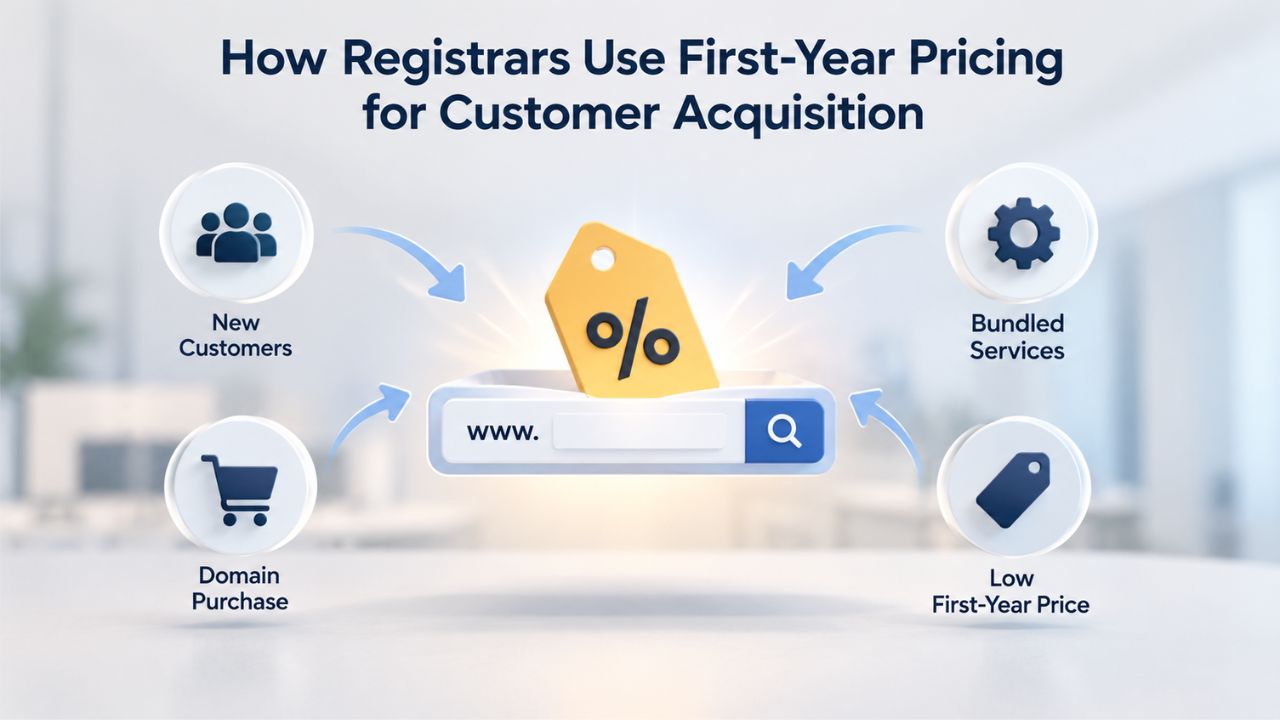
The first-year pricing you see advertised prominently serves a strategic purpose in the registrar business model. Registrars compete almost entirely on first-year rates because domain comparison websites and marketing materials emphasize headline pricing. When shopping for a domain, most people focus on the year-one cost rather than the cost of ownership over a full decade. This creates intense competitive pressure on first-year rates while allowing registrars greater flexibility on renewal pricing.
Why First-Year Offers Attract New Customers
The loss-leader model is straightforward: registrars calculate that a first-year discount is a cheap acquisition cost when compared to the lifetime renewals they’ll eventually capture from retained customers. A registrar offering an exceptionally low first-year rate bets that once you’ve built your online presence with that domain, you’ll renew it at standard market rates rather than abandon it. This business strategy is transparent in ICANN policy documentation and standard across the industry, though many registrants overlook the fine-print renewal pricing disclosures at the point of registration.
For many serious domain registrants, a domain represents a ten-year purchase commitment. A domain is a ten-year purchase for most people who register one seriously. Nine of those ten years are at renewal pricing, not first-year promotional rates. This means that first-year pricing represents just ten percent of your total cost of ownership, while renewal pricing determines ninety percent of your actual investment. Registrars understand this math intimately and price their services accordingly.
Why Renewal Pricing Differs Fundamentally from Year-One
The business logic is straightforward: registrars that spend acquisition budget to attract customers at a first-year loss expect to recoup that investment over subsequent years. If renewal rates were as low as first-year promotional rates, registrars would face financial viability challenges. They would be forced to cut support, reduce infrastructure investment, or exit the market entirely. Renewal pricing funds the customer service infrastructure, technical support, compliance overhead, and business profitability that keep domains secure and globally resolvable.
Transfers don’t solve this problem; a transfer adds a year to your registration under ICANN’s Transfer Policy, typically priced by the new registrar at a promotional rate, but still higher than first-year pricing and closer to renewal rates. Some registrants attempt to circumvent renewal costs by transferring their domains annually to capture promotional transfer rates at new registrars. Still, this strategy has both technical and practical limits that prevent indefinite cost avoidance.

Domain Name Registration
Each and every domain name comes with all you need to get online.
- Domain Forwarding and Masking: Direct any domain name you own to your website. Anyone who types that domain name into their browser is taken directly to your website.
- Domain Locking: Domain locking prevents accidental or intentional transfers of domain ownership and stops anyone from redirecting your nameservers.
- Total DNS Control: Manage your domain nameserver (DNS) records and set your email, FTP, sub-domains and website location all from one control panel.
- Change of Registration: Assign your domain name to someone else or change the contacts for your domain online anytime.
- Status Alerts: Monitor the status of your domain and get instant alerts if there's been a change.
- Auto Renew Protection: No need to watch expiration dates to make sure you renew on time! Auto renew keeps your domains, hosting, website builders, and other products in your name and under your control.
Domain Disclaimers:
- Special savings apply only to first year of registration. You must purchase entire section to qualify for special savings.
- The final price may differ because of additional sales, fees, and promotions.
- Products will automatically renew until cancelled. You may turn off the auto-renewal feature by visiting your account.
- Change of registration may require a fee for certain domains.
The Three-Layer Cost Structure Behind Every Domain
To understand where your domain payment actually goes, look at the full cost structure. When you pay for domain registration or renewal, that payment flows to three distinct layers: the registry operator that manages the TLD infrastructure, ICANN, which provides oversight and coordination, and the registrar, which serves as your customer-facing interface. Each layer performs essential functions that justify its portion of the total cost.
What the Registry Fee Actually Covers
A domain registry operates the authoritative database for a top-level domain, keeping the DNS records globally reachable and the registrant data secure and accessible. The registry operator manages the TLD’s central infrastructure, maintaining the systems that make every registered domain in that extension resolvable worldwide. The majority of your domain payment goes to the registry, which charges a wholesale fee for each registration and renewal. This fee structure ensures that registry costs are distributed fairly across all registrars and remains consistent regardless of where you register your domain.
Even if a registrar wanted to offer free domains permanently, registry fees alone make that impossible. These fees fund ongoing infrastructure that must continue operating for the lifetime of each active domain registration; server maintenance, security updates, redundancy systems, and data resilience are not optional features but essential components of a functioning domain system.
Each TLD’s registry operator sets registry fees and passes them to all ICANN-accredited registrars uniformly. ICANN policy requires that registry operators charge uniform renewal pricing; the price for each domain registration renewal must be identical to the price of all other domain name registration renewals in place at the time of renewal. This uniformity requirement prevents registries from charging different renewal rates to different registrars or from making arbitrary mid-year price changes.
How ICANN Fees and Registrar Margin Complete the Price
ICANN charges a per-transaction administrative fee for each domain registration, renewal, and transfer. While smaller than the registry fee component, it applies uniformly across all registrars and TLDs, ensuring fairness in oversight costs. On top of the registry fee and ICANN administrative fee, each registrar adds its own margin and operating costs. This registrar-level component is where pricing competition exists and where different registrars can offer varying rate structures.
The registrar margin covers essential business costs including customer support infrastructure, payment processing systems, account management technology, staff salaries, and compliance operations. The lowest first-year rates reflect a compressed or eliminated registrar margin, while renewal pricing reflects a margin that recovers the registrar’s customer acquisition cost and generates sustainable profit. This cost recovery mechanism is not hidden from customers; ICANN registry agreements require that if renewal pricing differs from the standard rate, registrars must provide clear and conspicuous disclosure to registrants at the time of registration. This disclosure obligation ensures customers can access renewal information when they make their purchasing decision.
Why Renewal Pricing Is Always Higher Than Year One
The renewal-versus-first-year pricing gap reflects the true economics of domain ownership and infrastructure maintenance. Renewal pricing captures the full cost of registry infrastructure, ICANN oversight, registrar service delivery, and registrar profitability. First-year pricing, by contrast, is heavily subsidized by registrars’ customer-acquisition budgets and does not reflect the actual cost of providing and maintaining domain services.
The Economics of Registrar Acquisition
Registrars invest significantly in customer acquisition because they view the domain business as a long-term customer relationship rather than a single transaction. From a business perspective, a registrar spending money to acquire a customer at a first-year loss expects to make that money back over the domain’s lifetime through renewal fees. This model works only if enough customers renew at sustainable rates; if too many abandon domains at renewal or immediately transfer to cheaper competitors, the acquisition economics collapse.
Different registrars employ different business strategies to capture market share. Some registrars compete aggressively on first-year pricing while maintaining standard renewal rates, betting that customer inertia and switching costs will keep you as a renewal customer. Other registrars use more moderate first-year rates paired with competitive renewal pricing, targeting customers who are willing to pay more upfront for long-term value. Still other registrars compete primarily on service quality, support responsiveness, and feature bundles rather than pure price competition on year-one rates. The “best” registrar depends on your individual priorities and what you value most in a domain provider.
The Math of Long-Term Domain Ownership
A domain is a ten-year purchase for most people who register one seriously, and nine of those ten years are at renewal pricing. When comparing registrars, evaluating them primarily on renewal rates rather than first-year rates produces dramatically different conclusions than headline price comparisons. If Registrar A offers an extremely low first-year rate but has standard renewal rates, and Registrar B offers moderate first-year rates with competitive renewal rates, the comparison looks very different when you calculate total cost of ownership over multiple years rather than focusing on year-one costs.
This is why smart domain buyers evaluate registrars on renewal rates, not first-year rates, and why registrars compete almost entirely on first-year price because that’s the number comparison sites rank. Still, the first-year price tells you almost nothing about what a domain costs you. The practical implication is that you should spend most of your due diligence effort investigating renewal rates, support quality, and feature bundling rather than optimizing for the absolute lowest first-year cost. Many registrants regret choosing a registrar based primarily on year-one pricing once they encounter high renewal costs or poor customer support during their first renewal cycle.
ICANN’s Transparency Rules Keep Registrar Pricing in Check
ICANN’s registry agreements include built-in safeguards designed to ensure registrars disclose renewal pricing accurately and prevent registrants from experiencing hidden fees or surprise billing. These transparency rules are global and apply uniformly to every ICANN-accredited registrar and every TLD extension. Understanding ICANN requirements helps you know where to find renewal pricing information and what rights you have as a customer.
What Registrars Must Disclose About Renewal Prices
ICANN policy requires that if a registrar offers renewal pricing different from the standard registrar renewal price, the registrar must provide documentation showing that the registrant expressly agreed to higher renewal pricing at the time of initial registration, with clear and conspicuous disclosure. This requirement means that registrars cannot unilaterally change your renewal rate after you’ve registered your domain; any renewal rate that differs from what was standard must have been disclosed to you at registration time and explicitly agreed to by you. In practice, registrars fulfill this requirement by including renewal rate information in their terms of service, checkout flow, or confirmation emails.
In practice, renewal price disclosures often appear in fine-print terms-and-conditions text or collapsible sections on checkout pages, and many registrants overlook or skip this information during registration. Both registrars and customers share responsibility for reviewing and retaining renewal pricing information. Registrars must provide clear disclosure; customers must review that information and make purchasing decisions accordingly. Niya Digital’s team has found through operational experience that customers who deliberately note and save their renewal-price disclosure at registration time are significantly more likely to budget accurately for future renewals and avoid renewal-related surprises or frustration.
How Registries and Registrars Coordinate on Price Increases
Registry operators must provide each ICANN-accredited registrar with advance notice of any renewal pricing increases, typically 30 calendar days in advance for price increases above certain thresholds. This requirement prevents registries from quietly raising fees without warning. It gives registrars time to adjust their own pricing strategies and communicate changes to customers. However, registrars are not required to proactively notify end customers of renewal price changes as uniformly, creating potential transparency differences between registrars.
Responsible registrars send renewal-rate change notices well before your renewal date, often months in advance. Less attentive registrars may only notify you through an invoice or automated reminder email that arrives closer to your renewal date. When selecting a registrar, look for one that shows proactive communication, such as sending renewal reminders months in advance and providing price-change notices well before your domain expires; this signals a registrar that prioritizes customer experience and transparency over purely transactional interactions.
How Domain Transfers Work, And Why They Don’t Solve High Renewals
Some registrants try to avoid renewal costs by transferring domains between registrars to repeatedly capture promotional transfer rates. This strategy has both technical and practical limits, and understanding how ICANN’s transfer policy works reveals why transfer rates function as a one-time reset rather than a permanent escape hatch from renewal costs.
The Transfer-Add-Year Mechanism
Under ICANN’s Transfer Policy, when sponsorship of a domain registration moves from one registrar to another, the term is extended by one year, typically priced by the new registrar at a promotional rate rather than their full renewal rate. This means that a well-timed transfer before your renewal date can extend your registration term and offer you a promotional rate for that added year. However, this mechanism includes a hard limit: the added year can’t push total registration beyond ten years, so this doesn’t work indefinitely on a heavily prepaid domain.
ICANN’s ten-year maximum registration term is a fundamental constraint built into the domain system. Once you’ve registered a domain for its full ten-year maximum term, you cannot extend it further until that term expires, regardless of how many transfers you execute. This rule prevents indefinite pre-payment strategies and forces registrants back into the renewal market every decade. Understanding this limit helps explain why transfer-based strategies cannot provide permanent cost avoidance.
The Economics of Transfer-Chasing
If you transfer your domain every year at renewal to capture promotional transfer rates, you’ll eventually encounter registrars that no longer offer them, or that charge identical rates for transfers and renewals. Many registrars have learned that repeat transfers signal price-chasing behavior and have adjusted their transfer pricing strategies to reduce arbitrage opportunities.
Beyond pricing, frequent transfers create real operational friction and risk. Each transfer requires administrative coordination, DNS configuration management, and account transitions across registrars. Mishandling the transfer process can cause DNS downtime. You’ll need to manage account access and billing information across multiple registrars. A transfer adds a year to your registration, so moving your domain at renewal time genuinely resets your cost, but only if the receiving registrar’s transfer rate is lower than your current registrar’s renewal rate. Comparing renewal rates across registrars before your domain expires is a simpler, lower-risk strategy than trying to optimize costs through annual transfers.
Ready to Register Domains with Transparent Renewal Pricing?
Niya Digital partners with an ICANN-accredited registrar to offer comprehensive domain registration services with transparent renewal pricing displayed upfront and proactive customer notifications. Build your multi-year domain strategy with clear costs and complete visibility, backed by registrar compliance and customer-focused support.
When and Why Registry Fees Increase
Registry fees are not static across time. Over years and decades, registries occasionally raise fees for ICANN-accredited registrars, and these increases pass through to end-customer renewal rates. ICANN policy requires advance notice of fee increases and limits how frequently and how much registries can raise fees, but increases do occur. Understanding when and why registry fees increase helps you make sense of renewal rate changes and plan for long-term domain costs.
Understanding Registry Fee Structures
Registry fee increases are typically rare events. Most ICANN-regulated registries raise fees once every few years, if at all, rather than implementing annual adjustments. When registries do increase fees, the increases typically range from moderate percentages. However, some TLDs have negotiated different caps or no caps with ICANN. Registry Operators must provide non-discriminatory advance notice of any price increase for domain name registrations, and shall continue to offer domain name registrations for periods of up to ten years.
Some legacy TLDs like .com and .net have negotiated price-cap agreements with ICANN that limit the annual percentage increase in registry fees. Newer gTLDs often have no price caps, meaning registries can raise fees at renewal time without upper-limit constraints. This difference in contract structures helps explain why renewal rates for newer TLDs sometimes fluctuate more than legacy TLD renewal rates over time.
How Registrar Cost Changes Affect Your Renewal Price
When a registry raises its fee to registrars, registrars must choose how to respond. They can absorb the cost by compressing their margin, or pass it through to renewal pricing. Most registrars pass at least a portion of registry fee increases to renewal rates, especially for bulk registrations where margins are already thin. Additionally, registrars’ own operating costs, payment processing fees, infrastructure upgrades, support team scaling, and compliance systems can rise independently of registry fees, prompting registrar-level renewal rate increases.
As a result, renewal rates can increase year to year as business costs and registry fees change over time. ICANN requires registries to give registrars advance notice of increases, but registrars’ obligations to notify end customers are softer and less uniformly enforced. This creates transparency gaps: some registrars proactively communicate renewal rate changes, while others notify you only when your renewal invoice is due. Choosing a registrar with a track record of proactive customer communication helps mitigate these transparency variations.
Choosing a Registrar Based on Long-Term Cost, Not Year-One Price
When selecting where to register a domain, focusing exclusively on first-year cost is a costly strategic mistake. A better approach is to compare total cost of ownership over three to five years, paying close attention to renewal rates and feature bundling, then choose the registrar whose overall value proposition best aligns with your budget and requirements.
Building a Comparison Table with Renewal Rates
| Factor | Importance for Long-Term Owners | How to Evaluate |
|---|---|---|
| First-Year Rate | Lower priority | Note it, but do not let it drive your decision alone |
| Renewal Rate | Highest priority | This determines what you’ll pay for 9 out of 10 years |
| Transfer Rate | Medium priority | Useful if you plan to move the domain later |
| Included Features | Medium priority | WHOIS privacy, SSL certificates, DNS management, check what’s bundled vs. à la carte |
| Support Availability | Medium priority | Email, live chat, phone support; verify match to your preferences |
| Rate Lock or Guarantee | Lower priority | Some registrars lock renewal rates; others do not |
| Payment Methods | Low priority | But affects total cost if you require specific payment options |
Different registrars have dramatically different renewal-rate strategies. A registrar that competes aggressively on first-year pricing may have standard renewal rates, while one that competes on long-term value may have moderate first-year rates paired with competitive renewal rates. The registrar with the lowest renewal rate for a given TLD, even if their first-year rate is higher, will save you money over the domain’s lifetime. Before registering, compare the renewal rate (not the first-year rate) across at least three registrars and verify that quotes are accurate and come from ICANN-accredited providers.
Why Renewal Rate Comparison Matters
When comparing registrars, request or look up the renewal rate upfront. If a registrar doesn’t advertise renewal pricing prominently on its website, contact its support team and ask directly; reluctance to share renewal pricing is a yellow flag that suggests a lack of confidence in its rates or a lack of concern for customer transparency. Transparency about renewal rates signals confidence in pricing and a registrar’s respect for your budgeting needs.
Domain price-comparison sites often list renewal rates alongside first-year rates, making it relatively easy to compare across registrars in one view. Most registrars display renewal pricing on their product pages, usually next to the first-year rate or in a collapsible details section. Some registrars hide renewal pricing behind account-creation requirements or a “view full pricing” button; this is a minor red flag, since transparent registrars typically lead with renewal rates rather than burying them. Researching renewal rates before you register is one of the most valuable investments you can make in long-term domain cost management.
Avoiding Renewal-Price Surprises: A Practical Guide
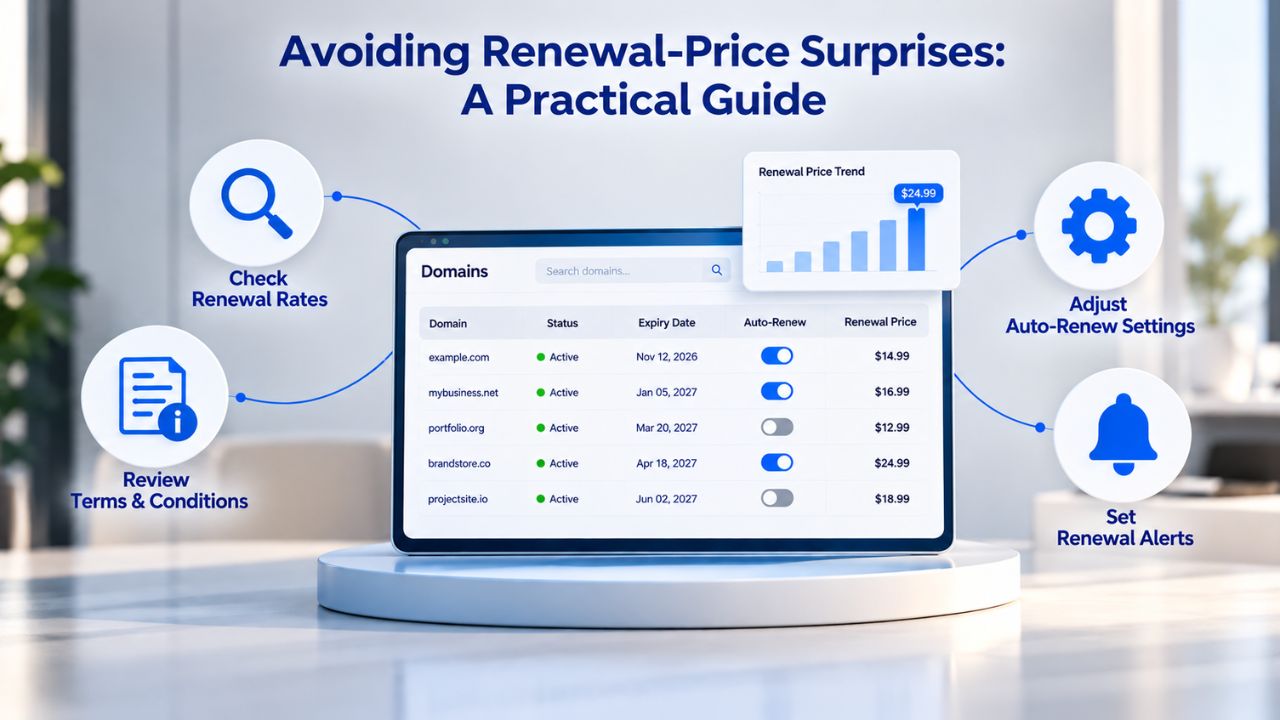
Renewal-price surprises happen when registrants overlook or forget the renewal-price disclosure at registration, fail to set renewal reminders, or assume renewal rates will remain constant or similar to initial rates. You can avoid all three failure modes with a few proactive steps at registration and throughout your domain’s lifecycle.
Where to Find Renewal Pricing Before You Register
Most registrars display renewal pricing prominently on their product pages, usually next to the first-year rate or in a clearly labeled collapsible details section. Some registrars hide renewal pricing behind account creation or a “view full pricing” button, which is a minor red flag suggesting they’re not prioritizing renewal-price transparency. Domain price-comparison websites typically list renewal rates alongside first-year rates for major registrars, making comparative shopping relatively straightforward. When you register a domain, take time to save or screenshot the renewal-price disclosure document alongside your order confirmation email.
Note your domain’s renewal date on your personal calendar and set multiple reminders: 90 days before expiration, 60 days before, and 30 days before. While most registrars send renewal reminders via email, these messages sometimes land in spam folders or get overlooked during busy periods. A personal calendar reminder ensures you have sufficient time to shop for better renewal rates at other registrars, negotiate with your current registrar, or simply budget for the renewal cost before your domain expires. This planning eliminates last-minute renewal pressure and panic.
Managing Renewals Across Multiple Registrars
If you own domains across multiple registrars or multiple TLDs, renewal management becomes operationally complex. Different registrars have different renewal dates, renewal rates, notification practices, and support responsiveness. Consolidating your domains with a single registrar or reseller, whenever possible, simplifies renewal management and reduces the risk of accidental expiration.
Maintain a spreadsheet or simple database of all your domain registrations, including the domain name, registrar, renewal date, renewal rate if known, registrar support contact information, and account login credentials or recovery information. Update this record annually and use it to plan your annual renewal budget comprehensively. Most registrars offer automatic renewal options that renew and bill your account on time, preventing accidental expiration due to overlooked renewal dates. However, review the terms carefully to understand exactly when charges occur and whether you can opt out of automatic renewal or request advance notice before charges are applied.
Budgeting for Multi-Year Domain Costs: A Three-Year Example
To understand how first-year pricing blindness derails budgets, examine concrete scenarios. Consider two hypothetical registrars offering the same TLD with different pricing strategies: Registrar A uses an extremely aggressive first-year rate to attract customers, while Registrar B uses more moderate first-year rates paired with competitive renewal pricing.
The Cost Breakdown Over Years 1–10
At first glance, Registrar A appears significantly cheaper based on its year-one offering. However, total cost across multiple years tells a different story. Over three years of ownership, Registrar A and Registrar B end up costing very similarly despite the massive first-year price difference. Over the full ten-year potential registration term, the registrar with moderate first-year rates but lower renewal rates actually saves money overall. This table illustrates why renewal rate matters far more than first-year rate.
| Year | Registrar A Annual Cost | Registrar B Annual Cost | Registrar A Cumulative Total | Registrar B Cumulative Total |
|---|---|---|---|---|
| Year 1 | Low rate | Moderate rate | Low rate | Moderate rate |
| Year 2 | Standard renewal | Competitive renewal | Cumulative through Year 2 | Cumulative through Year 2 |
| Year 3 | Standard renewal | Competitive renewal | Cumulative through Year 3 | Cumulative through Year 3 |
| Year 4 | Standard renewal | Competitive renewal | Cumulative through Year 4 | Cumulative through Year 4 |
| Year 5 | Standard renewal | Competitive renewal | Cumulative through Year 5 | Cumulative through Year 5 |
| Year 6 | Standard renewal | Competitive renewal | Cumulative through Year 6 | Cumulative through Year 6 |
| Year 7 | Standard renewal | Competitive renewal | Cumulative through Year 7 | Cumulative through Year 7 |
| Year 8 | Standard renewal | Competitive renewal | Cumulative through Year 8 | Cumulative through Year 8 |
| Year 9 | Standard renewal | Competitive renewal | Cumulative through Year 9 | Cumulative through Year 9 |
| Year 10 | Standard renewal | Competitive renewal | 10-year total | 10-year total |
Planning for Multiple Domains and Renewal Batching
If you register multiple domains, consolidating renewal dates can significantly simplify budgeting and reduce renewal-management overhead. Many registrars let you renew domains for multiple years upfront, locking in your renewal rate for that period. This locks in your total cost in advance and protects you against future renewal-rate increases from either the registry or the registrar. If renewal rates are expected to increase, multi-year upfront renewal can provide value; if rates are stable or declining, you’d pay more upfront than necessary.
Establish a yearly budget for domain renewals by adding up all your renewal dates and rates for the coming twelve months. If most renewals cluster in a single month, consider spacing them out over the year with multi-year renewal strategies or by transferring domains to better align renewal dates. This spreads costs evenly across the year and prevents the sudden cash outlay of multiple simultaneous renewals. Services like domain registration platforms can help automate renewals and send reminders well in advance to prevent accidental expiration.
Understanding Registrar Renewal Policy and ICANN Compliance
Renewal policy transparency is a significant competitive advantage in the registrar industry. Registrars that publish renewal rates prominently on their websites, notify customers well before renewal dates, and consistently honor their published rates earn strong customer trust and loyalty. Conversely, registrars that bury renewal pricing in fine print or pressure customers to renew at rates higher than originally advertised create customer frustration and lose business to competitors.
How to Verify a Registrar’s Compliance with ICANN Policy
An ICANN-accredited registrar must comply with uniform renewal pricing rules and cannot charge different renewal rates to different customers for the same TLD, except in rare circumstances involving documented pre-registration disclosures. You can verify a registrar’s accreditation status by checking ICANN’s Accredited Registrar Directory, which lists all currently authorized registrars and their accreditation status. If a registrar claims ICANN accreditation but does not appear in the directory, they may be a reseller operating under another registrar’s accreditation license.
Resellers like Niya Digital operate under an ICANN-accredited registrar’s license and must comply with the same renewal-pricing rules and transparency requirements. However, the underlying registrar partner handles the technical compliance infrastructure. When choosing a registrar or reseller for your domain registration needs, confirming accreditation or valid reseller status is a quick way to verify they’re legally authorized to offer domain registration services and subject to ICANN’s governance and rules.
What to Do If a Registrar Violates Renewal Pricing Policy
If a registrar charges you a renewal rate that differs significantly from their published rate or from the specific renewal rate disclosed to you at registration time, contact their support team and request clarification and documentation. If they cannot resolve the discrepancy to your satisfaction, file a formal complaint with ICANN or with the relevant government consumer-protection authority in your jurisdiction. ICANN takes pricing-policy violations seriously, and registrars have strong incentives to resolve disputes quickly before they escalate to formal complaints and regulatory attention.
For domain registration and hosting services, selecting a registrar or reseller with a strong track record of transparency and customer advocacy reduces your risk of surprise renewal costs and ensures you’re working with a compliant, customer-focused provider. Domain registries operate the authoritative database for a TLD, so choosing your registrar carefully matters; poor registrar support or a surprise price increase at renewal can put your online presence at risk. Taking time to evaluate registrars based on transparency, support quality, and renewal-rate competitiveness is a worthwhile investment.
Continue Building Your Domain Strategy with Niya Digital
Long-term domain ownership requires deep understanding of renewal rates, proactive comparison of registrar options based on total cost of ownership, and careful planning of your annual renewal budget. Niya Digital’s partnership with an ICANN-accredited registrar ensures transparent renewal pricing, proactive support and reminders before expiration, and complete compliance with global ICANN domain-management standards and transparency requirements.
Frequently Asked Questions
Why is domain renewal always more expensive than the first year?
Registrars use first-year discounts strategically to attract customers at an acquisition loss, expecting to recover that cost through renewal pricing over the domain’s ten-year lifecycle. The renewal rate reflects the true cost of maintaining registry infrastructure, funding ICANN oversight, providing registrar customer service, and generating sustainable business profitability. First-year promotional pricing is an acquisition strategy designed to grow your customer base, not a reflection of the actual cost of providing domain services. This business model is foundational to how the registrar industry operates globally and has remained consistent for decades.
Can I lock in my renewal rate for multiple years?
Yes, many registrars let you renew your domain for multiple years upfront, locking in your current renewal rate for that period. This strategy protects you against future renewal-rate increases, but only for the years you’ve prepaid. Once those prepaid years expire, renewal pricing may have increased. Multi-year renewal is most valuable if current rates are high or expected to rise, but provides no advantage if rates are stable or declining. Always read the renewal terms carefully before committing to multi-year prepayment to ensure you understand the renewal rate that will apply after your prepaid period expires.
What’s the difference between registry fees and registrar fees?
Registry fees are the wholesale costs set by each TLD’s registry operator and passed uniformly to all ICANN-accredited registrars for each domain registration and renewal. Registry fees are unavoidable and identical across all registrars for the same TLD. Registrar fees, by contrast, are the markup registrars add on top of registry and ICANN fees to cover operating costs, customer support, infrastructure, and profit margin. Registry fees are standardized; registrar fees vary significantly by registrar based on their business model, service quality, and competitive positioning. This distinction explains why the same TLD costs different amounts at different registrars.
If I transfer my domain to a new registrar, does the renewal price reset?
Transferring your domain adds one year to your registration term, typically priced at a promotional transfer rate by the receiving registrar. This transfer rate is usually lower than the current registrar’s standard renewal rate but higher than typical first-year promotional rates. Transfer rates can represent a one-time cost advantage, but comparing renewal rates across registrars is a more reliable long-term strategy than attempting to optimize costs through annual transfers. Frequent transfers add operational complexity and DNS risk, so finding a registrar with genuinely competitive renewal rates is a more practical approach.
Do all ICANN-accredited registrars charge the same renewal price?
No. While ICANN policy requires registry operators to charge uniform renewal rates to all registrars, individual registrars can set different markup percentages and margins on top of those wholesale registry fees. This means renewal rates for the same TLD can vary substantially across different registrars based on their business model, included services, support quality, and competitive positioning. Shopping around among multiple registrars to compare renewal rates is always worthwhile, as even modest differences compound significantly over a decade of domain ownership.
Why do some registrars’ renewal prices jump at renewal time?
Renewal price increases can come from several sources: the registry raising its wholesale fees and the registrar passing that increase on to customers, changes in the registrar’s operating costs, or the end of a promotional renewal period. Registrars must disclose renewal rates at the time of registration; if your renewal rate is substantially higher than disclosed, contact support for clarification. If a legitimate price increase from the registry is the cause, ICANN policy requires the registry to have notified the registrar in advance, which should allow the registrar to communicate the change to affected customers.
How can I find a registrar’s renewal price before I register?
Most registrars display renewal rates on their product pages, often in a collapsible “See full pricing” or “Renewal rates” section. Domain price-comparison websites typically list renewal rates alongside first-year rates for major registrars, making comparison shopping easier. Before registering, compare renewal rates across at least three registrars to understand the market range. Look for registrars that display renewal pricing prominently and transparently rather than hiding it behind account creation or multiple clicks.
What should I do if my registrar increases my renewal price without notice?
Check your original registration agreement and any renewal notices you’ve received. ICANN policy requires registries to provide registrars with advance notice of price increases, but registrars’ obligations to notify end customers vary in consistency. If you received no advance notice of a renewal increase, contact your registrar’s support team and request a written explanation. If the price increase violates your original renewal-price disclosure, file a complaint with ICANN or your local consumer-protection authority.
Is it cheaper to let a domain expire and re-register it at a promotional first-year rate?
No, this strategy is generally more expensive and risky than simply renewing before expiration. Letting a domain expire risks losing it entirely; while registries typically hold expired domains in a grace period during which you can reclaim them, this period is short and may involve additional recovery fees. Re-registering an expired domain often costs more than renewing it before expiration. Additionally, domain expiration interrupts DNS service, disrupts email delivery, and can cause you to lose search engine rankings and customer trust. Renewing before expiration is safer and almost always cheaper than letting it expire and re-registering.
How do I prevent domain renewal surprises?
Save your renewal-price disclosure at registration and store it with your domain registration confirmation. Set calendar reminders for 90, 60, and 30 days before your renewal date to give yourself ample time to evaluate options. Compare renewal rates at competing registrars before your renewal date arrives. Many registrars offer multi-year renewal, which locks in current rates and can simplify budgeting if rates are stable or expected to increase. Proactive planning and calendar reminders eliminate renewal surprises.
Can I negotiate a lower renewal rate with my registrar?
In some cases, particularly if you’re a long-term customer managing multiple domains, you can contact your registrar’s support team and request a loyalty discount or rate match. Most registrars will not negotiate significantly below their advertised renewal rates, but the conversation is worth having. If your current registrar declines to negotiate, transferring to a competitor with lower renewal rates is your most effective option. Registrars compete on renewal pricing as much as they do on first-year pricing, and you can shop around at renewal time.
Why do some registrars charge extra for WHOIS privacy at renewal?
Some registrars include WHOIS privacy protection for free during the first year but charge a separate renewal fee for it in subsequent years, creating a hidden cost that surprises customers at renewal time. Transparent registrars either include privacy protection for free at renewal or clearly disclose the separate privacy renewal fee upfront at registration. When comparing registrars, confirm exactly which privacy features are included at no charge at renewal and which require additional fees. This clarity prevents renewal-time surprises.
What is a “qualified marketing program” in ICANN renewal pricing?
ICANN policy allows registries to offer discounted renewal rates through “qualified marketing programs,” temporary promotional discounts that are available to all registrars equally. These programs are rare and typically short-term, lasting a few months rather than years. If you see a renewal discount advertised as part of a qualified marketing program, understand it’s likely a limited-time offer, not a permanent renewal rate. Don’t rely on these temporary programs for long-term budgeting.
How do ICANN fees affect my domain renewal cost?
ICANN charges a small per-transaction administrative fee for each domain registration, renewal, and transfer. This fee is identical regardless of which registrar you use or which TLD you’re registering. While ICANN’s fee is a relatively small component of your total renewal cost, it’s unavoidable and applies uniformly across the entire system. The bulk of the renewal cost goes to the registry operator and the registrar’s margin; ICANN’s per-transaction fee is one of three component layers that make up your total renewal cost.
Should I use a domain reseller or go directly to an ICANN-accredited registrar?
Both options are legitimate and have valid use cases. Resellers operate under an ICANN-accredited registrar’s license and must comply with the same renewal-pricing and transparency rules that apply to direct registrars. Resellers often bundle services like domain registration with hosting, email, and website building, which can simplify management for small businesses. Direct registrars typically offer a more specialized focus on domain management. The key evaluation criterion is whether your provider (registrar or reseller) is ICANN-compliant and transparent about renewal rates. Neither option is inherently superior; it depends on your specific needs and preferences.
Glossary
- Loss Leader: A product or service offered at a low rate or at a loss to attract new customers, with the expectation of recouping the cost through higher-margin future transactions or long-term customer relationships. In domain registration, the heavily discounted first-year rate serves as a loss leader to acquire customers.
- Registry Fee: The wholesale fee charged by a TLD’s registry operator to each ICANN-accredited registrar for each domain registration and renewal. Registry fees are uniform across all registrars for a given TLD and form the base cost component of every renewal rate.
- Renewal Pricing: The rate charged by a registrar for extending a domain’s registration term by one additional year. ICANN policy requires that renewal pricing be uniform across all customers of a registrar for the same TLD, with limited exceptions for pre-disclosed discounts or qualified marketing programs.
- ICANN Fee: The small per-transaction administrative fee charged by ICANN to all registrars for each domain registration, renewal, and transfer. This fee is standardized across all TLDs and registrars and funds ICANN’s oversight and coordination functions.
- Registrar Margin: The profit or markup that a registrar (or reseller) adds on top of registry and ICANN fees to cover its operating costs, customer support, infrastructure, and business profitability. Registrar margins vary across different registrars and represent where pricing competition occurs in the domain market.
- Transfer Rate: The fee charged by a registrar to accept a domain transfer from another registrar. Under ICANN policy, transfers extend a domain’s registration by one year. Transfer rates are typically promotional and lower than standard renewal rates for the receiving registrar but higher than typical first-year rates.