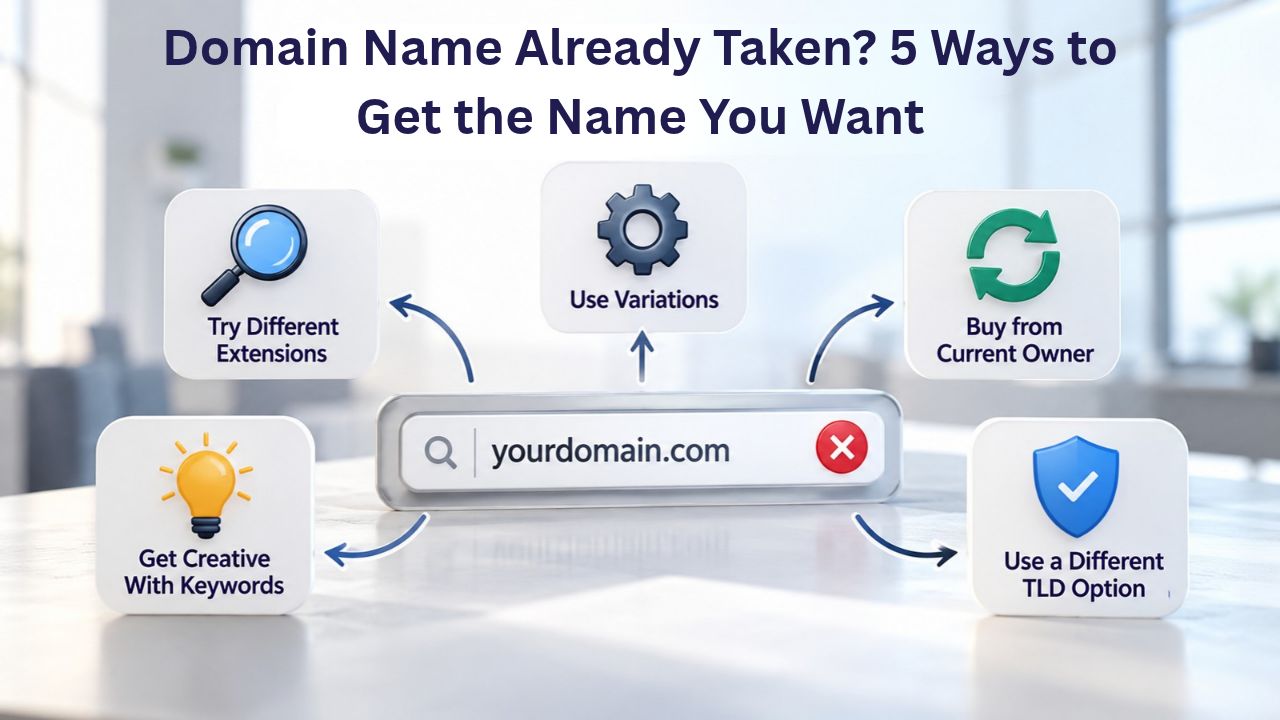
When your ideal domain is registered by someone else, the path forward isn’t blocked; it’s different. Over 157 million .com and .net domains are actively registered, with countless others across alternative extensions. This scarcity means most memorable names are already claimed. Whether your preferred domain expired, is held by an investor, or belongs to an active owner, five proven acquisition strategies exist to help you move forward. Niya Digital is a reseller partnered with an ICANN-accredited registrar to guide you through each pathway, from monitoring expiring domains to facilitating premium acquisitions.
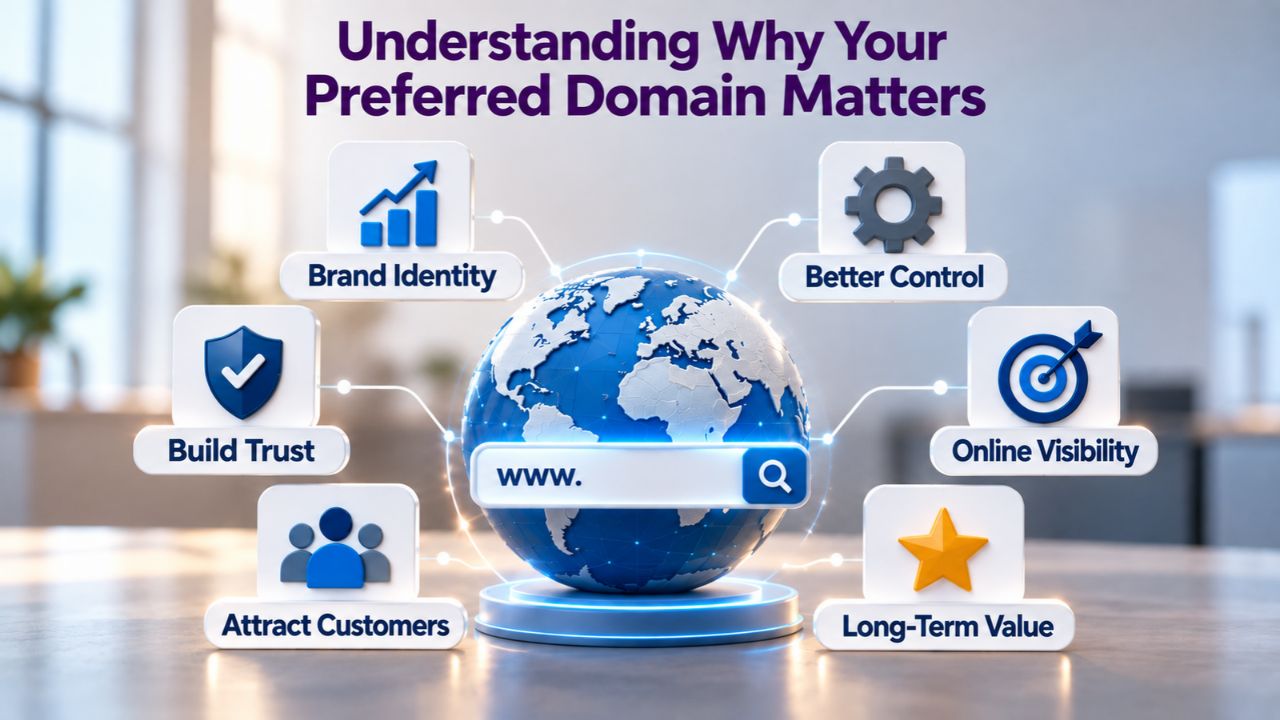
Understanding Why Your Preferred Domain Matters
Securing a specific domain name is foundational to building brand recognition and online authority. When your first choice is unavailable, understanding why shapes your strategic options. Domain availability varies by extension, ownership status, and market demand, and the pathways to acquire taken names differ significantly in complexity, timeline, and likelihood of success. This section explores the landscape of domain scarcity and why desirable names command such attention in today’s market.
Domain Availability and Market Realities
Over 628.5 million domain names are registered globally, yet only about 10% are actively in use beyond simple parking or forwarding. This statistic reflects a market landscape where many desirable names are held for brand protection, investment speculation, or legacy reasons rather than active operation. The .com extension dominates with 233.6 million registrations, representing 37% of all domains worldwide. This concentration creates intense competition for short, memorable names that communicate instantly. Even among newer generic top-level domains (gTLDs) such as .io, .co, and .online, premium names remain scarce because of prior registration and competitive demand.
Your desired domain may be taken for several distinct reasons. An active owner may be using it for an established business or service. An investor or domain speculator may be holding it for future resale, betting on increased business demand or keyword value. An expired registration may linger in the recovery window, awaiting restoration by its original owner. Or a previous registrant may have secured it years ago and renewed it annually without ever considering sale. Each scenario opens different acquisition pathways. Identifying which situation applies to your target domain helps you choose the most realistic, cost-effective strategy.
Why Desirable Domains Command Attention
Short, memorable domain names with high commercial appeal are fundamentally finite. The domain aftermarket processes thousands of transactions annually, reflecting how businesses and individuals actively invest in premium digital real estate to strengthen their online presence and brand positioning. The domain aftermarket facilitates 144,700+ annual sales totaling approximately $185 million USD, demonstrating robust demand for valuable names.
Names tied to high-value keywords, recognizable brand concepts, or strong phonetic qualities attract multiple buyers simultaneously, driving competition and sustained interest. This market dynamic means names held by active owners rarely become available, while speculative holdings may eventually be released or sold. Understanding this competitive landscape clarifies why some taken names are realistically acquirable through one method or another, while others require deep pockets or extraordinary patience.
Domain Lifecycle and Strategic Acquisition Windows
| Lifecycle Phase | Duration | Owner Can Use Domain? | Public Can Register? | Strategic Opportunity |
|---|---|---|---|---|
| Active ownership and renewal | Indefinite (renewed annually) | Yes (full functionality) | No | Monitor for abandonment; plan alternative strategies |
| Expiration notice and auto-renew grace period | Up to 45 days | Limited (may be held for renewal) | No | Assess owner’s renewal intent; prepare backorder if warranted |
| Redemption Grace Period (RGP) | 30 days | No (DNS disabled) | No (prohibited) | Peak backorder window; owner can still restore at higher cost |
| Pending Delete phase | 5 days | No | No | Final backorder window; automated systems monitor continuously |
| Public availability and registration | Open-ended (until registered) | N/A | Yes | Immediate registration possible via backorder or direct search |
| Registry release to market | Ongoing | N/A | Yes (first-come, first-served) | Fastest available access; no owner recovery possible |

Domain Name Registration
Each and every domain name comes with all you need to get online.
- Domain Forwarding and Masking: Direct any domain name you own to your website. Anyone who types that domain name into their browser is taken directly to your website.
- Domain Locking: Domain locking prevents accidental or intentional transfers of domain ownership and stops anyone from redirecting your nameservers.
- Total DNS Control: Manage your domain nameserver (DNS) records and set your email, FTP, sub-domains and website location all from one control panel.
- Change of Registration: Assign your domain name to someone else or change the contacts for your domain online anytime.
- Status Alerts: Monitor the status of your domain and get instant alerts if there's been a change.
- Auto Renew Protection: No need to watch expiration dates to make sure you renew on time! Auto renew keeps your domains, hosting, website builders, and other products in your name and under your control.
Domain Disclaimers:
- Special savings apply only to first year of registration. You must purchase entire section to qualify for special savings.
- The final price may differ because of additional sales, fees, and promotions.
- Products will automatically renew until cancelled. You may turn off the auto-renewal feature by visiting your account.
- Change of registration may require a fee for certain domains.
Strategy 1: Wait for Expiration and Use Backorder Services
When a domain owner forgets to renew or chooses not to continue holding a registration, the domain enters a formal recovery and release cycle governed by ICANN’s Expired Registration Recovery Policy (ERRP). A backorder service monitors this precise process and attempts instant registration the moment the name becomes publicly available. This strategy is passive, requires minimal ongoing effort, and can be highly cost-effective, but success is never guaranteed, especially when multiple buyers backorder the same expiring domain.
How the Domain Lifecycle Works
When a domain expires and is not renewed, the original registrant has a 30-day Redemption Grace Period (RGP) to restore it before it becomes publicly available. During this 30-day window, the registry disables DNS service to prevent continued operation and prohibits transfers to other registrars, protecting the original owner’s recovery rights and opportunity to reclaim the name.
After the RGP window expires without restoration, the domain enters a 5-day “Pending Delete” phase, during which the registry holds it but officially schedules it for public release. Once this phase completes, the domain is dropped and made available for registration on a first-come, first-served basis to any registrar or individual worldwide. Understanding this lifecycle is critical to timing your acquisition strategy effectively.
This multi-stage process creates predictable windows that specialized backorder services monitor continuously. Backorder platforms track expiring domains throughout their lifecycle and monitor their status in real time across all phases. When the registry releases the name to the public, these specialized services use automated systems and direct registry connections to attempt registration within milliseconds of availability. The speed of these systems matters enormously, as thousands of backorders from competing users worldwide may fire registration requests simultaneously for the same domain. If you are the only backorder placed on that particular domain, you will typically secure it automatically, and the domain will be registered to your account.
Using a Backorder Service Effectively
Backorder services monitor an expiring domain and automatically attempt registration within seconds of release; success depends on whether competing users place simultaneous backorders. To place a backorder, log into a backorder platform, search for your desired domain, confirm its expiration status and RGP timeline, and submit your backorder request. Most services charge a flat fee per domain that applies only if the backorder succeeds in registering the name; if the attempt fails due to competing backorders or auction loss, you are notified, and your fee is typically credited toward attempting a different domain. This structure means you pay only for successful acquisitions, not for failed attempts, making backorder a budget-conscious strategy.
Backorder success is probabilistic and depends on owner behavior and market competition. If the domain owner renews their registration (the most common outcome), the name remains held, and your backorder expires without charge or result. If the owner abandons it and only your backorder exists, you will secure the domain. If multiple backorders exist, most services conduct an auction among backorder users, and the highest bidder wins; this introduces competition even when the name becomes available.
Realistic timelines range from months to years, as many backorders are placed years in advance for domains their owners may never abandon. This strategy suits patient buyers with low urgency and a clear budget. It is not reliable for critical business timelines or situations requiring immediate acquisition.
Strategy 2: Purchase from the Domain Aftermarket
The secondary domain market, or aftermarket, is a thriving ecosystem where already-registered domains are bought and sold among private parties, investors, and professional brokers. Buyers can participate in competitive auctions, make direct offers to current owners, or negotiate privately with sellers who have chosen to list their names. This strategy is much faster than backorder services and gives you direct access to motivated sellers. However, it typically involves higher acquisition costs, as pricing reflects the domain’s perceived market value, competitive demand, and the seller’s confidence in what their name is worth.
Finding and Bidding on Aftermarket Domains
Domain aftermarket platforms act as centralized marketplaces that aggregate inventory from owners and professional brokers worldwide. Sellers list domains for fixed prices (Buy-It-Now), starting bids in competitive auctions, or as “make an offer” listings where you propose a custom price. Search your desired name across multiple platforms to discover which variations or closely related names are available and compare their relative market positioning. Once you identify a candidate domain, review its history, any existing traffic or reputation, and owner contact transparency to assess legitimacy and determine whether the listing represents a genuine opportunity. Legitimate platforms provide escrow protections and clear transfer procedures.
Auction participation typically works like traditional online auctions: you place incremental bids, and the highest bidder at auction end wins the domain. Aftermarket platforms almost universally use neutral escrow services to secure transactions, meaning an independent third party holds funds until the seller confirms the domain transfer has completed successfully. This protects both buyer and seller equally and is a standard industry practice. Direct negotiation with a seller via the platform’s anonymous messaging system can sometimes yield better terms than a public auction, especially if the owner is motivated to sell quickly or if you can demonstrate serious interest and immediate funding.
Costs and Realistic Expectations
Aftermarket domain values vary dramatically based on perceived business value, competitive demand, and owner motivation. Generic four-letter names may list at moderate to high valuations; brandable single-word domains command substantial investments; and ultra-premium names have sold for millions of dollars. Market pricing reflects both genuine speculation and real business demand, creating significant variance across similar name categories. Before committing to an aftermarket purchase, research comparable sales on NameBio (a domain sales history database) to benchmark what similar names have sold for in recent transactions. If a listed price seems inflated relative to comparable sales, other equally attractive alternatives often exist, and walking away from overpriced options strengthens your negotiating position if the seller is motivated to close a deal.
Strategy 3: Use a Professional Domain Broker
A domain broker is a licensed intermediary who negotiates the purchase of registered domains on your behalf, typically maintaining complete anonymity throughout the process to prevent price inflation and strategic disadvantage. Brokers contact owners, assess realistic valuations based on market data, negotiate terms on your behalf, and handle all escrow and transfer logistics from start to finish. Professional brokers typically dedicate 30 days to negotiate a sale with the current domain owner, with end-to-end timelines ranging from 4–8 weeks depending on owner responsiveness and negotiation complexity. This route costs more than direct acquisition. Still, it removes tremendous friction and significantly increases the likelihood of success when pursuing high-value domains that are difficult to acquire independently.
How Professional Brokers Operate
When you hire a broker, you provide your target domain, your maximum budget or desired price range, and any specific constraints such as timeline urgency or special terms. The broker then researches the owner’s identity and contact information using public WHOIS data, specialized networking contacts, and professional research databases. Y
our personal domain broker agent contacts the domain owner, presents your offer anonymously, and begins negotiations on your behalf. The owner learns only that someone represented by a broker wishes to acquire their domain, not who you are, what your business is, or how urgently you need the name. If the owner responds positively, negotiations proceed with the broker shuttling offers and counteroffers between you and the seller until a deal is struck or the process concludes.
The anonymity that professional brokers provide is genuinely valuable. It prevents seller price inflation; the owner does not know your identity, your business, your desperation level, or whether you are competing against other buyers. This information asymmetry enables fairer negotiations and often results in lower final prices than a buyer negotiating alone would achieve. Brokers also handle professional valuation, which many individual buyers significantly underestimate or overestimate. A professional valuation draws on comparable sales data, market trends, and strategic value to identify a realistic opening offer and target price range. This data-driven approach often results in acquisitions at substantially lower prices than novice negotiators would pay.
When to Engage a Broker
Professional brokers are most effective when the domain is high-value, the owner is hard to locate or unresponsive to direct contact, or you need strategic anonymity during negotiations. Broker timelines and success rates vary based on the owner’s willingness to sell and the domain’s perceived value.
If the owner is a large corporation or protected behind privacy services, broker engagement is often necessary because direct contact information is either unavailable or impossible to obtain. Conversely, if the domain is a lower-value name held by an accessible individual with clear contact information, direct negotiation or DIY approaches may succeed at significantly lower cost. Brokers offer the best value when the investment size justifies their commission structure and owner access is genuinely difficult.
Strategy 4: Negotiate Directly with the Current Owner
If a domain is actively registered and in use, you may be able to negotiate directly with the current owner, which can be cost-effective. A WHOIS lookup reveals the registered contact information; from there, you can research the owner’s organization, locate their business email or public contact channels, and make a direct acquisition inquiry. This approach carries no upfront cost and can sometimes succeed immediately if the owner has never considered selling but is open to a compelling offer. However, it carries real risks: direct outreach can inflate the price if the owner realizes strong external demand exists, may fail if contact information is privacy-protected, and requires strong negotiation and business communication skills to avoid overpaying.
Finding and Contacting the Domain Owner
Use a WHOIS lookup tool to identify the current registrant of your target domain. The WHOIS record displays the registered owner’s name, organization, email, and phone number, though many registrants use privacy-protection services (WHOIS privacy) that mask this information behind a proxy. If contact details are openly visible, research the owner’s business online to build context; if they operate a company using the domain, you have a legitimate business reason to inquire. If the domain is privacy-protected or contact information leads to dead ends, direct negotiation becomes impractical, and a professional broker or aftermarket approach becomes more efficient.
When contacting an owner directly, keep your inquiry professional and your initial message brief. Explain who you are, what your business or project is, and your genuine interest in acquiring the name. Avoid aggressive pressure or unrealistically high initial offers, which signal desperation and strengthen the owner’s negotiating position by anchoring them to maximize their return. Many owners will consider selling if you approach them respectfully and present a reasonable, competitive offer, especially if they see little value in holding the name or are transitioning their business. If the owner declines or does not respond, move to a broker or aftermarket strategy rather than pursuing repeated contact.
Practical Realities and Constraints
Direct negotiation works best for lower-value, short-name domains where owner identification is straightforward, and contact information is accessible and legitimate. Typical end-to-end timelines for direct negotiation range from 1–4 weeks of back-and-forth negotiation before a deal closes, plus 1–2 additional weeks to complete the transfer. If your budget is limited or your timeline is short, direct negotiation is worth attempting as a low-cost first step. If the owner is unresponsive, privacy-protected, or makes unreasonable demands, professional brokerage or aftermarket acquisition becomes necessary. Be mentally prepared to walk away if asking prices become unreasonable; alternative acquisition strategies and alternative domain names often provide substantially better value than overpaying for a single-owner holdout.
Strategy 5: Choose an Alternative Domain Extension
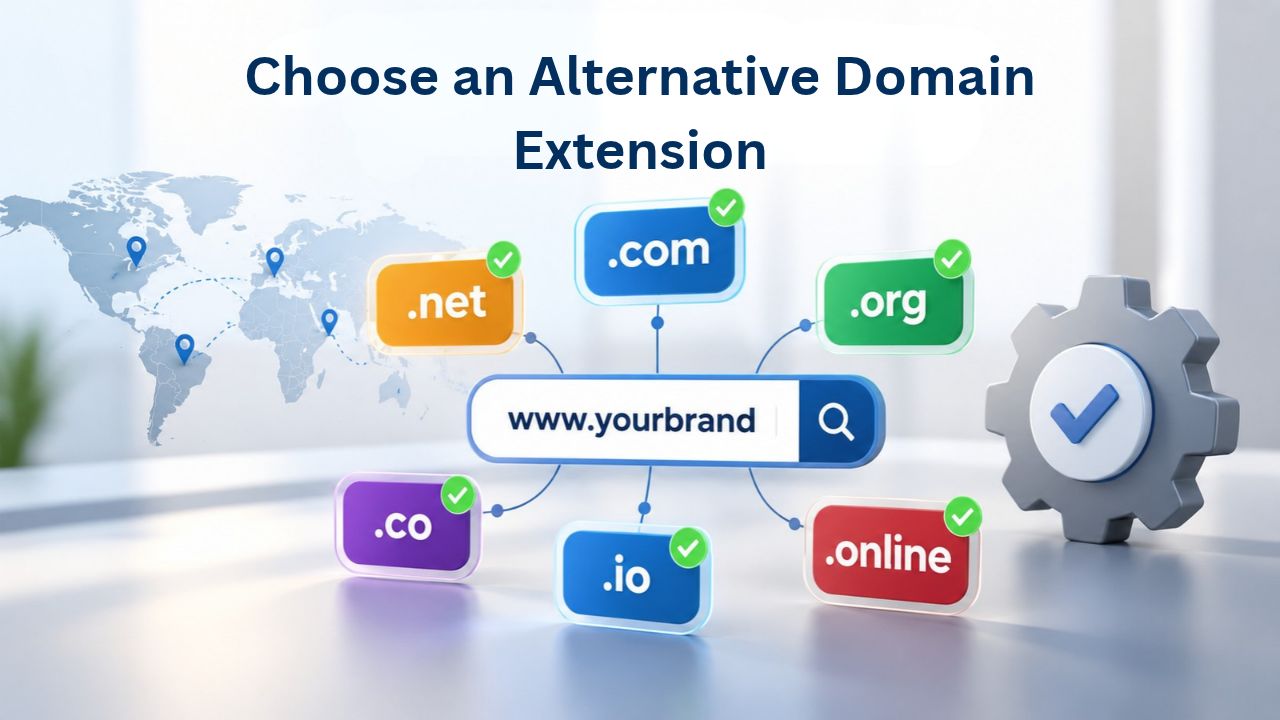
If your preferred name is unavailable in .com or your target extension, registering the same name under a different top-level domain (TLD) offers an immediate, cost-effective alternative. Alternative extensions like .net and .online provide professional, memorable options when your preferred .com is taken. Many successful businesses now register multiple TLDs defensively, protecting their brand across extensions, and effectively reach global audiences using non-.com primary domains. Modern search engine optimization treats most TLDs equally; trust and memorability depend on brand-building strength, content quality, and backlink authority, not extension choice alone.
Legacy and New gTLD Options
The .com and .net TLDs held a combined 169.8 million registrations globally as of Q1 2025, while newer gTLDs such as .xyz, .online, and .store grew 31.3% year over year](https://www.dnib.com/articles/the-domain-name-industry-brief-q1-2025). If your exact name is taken in .com, substantial alternatives exist with distinct positioning and brand perception. .net remains long-established and carries professional legitimacy;.org signals nonprofit or community-focused mission alignment .co has gained legitimacy as a commercial alternative; .io enjoys particular popularity in technology and startup communities; .online, .tech, .shop, and other industry-specific extensions provide descriptive positioning tied to your business category; and country-code extensions like .uk, .de, or .in establish local market authority and presence. Each carries different brand perception and geographic implications, though Google generally treats most TLDs equally for search visibility.
The strategic advantage of alternative extensions is immediate availability and rapid deployment compared to purchasing a taken name through aftermarket or broker channels. Names available in alternative TLDs typically register immediately and are ready for use within hours, compared to weeks or months for acquisition strategies. This speed makes alternative TLDs attractive for time-sensitive launches, new product lines, or geographic market expansion.
Disadvantages include: visitor habit bias and direct navigation uncertainty (users may type .com by default and not find you), potential perception of lesser legitimacy or authority (though this bias is steadily weakening as brands normalize across extensions), and the need to register and maintain multiple extensions defensively to protect your brand from competitor registration. If you are launching a new brand and timeline is critical, an alternative TLD is a rapid, efficient entry point; you can acquire the premium .com later as budget and opportunity align.
Strategic Multi-Extension Approaches
Newer domain extensions like .ai, .io, and .xyz are powerful when used with intent and support your positioning, not replace the foundation of trust. Many successful businesses started with an alternative TLD and later upgraded to .com as their brand scaled and budget increased. Others employ geographic segmentation, using country-code TLDs for targeted regional markets while maintaining .com for global brand reach. Some maintain separate TLDs for different product lines or business divisions to create focused market positioning. The right strategy depends on your growth timeline, target audience geography, competitive landscape, and budget trajectory. Still, an alternative extension is never a permanent limitation on your brand if your business strength and content quality are compelling.
Ready to Navigate Your Domain Acquisition?
Niya Digital is a reseller partnered with an ICANN-accredited registrar, helping you navigate expiration windows, aftermarket marketplaces, backorder services, and professional acquisition channels effectively. Whether you’re monitoring a domain for expiration, bidding in auctions, or engaging a broker for a premium name, expert guidance streamlines the process and improves your acquisition outcome. Our team helps buyers evaluate options, match strategies to their situation, and coordinate seamlessly across all acquisition channels.
Comparing Acquisition Methods: Which Strategy Fits Your Situation
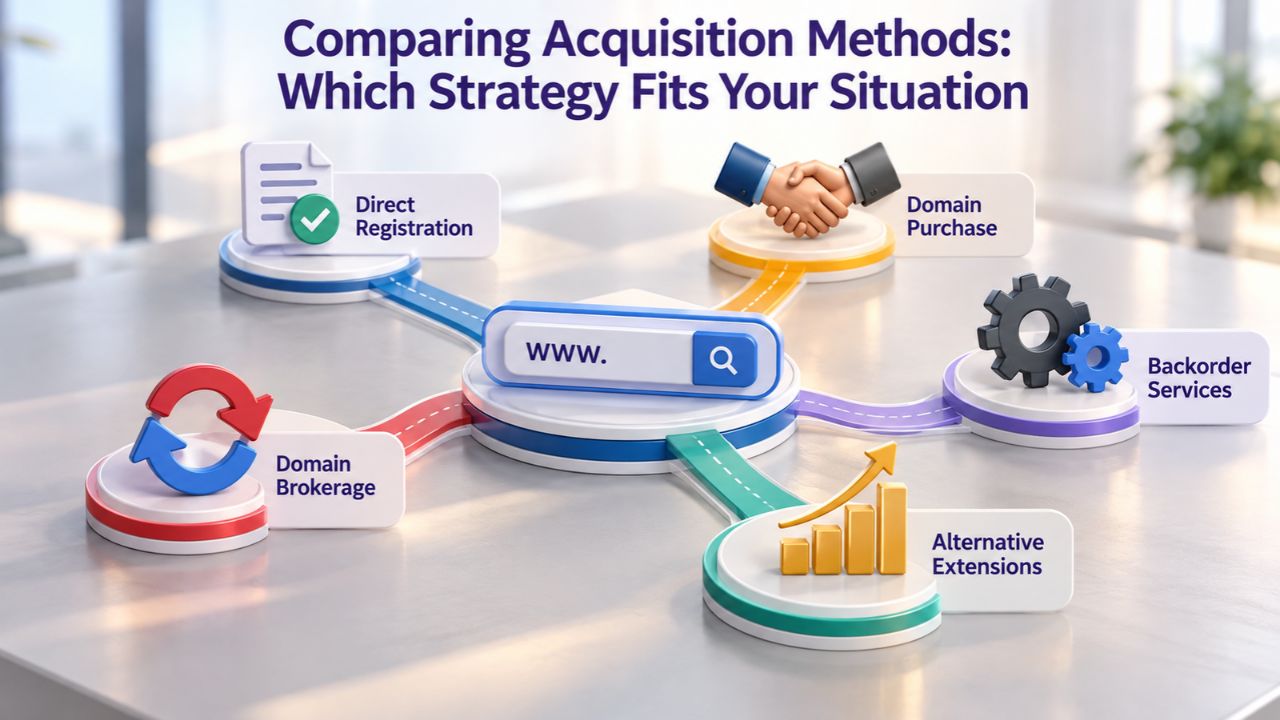
Each acquisition strategy works best in different circumstances. Your choice depends on your budget constraints, timeline urgency, the domain’s perceived value, and your comfort with negotiation. Understanding how each method aligns with your situation helps you make informed decisions that maximize your chances of success while minimizing wasted time and resources. This section walks you through a decision framework that matches acquisition methods to real-world business scenarios.
Matching Your Budget to Acquisition Method
Some acquisition methods require significant upfront capital, while others cost little to nothing. Direct negotiation and backorder services cost little; backorder services typically charge only when successful, and direct contact costs nothing. Aftermarket purchases vary dramatically based on current listings and competitive demand; you control your maximum bid and walk away if prices exceed your budget. Professional broker services involve commission structures rather than fixed fees, making them scalable to any deal size. When your budget is severely constrained, backorder and direct negotiation are realistic options; when you have capital to deploy, aftermarket and broker services open doors to immediate acquisition. Honesty about your budget upfront prevents wasted effort pursuing domains beyond your financial reach.
When evaluating budget-to-strategy fit, consider not just acquisition cost but total cost of ownership over time. An alternative TLD registration costs pennies per year but requires multiyear brand-building effort to match the authority of a premium .com. An aftermarket domain costs more upfront but arrives with established history and potential traffic. A broker-negotiated acquisition costs commission but saves your team weeks of negotiation time, time you could invest in business growth instead. Calculate the true value of each option, including opportunity costs and the time your team must invest.
Timeline Urgency and Realistic Expectations
If you need a domain immediately, backorder and broker services are impractical. You can register an alternative TLD instantly or bid in live auctions if suitable aftermarket inventory exists. If your timeline is moderate (2–4 weeks), direct negotiation or active aftermarket shopping becomes viable. If you have months or years of patience, backorder services can be extremely cost-effective. Matching timeline urgency to acquisition method prevents frustration and expensive mistakes. Many businesses pursue broker services on urgent timelines, then become frustrated when the 30-day negotiation window doesn’t produce results quickly enough. Understanding realistic timelines for each method prevents misaligned expectations.
Timeline also affects success likelihood. Rushed acquisitions often result in overpayment or poor strategic decisions. Taking 2–3 weeks to research aftermarket options, place strategic bids, and negotiate thoughtfully typically yields better outcomes than panicked acquisitions. Conversely, delaying acquisition beyond the necessary timeline creates business opportunity costs and risk; a competitor might register the name you’re hesitating on, or market conditions might shift. The sweet spot is moving deliberately but decisively, gathering information quickly without analysis paralysis.
Domain Value and Strategic Importance
A domain you need for immediate business operations warrants different spending than a speculative hold or defensive brand protection registration. If the domain is mission-critical for your business identity and customer discovery, higher acquisition costs may be justified by the strategic value it provides. If the domain is defensive or supplementary, lower-cost alternatives like alternative TLDs become more attractive. Assess genuinely: Does this specific name drive customer acquisition, or would an alternative name work just as well? Understanding the domain’s actual business value prevents both overspending on names that don’t justify premium costs and underspending on truly critical names.
Strategic importance also determines which acquisition method to pursue. Premium domains critical to brand positioning warrant broker services and professional negotiation. Defensive registrations across multiple TLDs can use cost-effective backorder and alternative extension strategies. Speculative investments might rely entirely on aftermarket hunting for underpriced names. Matching your acquisition strategy to strategic importance ensures you deploy resources (budget, time, attention) where they generate the highest return on investment.
Understanding Your Acquisition Options: Timeline and Outcome Comparison
| Acquisition Method | Typical Timeline | Success Likelihood | Best For | Key Consideration |
|---|---|---|---|---|
| Backorder service | Months to years (variable) | Low (competing backorders common) | Patient buyers; lower-value domains; long-term monitoring | Owner must abandon for success; no guarantee |
| Domain aftermarket (auction) | 1–3 weeks | High if competitive bidding succeeds | Immediate acquisition; transparent pricing; seller motivation confirmed | Requires budget to compete; transparent pricing enables planning |
| Domain aftermarket (direct offer) | 1–4 weeks negotiation + 1–2 weeks transfer | Medium to high (owner discretion) | Motivated sellers; lower-value names; direct negotiation skill | Owner may inflate price if sensing demand |
| Professional broker | 4–8 weeks (including 30-day negotiation window) | Medium to high (expert negotiation) | High-value domains; difficult-to-reach owners; anonymity needed | Commission structure justified by complexity and value |
| Direct owner contact | 1–4 weeks negotiation + 1–2 weeks transfer | Low to medium (owner may inflate price) | Accessible owner contact; budget-conscious buyers; no intermediary fees | Requires negotiation skill; risks price inflation |
| Alternative TLD registration | Immediate | Guaranteed (name typically available) | Time-critical launches; brand expansion; cost-effective brand protection | Requires multi-extension strategy for brand defense |
Common Pitfalls and How to Avoid Them
Most domain acquisition failures stem from predictable mistakes, not market conditions beyond your control. Understanding common pitfalls helps you avoid expensive missteps and navigate acquisition channels more skillfully. Even experienced buyers hit obstacles; knowing them in advance lets you plan contingencies and make better decisions when complications arise.
Overestimating Domain Value and Overpaying
The most common acquisition mistake is falling in love with a specific name and overpaying dramatically because you perceive it as irreplaceable. Every domain you want has alternatives, similar names, alternative extensions, or related variations that serve your business purpose almost as well. Buyers who convince themselves “this is the only domain that will work” lose negotiating leverage and often pay 2–3 times more than the name’s realistic market value; research comparable aftermarket sales before making offers. Use online domain appraisal tools as starting points (though they are imprecise). Ask brokers for valuation benchmarks. The goal is to know what similar names actually sell for, not what seller optimism might suggest.
When a seller quotes an asking price far above comparable sales, remember you can always walk away. The domain will still exist; other buyers will emerge; you can try again later with a lower offer. Sellers who overprice often eventually accept lower bids from persistent buyers who circle back after weeks or months. Patience and discipline prevent overpayment far more effectively than aggressive bidding. If a name feels too expensive, it probably is; trust that instinct and move on to alternatives. Your business success does not depend on any single domain name, even if your initial preference suggests otherwise.
Misunderstanding ICANN Lock Periods and Transfer Timeline
Many buyers try to transfer during 60-day lock periods and get confused when transfers are blocked. They assume the registrar is being difficult, but ICANN policy universally prohibits transfers for 60 days after registration or a prior transfer. This lock cannot be bypassed; you must wait the full 60 days. Similarly, buyers often don’t allow sufficient time for transfer completion before critical business milestones. A transfer that takes 5–7 business days, plus email confirmations and processing delays, can easily take 10–14 calendar days. Never initiate a transfer fewer than 2–3 weeks before you need the domain operational.
Many acquisitions also fail because buyers don’t maintain access to their admin email during transfer. ICANN requires the gaining registrar to send confirmation emails to the admin contact; if you can’t access that email to confirm, the transfer stalls. Before engaging any acquisition strategy, ensure your admin contact email is current, monitored, and accessible. Test email forwarding if necessary. This single oversight has derailed countless acquisitions that were otherwise proceeding smoothly toward completion.
Pursuing Single Domains When Alternatives Exist
Fixation on a single domain name prevents many buyers from moving forward efficiently. If your preferred .com is unavailable or prohibitively expensive, equivalent or superior alternatives usually exist. An alternative TLD with your exact name often outperforms a forced variation of your preferred extension. A premium aftermarket domain with slightly different keywords might offer better market positioning than your original choice. Flexibility in domain strategy enables faster acquisitions and often better outcomes. Spend your mental energy on acquiring a quality domain quickly rather than endlessly pursuing one perfect name.
The business landscape doesn’t require you to own a single specific domain to succeed. Many thriving companies launched with alternative TLDs or unconventional names, then acquired premium .com registrations later once their brand was established. Others never bothered acquiring their original preference and remained successful anyway. Domain choice matters far less than business execution, marketing, and service quality. A mediocre domain name with exceptional business performance outperforms a premium domain name with weak execution every single time.
Getting Expert Help and Managing Your Acquisition
Even when you understand acquisition strategies intellectually, managing the process skillfully benefits from guidance and support. The right partner can simplify navigation, prevent costly mistakes, and accelerate timelines. Knowing when to engage professional help and how to work with partners effectively transforms acquisition from a frustrating solo effort into a streamlined process.
When to Engage Niya Digital and Domain Acquisition Services
Niya Digital’s team can assist at multiple points in your acquisition journey. If you’re uncertain which strategy to pursue, our specialists can assess your situation, timeline, budget, and strategic needs, then recommend the most efficient pathway forward. If you’re bidding in aftermarket auctions, we can provide market research and valuation benchmarks to guide your bid strategy. If you’re considering broker services, we can connect you with qualified partners and explain realistic timelines and commission structures. If you’re placing backorders, we can help you monitor expiration status and ensure your request is placed correctly.
The right support prevents expensive mistakes and meaningfully accelerates acquisition timelines. Many buyers spend weeks researching acquisition methods on their own, only to make avoidable errors that cost them either money, time, or both. Professional guidance can compress this learning curve from weeks to hours, getting you to actual acquisition much faster. Even if you ultimately manage acquisition independently, a consultation with domain specialists clarifies your options and helps you make confident decisions aligned with your situation.
Working Effectively with Brokers and Aftermarket Platforms
If you engage a broker, provide clear information about your budget, timeline, and strategic goals upfront. Brokers work better when they understand your true maximum price (not your opening offer), your firm deadline (if one exists), and whether you’re pursuing this domain for core business operations or peripheral reasons. Transparency helps brokers negotiate more effectively because they understand your real constraints and can communicate realistic expectations to sellers. Conversely, vagueness or exaggeration wastes broker time and damages your credibility for future negotiations.
When bidding on aftermarket platforms, set your maximum bid before the auction ends and stick to it. Auction fever, where competitive bidding causes you to exceed your planned maximum, is a real psychological phenomenon that results in overpayment. Decide in advance what you will pay, enter that as your maximum bid, and walk away if you’re outbid. The domain will still exist; other sellers will emerge; you can try again later. Discipline in bidding prevents regret and maintains your financial discipline across multiple acquisition attempts.
Documentation and Transfer Readiness
Before your acquisition completes, ensure your registrar account is set up, and your admin contact email is current and monitored. When the domain transfers to your account, you’ll need immediate access to update DNS records, configure services, and begin operations. Delays or confusion about access after the transfer completes waste the momentum you built through acquisition. Prepare your operational infrastructure before the domain arrives, not after.
Keep careful records of all communications, agreements, and transaction details throughout the acquisition process. This documentation protects you if disputes arise and provides a clear record of commitments made. For significant acquisitions, consider having an attorney review purchase agreements or broker contracts before signing. The cost of legal review (typically a few hundred dollars) is minimal compared to potential disputes over domain ownership, payment obligations, or transfer terms.
Building Your Long-Term Domain Strategy
Domain acquisition is rarely a one-time event. Most organizations benefit from ongoing domain strategy that includes brand defense across multiple extensions, geographic market expansion, and preparation for future business growth. A long-term vision guides your immediate acquisition decisions and prevents costly, fragmented efforts.

Multi-Extension Defensive Strategy
Many organizations register their brand name across multiple TLDs (.com, .net, .org, and other extensions) to prevent competitors or squatters from using similar names and causing confusion. This defensive strategy is especially valuable if your brand is distinctive or valuable. You don’t necessarily need to develop unique content for each extension; most can redirect to your primary domain, but ownership prevents brand confusion and protects your online identity. You can build this portfolio gradually as budgets allow rather than all at once; prioritize your most critical extensions and expand over time.
A defensive strategy also protects against future market shifts. If search engines or user behavior eventually shift toward preferring alternative TLDs in your industry, you already own your brand across those extensions. If your primary market evolves geographically, you have country-code extensions ready. This forward-looking approach requires modest investment but provides substantial protection against competitive and market-driven risks. Many successful organizations view multi-extension portfolio building as routine brand management, not an optional luxury.
Growth-Stage Domain Planning
As your business scales, your domain needs evolve. New product lines might warrant dedicated domains. Geographic expansion into new markets might require country-code extensions or regional domains. Acquisition of competitor businesses might bring desirable domains into your portfolio. Building a long-term domain strategy prepares you to handle these evolution points efficiently rather than reactively. If you know you’re planning European expansion next year, you can begin researching and acquiring relevant country-code extensions now, before competitive pressure increases.
Long-term planning also helps you allocate your budget wisely. A startup with limited budget might register a single alternative TLD and commit to acquiring a premium .com within 18 months as revenue grows. An established company might allocate annual budget for defensive registrations and premium domain acquisitions that support new market initiatives. By planning strategically, you align domain acquisition with business growth rather than treating domains as reactive afterthoughts.
Monitoring and Renewal Management
Successful domain strategies require ongoing management. Set renewal reminders well before expiration to prevent accidental loss. Some registrars offer auto-renewal services; ensure these are enabled for critical domains. Monitor for trademark threats or competitive registrations that might conflict with your brand. Every few years, audit your domain portfolio to identify underperforming registrations you can let expire and reallocate those renewal funds to higher-value acquisitions.
Niya Digital’s team has found that organizations benefit greatly from centralized domain management and renewal-tracking systems. Rather than spreading domains across multiple registrars with different renewal dates, consolidating management in one platform prevents lapses. It simplifies administration as your portfolio grows from dozens to hundreds of domains; professional portfolio management transitions from nice-to-have to essential business infrastructure. Planning for this evolution now prevents costly mistakes as your organization scales.
Secure Your Ideal Domain with Confidence
Anticipate common pitfalls and avoid costly mistakes. Niya Digital is your partner throughout this journey, helping you evaluate options, connect with domain specialists, manage acquisitions, and build long-term domain strategies aligned with your business growth. Whether your timeline is urgent or your approach is strategic, expert guidance turns domain acquisition from a frustrating solo effort into a streamlined process.
Frequently Asked Questions
What is the Redemption Grace Period (RGP) and how long does it last?
The Redemption Grace Period is a 30-day window that begins immediately after a registrar deletes a domain. During this time, the original registrant can restore the domain by contacting their registrar and paying a redemption fee. The public cannot register the domain during RGP, and transfers are prohibited. After 30 days without restoration, the name enters a 5-day Pending Delete phase, then is released for general registration on a first-come, first-served basis.
Can I transfer a domain during its Redemption Grace Period?
No, the registry prohibits transfers during the Redemption Grace Period. If you want to acquire a domain in RGP, you must wait until the 30-day window expires and the domain is released to the public. At that point, you can register or transfer the domain freely. Backorder services monitor domains through RGP and automatically attempt registration the moment release occurs.
How does a backorder service work, and can it guarantee I’ll get the domain?
A backorder service monitors an expiring domain and automatically attempts to register it the moment it is released to the public. When you place a backorder, the service tracks the domain’s status through expiration, RGP, and deletion phases. Upon release, the service’s automated systems fire registration requests within milliseconds. If you are the only backorder placed on that domain, you will typically secure it. If multiple backorders exist, services hold an auction among backorder users. Backorders do not guarantee success and carry no refund if competitors or the original owner obtain the domain first.
What is the domain aftermarket, and where can I buy domains from it?
The domain aftermarket is the secondary marketplace where already-registered domains are bought and sold between private parties, brokers, and investors. Major platforms include Sedo, Afternic, GoDaddy Auctions, and NameJet. Sellers list domains at fixed prices, through auctions, or with “make an offer” listings. Buyers can browse inventory, place bids, negotiate directly with sellers via anonymous messaging, and complete purchases through escrow services. Aftermarket domains typically cost more than standard registration because of their perceived business value and existing ownership.
How much does it cost to hire a domain broker, and what can I expect?
Professional domain brokers typically charge a commission on the final sale rather than flat fees. A broker will identify your target domain’s owner, research its realistic market value, contact the owner anonymously, negotiate on your behalf, and handle escrow and transfer. Brokers dedicate up to 30 days to negotiation efforts, and timelines from initial engagement to completed transfer typically range from 4–8 weeks. Expect to invest in this service when the target domain’s value justifies professional negotiation or when the owner is difficult to locate.
Can I find the current owner of a domain using WHOIS?
Yes, a WHOIS lookup reveals the registered owner’s name, organization, email, and phone number. However, many registrants use WHOIS privacy-protection services that mask this information behind a proxy. If privacy protection is in place, you cannot identify the actual owner through standard WHOIS. In those cases, a professional broker or an aftermarket approach is more practical than direct contact.
Is direct negotiation with a domain owner a good strategy?
Direct negotiation works if the owner’s contact information is accessible and you have strong negotiation skills. Direct outreach can succeed if the owner is open to selling and you make a reasonable offer. Still, it risks inflating the price if the owner realizes there’s active demand. If the owner is privacy-protected or unresponsive, professional brokers or the aftermarket provide more efficient alternatives. Many buyers find that these approaches yield better results, especially for high-value domains.
How do alternative domain extensions affect my business or SEO?
Google generally treats most TLDs equally for SEO purposes. Trust and memorability depend on your brand strength, content quality, and backlink authority, not extension choice. However, visitors may have psychological biases toward .com. Country-code TLDs like .uk or .ca may boost rankings within specific countries, while industry-specific extensions reinforce positioning within niche markets. Choose an extension that supports your brand strategy, not one that undermines it.
What is the ICANN 60-day transfer lock, and why does it exist?
ICANN policy mandates a 60-day transfer lock immediately following new domain registration or after a domain has been transferred to a new registrar. This lock prevents the domain from being transferred to another registrar during that cooling-off period. This rule is a security measure designed to prevent domain hijacking; it gives the previous registrant time to detect and report unauthorized changes before a domain can be moved. You can’t bypass or shorten this lock; you must wait the full period.
How long does an actual domain transfer take once initiated?
The ICANN transfer process typically takes 5–7 business days from authorization code submission to completion, excluding pre-transfer lock delays. However, the full timeline depends on whether the domain is within a 60-day lock, whether the admin email is accessible, and the registrar’s processing speed. Start transfers well before domain expiration, and keep your admin email current and monitored. Never transfer a domain fewer than 5–7 days before expiration, as delays could cause it to expire before completion.
What happens if I try to acquire a domain and fail, can I recover my investment?
Backorder services typically credit failed backorder fees toward future backordered domains. Aftermarket auction platforms automatically refund unsuccessful bids. Direct negotiation failures involve no cost. Professional broker services are non-refundable if the broker expends effort, but the owner declines to sell; you pay for the service attempt. Alternative TLD registrations are standard purchases; if you’re unsatisfied, you can let the registration expire or keep paying renewal fees. Niya Digital’s team has found that setting realistic expectations upfront helps buyers make informed decisions and avoid disappointment.
Can Niya Digital help me acquire a specific domain?
Niya Digital partners with an ICANN-accredited registrar to provide domain transfer and registration services. Our support team can guide you through each acquisition strategy, assist with backorder placement, navigate aftermarket purchasing, initiate transfers, and connect you with domain broker services when professional negotiation is needed. Contact Niya Digital support to discuss your specific domain acquisition situation.
What should I do if my desired domain name is taken, where do I start?
Start by confirming the domain’s current status and owner using WHOIS. If it is active, assess whether direct negotiation, a broker, or the aftermarket is realistic based on your budget and timeline. If it is expired, check whether it is in the Redemption Grace Period and consider a backorder. If none of those options appeal, explore alternative TLDs or related name variations. Niya Digital support can help you choose the strategy that best fits your situation.
Glossary
- ICANN (Internet Corporation for Assigned Names and Numbers): The nonprofit organization that coordinates global domain name system policy, oversees registrar accreditation, and establishes policies governing domain registration, transfer, and recovery procedures.
- Redemption Grace Period (RGP): A 30-day window after domain expiration during which the original registrant can restore the registration by paying a redemption fee. Public registration is prohibited during RGP; transfers are disabled. After expiration, the domain enters Pending Delete, then is released for general registration.
- Backorder: A service request placed with a registrar or specialized platform to monitor an expiring domain and automatically attempt registration the moment it is released to the public. Backorders are not guaranteed; success depends on competing requests and platform speed.
- Domain Aftermarket: The secondary marketplace where already-registered domains are bought and sold between private parties, brokers, and investors. Transactions occur through auction platforms, direct negotiation, or fixed-price Buy-It-Now listings.
- WHOIS Lookup: A query tool that retrieves publicly available registration information for a domain, including the registered owner’s name, organization, contact email, and phone number. Privacy-protection services can mask this information behind a proxy.
- Domain Broker: A professional intermediary who negotiates the purchase of a registered domain from its current owner on behalf of a buyer. Brokers maintain buyer anonymity, research realistic valuations, and handle escrow and transfer logistics; they typically charge a commission on the sale.
- 60-Day Transfer Lock: An ICANN-mandated security hold that prevents inter-registrar transfer of a domain for 60 days following initial registration or following a prior transfer completion. This lock cannot be bypassed and is a global security measure against domain hijacking.