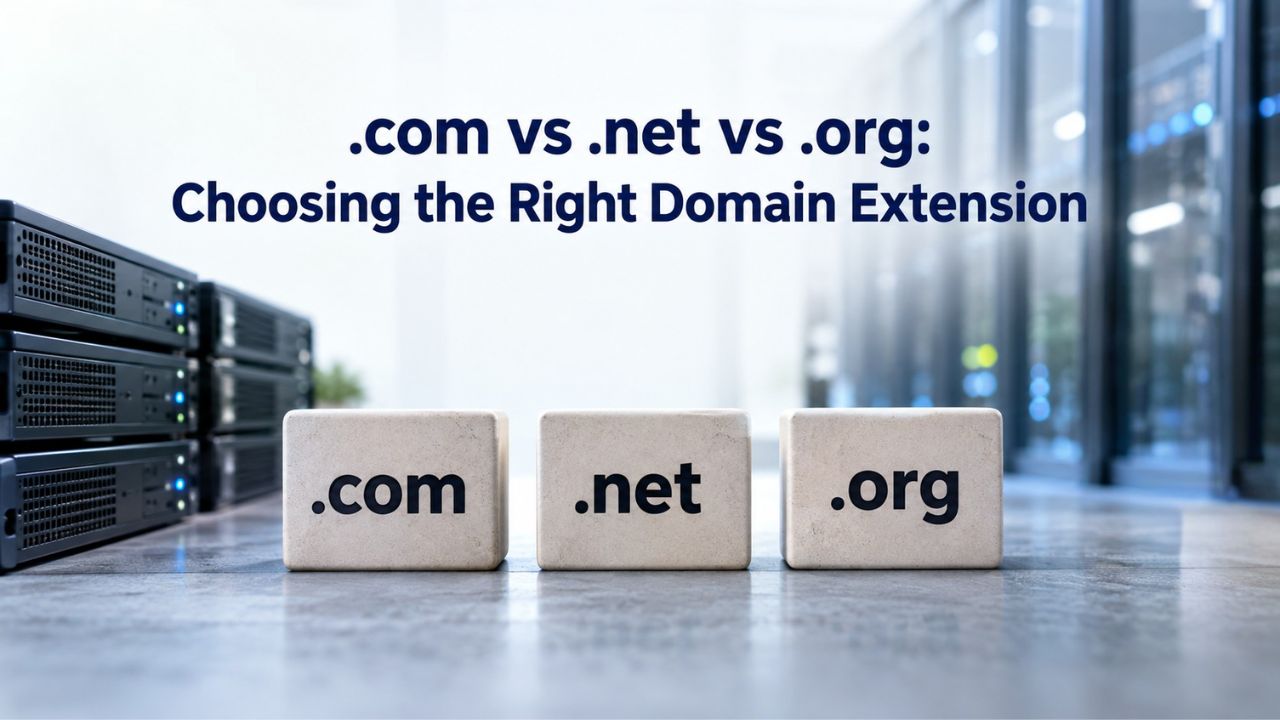
Understanding Domain Extensions and Their Origins
The domain system launched with three original generic top-level domains created in 1985: .com for commercial use, .net for network infrastructure, and .org for miscellaneous organizations. Today, despite their historical intentions, all three remain completely unrestricted; any individual, business, or organization worldwide can register in any of them without proving eligibility. This openness makes extension choice purely strategic, not regulatory.
How Registries Manage Each Extension
Verisign operates both .com and .net as the official registry operator, while the Public Interest Registry manages .org. These registries maintain the global database of all registered domains within each extension and set baseline policies like the 30-day redemption grace period that allows domain owners to restore expired domains before public release.
However, the choice of registrar, which reseller or ICANN-accredited partner you purchase through, directly affects the support and features you access.
Registration Counts and Global Adoption
The numbers reveal which extensions dominate. .com leads with 161 million registered domains globally, making it the most recognized and most-contested extension. .net holds 12.5 million registrations, serving as a fallback when .com names are unavailable.
.org, though smaller in raw count, carries outsized influence in the nonprofit and open-source sectors, where it has become the default expectation. Together, these three legacy extensions represent the foundation of the early internet namespace and shape how over 185 million domain registrations are allocated globally.

Domain Name Registration
Each and every domain name comes with all you need to get online.
- Domain Forwarding and Masking: Direct any domain name you own to your website. Anyone who types that domain name into their browser is taken directly to your website.
- Domain Locking: Domain locking prevents accidental or intentional transfers of domain ownership and stops anyone from redirecting your nameservers.
- Total DNS Control: Manage your domain nameserver (DNS) records and set your email, FTP, sub-domains and website location all from one control panel.
- Change of Registration: Assign your domain name to someone else or change the contacts for your domain online anytime.
- Status Alerts: Monitor the status of your domain and get instant alerts if there's been a change.
- Auto Renew Protection: No need to watch expiration dates to make sure you renew on time! Auto renew keeps your domains, hosting, website builders, and other products in your name and under your control.
Domain Disclaimers:
- Special savings apply only to first year of registration. You must purchase entire section to qualify for special savings.
- The final price may differ because of additional sales, fees, and promotions.
- Products will automatically renew until cancelled. You may turn off the auto-renewal feature by visiting your account.
- Change of registration may require a fee for certain domains.
SEO Impact: Why Extension Choice Doesn’t Rank Your Site
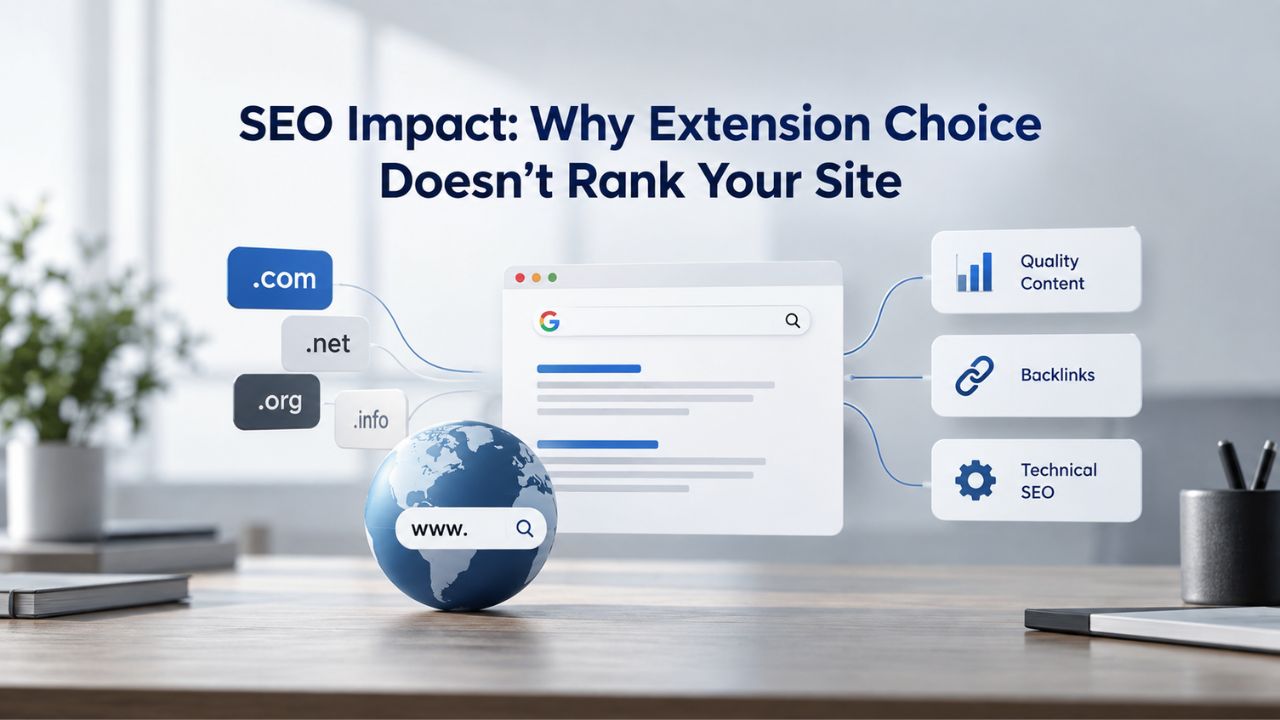
A persistent myth claims that .com domains rank better in search results than .net or .org. Google treats all generic top-level domains (gTLDs) equally; your choice of extension does not directly affect search rankings. Content quality, technical SEO, backlink profile, and site speed matter far more than whether your domain ends in .com, .net, or .org.
Direct Ranking Treatment Across Extensions
Google’s official position confirms that it treats all generic top-level domains equally in its algorithms. No ranking advantage flows to .com, .net, or .org solely based on extension choice. This equal treatment applies globally to all gTLDs, making extension selection a strategic branding decision rather than a technical SEO factor. The algorithm evaluates content, authority, and user experience, never the TLD suffix.
How Extension Choice Indirectly Influences Rankings
Though the extension itself carries no ranking weight, it does influence click-through rate and user perception, both indirect SEO factors. When users see two identical search results, one with .com and one with .net, they are significantly more likely to click the .com link, simply because .com feels more familiar. Higher CTR signals engagement to search engines, which can support rankings over time. Research shows .com achieves a 44% memorability score, higher than any other legacy extension, meaning users remember .com addresses more reliably.
| Factor | .com | .net | .org |
|---|---|---|---|
| Direct SEO Ranking Impact | None | None | None |
| User Memorability | 44% | Lower | 32% |
| CTR Advantage (Perception) | Highest due to strong user familiarity | Moderate | Moderate, especially for nonprofit organizations |
| Search Engine Algorithm Treatment | Equal | Equal | Equal |
| Geographic Targeting | Global | Global | Global |
| Competitive Availability | Very High | High | Moderate |
Brand Perception and Consumer Trust Signals
Consumer research reveals that domain extensions carry measurable psychological weight. 70% of consumers place implicit trust in .com and .org domains, giving those extensions an immediate credibility boost. This trust gap opens before your site even loads; it’s pure extension recognition.
Trust Scores and Audience Expectations
.com rated 3.5 out of 5 for trust perception, while .org scored 3.3 out of 5. The difference is small but consistent across multiple independent surveys. 91% of consumers rated .com, .net, and .org as trustworthy destinations overall, suggesting that all three legacy extensions remain far ahead of newer alternatives. The real divide emerges when visitors land on your site and notice the gap between extension and business model; a .org e-commerce store or .net nonprofit may confuse visitors about who you actually are.
Extension as a Positioning Signal
.org carries such strong associations with nonprofit organizations and mission-driven work that many consumers assume a .org site is fundamentally different from a .com site. This assumption is partly earned: nonprofits, open-source projects, advocacy groups, and community initiatives cluster heavily in .org. .net, meanwhile, originally intended for network providers, evolved into a tech-first alternative that suggests a more technical or developer-focused organization. .com remains the universal business default; when someone guesses a company URL, they default to .com.
Choosing by Business Model and Use Case
The right extension aligns your domain with visitor expectations. Different business types benefit from different signals when selecting Business Domain Hosting and enterprise Domain and Hosting Services.
When to Choose .com
E-commerce stores, SaaS products, service businesses, and general professional presences benefit from .com’s universal recognition. If you want to buy a Domain Name Online for a commercial audience or operate globally, .com removes friction; users expect it, remember it, and trust it by default. .com also protects your brand in a crowded marketplace; many businesses register their name in all three extensions defensively to prevent competitor or squatter activity.
When to Choose .org or .net
.org works best for nonprofits, charities, open-source projects, community groups, and advocacy organizations. The extension immediately signals mission-driven work and public interest. However, for-profit businesses can legally register .org without restriction; no proof of nonprofit status is required, but doing so risks brand confusion if your audience expects a nonprofit. Some mission-focused for-profit consulting firms use .org to emphasize social impact.
.net serves as a professional alternative when .com is unavailable, and works well for technology companies, web hosts, internet service providers, and developer-focused communities. .net suggests technical expertise without being as universally trusted as .com or as mission-focused as .org. It’s a solid middle ground: recognizable, professional, and less fought over than .com.
ICANN Transfer Locks and 60-Day Hold Periods
Understanding ICANN’s transfer policies prevents costly delays if you ever need to move your domain to a new registrar.
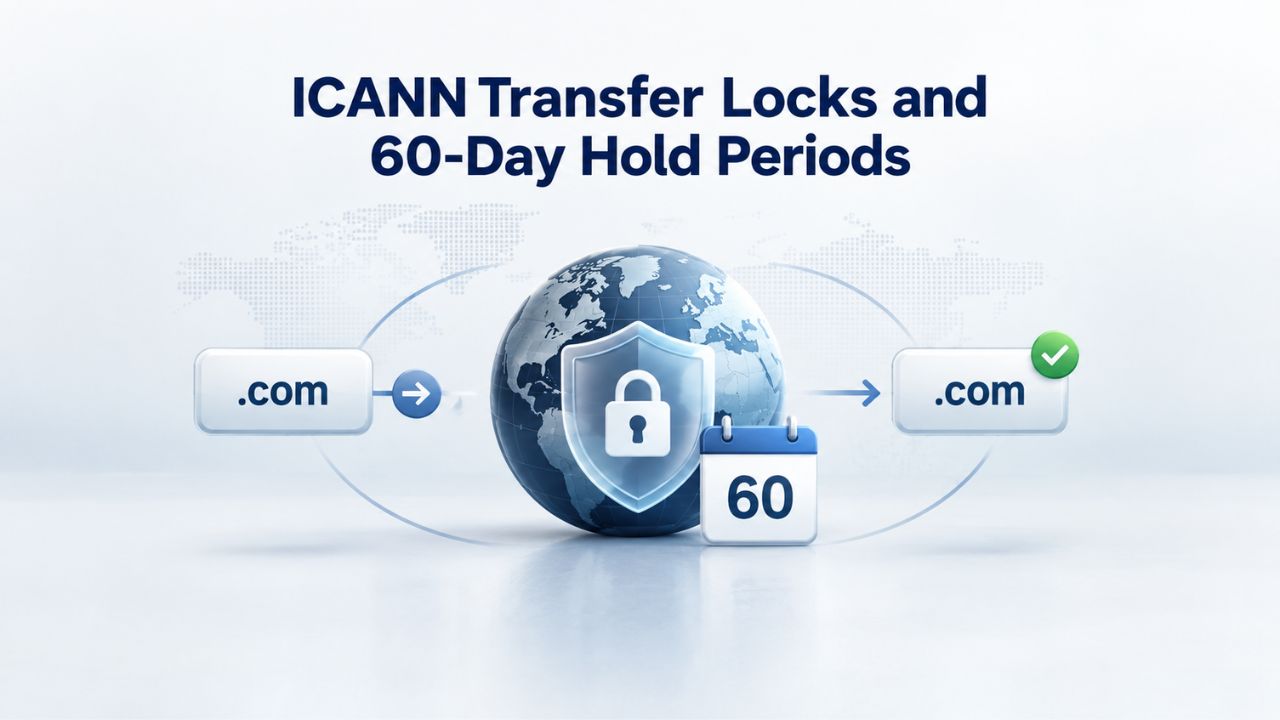
When Transfer Restrictions Apply
ICANN policy imposes a 60-day transfer lock in three scenarios: within 60 days of initial registration, within 60 days of a previous transfer, or within 60 days of changing registrant contact information.
This applies uniformly to .com, .net, and .org. The lock prevents unauthorized transfers and gives registrants time to dispute fraudulent registrations. Some registrars offer the option to opt out of the contact-change lock, though ICANN does not require them to.
What Happens if Your Domain Expires
If you miss a renewal, your domain enters a grace period (typically 29–30 days, depending on the registry), during which you can still renew at standard rates. Your DNS continues to resolve normally. After the grace period, the domain enters a 30-day redemption grace period (RGP), during which only the previous owner can restore the deleted registration through the previous registrar. During RGP, transfers are prohibited; you cannot move the domain until it is restored. After RGP expires, the domain is deleted and returns to the public pool for anyone to register.
Register Your Domain Through a Best Domain Registrar Partner
Whether you’re registering your first domain or managing a portfolio across multiple extensions, choosing the right Domain Hosting Provider is as important as choosing your extension. Niya Digital provides Domain Registration Services, Domain Transfer Services, and Domain Name Management through an ICANN-accredited registrar partner, supporting .com, .net, and .org with transparent policies, straightforward management tools, and responsive customer support for all your domain hosting needs.
Availability, Competition, and Global Reach
.com names are exhausted at the obvious level; memorable single words and common business terms are registered or held as investments. Yet all three extensions, .com, .net, and .org, serve global audiences with no geographic restrictions.
Finding Your Ideal Name and Availability Strategy
Your preferred name may be available in .net or .org even if .com is taken. Many businesses register defensively in all three extensions to prevent competitors from using alternatives to poach traffic. This strategy protects your brand; for startups and small businesses, securing all three variants costs little and eliminates a liability.
Alternatively, a different, available .com often outweighs a perfect-name .net or .org; a memorable .com domain you own typically beats an awkward compromise in any other extension. If your chosen name is free in .org or .net and aligns with your business model, claim it; availability ultimately trumps historical intention.
Global Competition and International Expansion
Unlike country-code domains (.uk, .de, .in), which signal local relevance and receive geographic search boosts in their home countries, .com, .net, and .org are global by design; they carry no geographic targeting signal to search engines. An Indian business using .com competes on equal footing with a U.S. business using the same .com domain.
This universality makes legacy gTLDs ideal for businesses with international ambitions. .com, .net, and .org enjoy widespread recognition across English-speaking markets and among international business communities; for truly global brands, a legacy gTLD is safer than betting on regional perception of newer alternatives.
Domain Renewal and Lifecycle Management
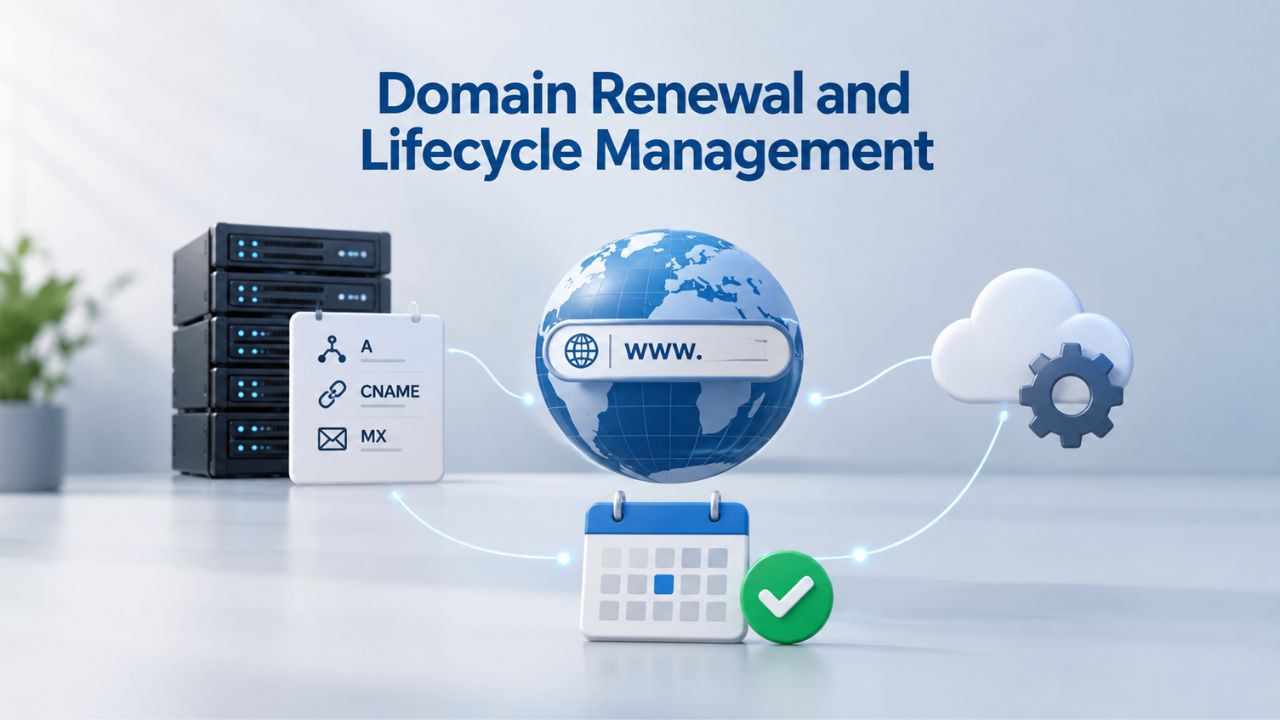
All three extensions follow identical renewal and expiration mechanics, set by ICANN. Professional Domain Renewal Services ensure your registration never lapses unintentionally.
Setting Up Secure Domain Registration and Auto-Renewal
Most registrars offer automatic renewal by default as part of Secure Domain Registration, renewing your domain annually before expiration. This prevents accidental lapses. Disabling auto-renewal leaves you responsible for manual renewal within the grace period; if you forget, your domain enters recovery mode, then deletion. Niya Digital’ team has found that most domain loss incidents occur not from registration decisions. Still, from expired renewals; a simple calendar reminder or automatic renewal setting could have prevented them.
Multi-Year Registration for Stability
You can register or renew .com, .net, and .org domains for 1 to 10 years at once. Some businesses register for 3–5 years to lock in pricing and avoid frequent renewals. Longer registration periods also signal stability to search engines and visitors; a domain registered through 2030 suggests the business intends to stay around.
Deciding: A Framework for Your Choice
Your decision should reflect your business model, audience, and long-term vision.
Alignment Questions to Ask
What is your primary audience?
B2C e-commerce and general consumer audiences expect .com. Nonprofits and mission-focused initiatives benefit from .org’s credibility. Tech companies and developer communities align with .net.
How important is brand familiarity?
If your name is common or easy to misspell, .com’s higher memorability becomes valuable.
What if your preferred name is unavailable in .com?
A strong alternative name in .org or .net beats an awkward compromise in .com.
Are you operating locally or globally?
Legacy gTLDs serve global audiences equally; country-code domains target specific regions.
Do competitors own your name in other extensions?
Defensively register in all three if budget allows; it’s cheap insurance against brand erosion.
| Business Type | Recommended Extensions | Why |
|---|---|---|
| E-commerce Store | .com (primary); .net, .org (defensive) | .com inspires the highest consumer trust and is the most memorable extension for online shopping. |
| Nonprofit Organization | .org (primary); .com (defensive) | .org immediately communicates a mission-driven or public-interest organization. |
| Tech Startup or Software Company | .com or .net (primary) | .com offers broad brand recognition, while .net remains popular for technology-focused businesses. |
| Open-Source Project | .org | .org is widely recognized as the preferred extension for community-led and open-source initiatives. |
| Consulting or Service Business | .com | .com is the global standard for professional businesses and is easiest for customers to remember. |
| Advocacy or Community Group | .org | .org reinforces a nonprofit, advocacy, or community-focused identity. |
| Personal Blog or Portfolio | .com or .net | Both extensions work well for personal branding, with the choice often depending on availability and branding goals. |
All three extensions will work the same way: your domain will work, your email will route, and your DNS will resolve. The difference is purely perceptual and strategic.
Registering, Transferring, and Managing Your Domain
Once you’ve chosen your extension and confirmed availability, the next step is registration through an ICANN-accredited registrar or reseller.
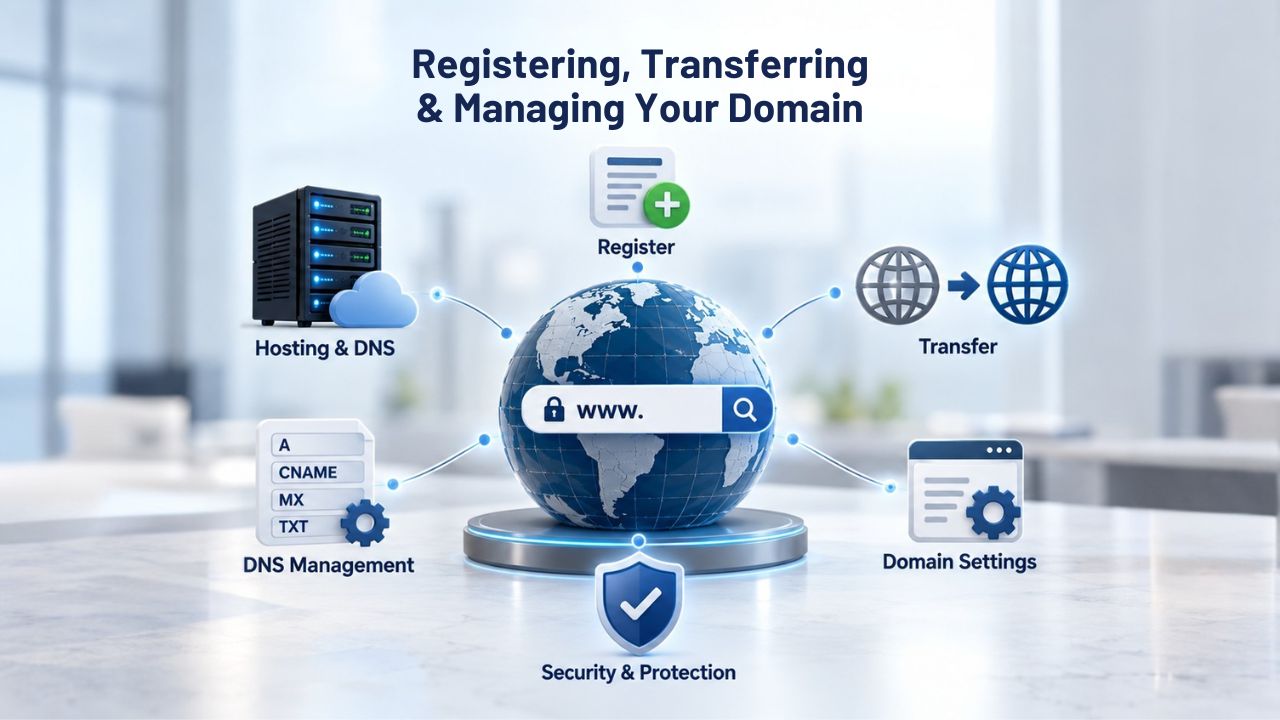
Registration and Domain Transfers
Enter your chosen domain into a domain search tool, confirm it’s available, and add it to your cart. You’ll provide registrant, administrative, technical, and billing contact information; ICANN requires accurate data for domain recovery and dispute resolution. Upon payment, your registration activates immediately; DNS typically propagates within minutes, though full global propagation can take up to 24 hours. Your registrar provides account access to manage DNS records, renew your domain, update contacts, and configure domain privacy if desired.
If you already own a domain registered elsewhere, moving it is straightforward. Unlock your domain at your current registrar, request your authorization code (also called an AuthInfo code or transfer code), and initiate the transfer through your new registrar. The transfer typically completes within 5–7 days, and your domain remains active throughout. ICANN’s 60-day lock applies; you cannot move a domain within 60 days of initial registration or a previous transfer.
Ongoing Management and Support
Your registrar account lets you manage DNS records and point your domain to your web hosting provider. Most registrars include DNS hosting and email forwarding at no extra cost. If you later change registrant information (address, name, email), ICANN’s transfer lock kicks in again; you won’t be able to transfer for 60 days unless you opt out beforehand.
Secure Your Domain and Plan Ahead
Registering a domain is straightforward, but securing your investment requires attention to renewal and basic security practices.
Prevent Accidental Loss
Set automatic renewal and keep your email contact current so renewal reminders reach you. Add a backup email address to your registrar account. If you plan to sell your business, transfer your domain early; ownership changes add complexity. Domain hijacking is rare but possible; enable two-factor authentication on your registrar account if available and consider domain transfer locks that require additional verification to move your domain.
Plan for Growth
Choose an extension that supports your long-term brand vision. If you might expand internationally, a .com or .org scales better than a country-code domain. If you’re uncertain whether to choose .com or .org, claim your brand name in both; the small annual cost is negligible compared to building brand equity. Reserve related keywords and brand variations defensively; someone else will if you don’t.
Get Expert Support for Your Domain Strategy
Building a strong web presence starts with choosing the right domain extension and registering it with a partner you can trust. Niya Digital’s team of domain and infrastructure specialists is ready to help you select the perfect name, navigate the registration and transfer process, and support your domain management with responsive, knowledgeable service tailored to your business goals.
Frequently Asked Questions
Does my choice of .com vs .net vs .org affect my search rankings?
No. Google and other search engines treat all generic top-level domains equally and do not favor one extension over another in their ranking algorithms. Your content quality, technical SEO, and backlink profile matter far more than your extension.
The extension can indirectly influence rankings only if it affects click-through rate or user trust; for example, .com’s higher memorability may result in more clicks from search results, which can support rankings.
Can I use a .org domain for my for-profit business?
Yes, absolutely. Unlike .edu and .gov, which are restricted to educational institutions and U.S. government entities, respectively, .org has no eligibility restrictions; anyone can register it. However, because consumers strongly associate .org with nonprofit organizations, using .org for a commercial e-commerce store may be confusing. .org works well for mission-focused for-profit businesses, B-corporations, and social enterprises where public-interest messaging aligns with your brand.
If my preferred name is taken in .com, should I choose .net or .org?
Choose the extension that best reflects your business model. If you’re a tech company, .net signals technical credibility. If you’re nonprofit-focused, .org is ideal. If neither extension perfectly fits, consider whether your chosen name in .com (perhaps with a modifier or different spelling) is stronger than your preferred name in .net or .org. A memorable, available .com often outweighs a perfect-name .net or .org. That said, all three extensions are recognized and trusted by consumers; don’t delay launching over extension choice.
What happens if my domain expires?
Your domain enters a grace period (typically 29–30 days) during which you can renew at standard rates, and your site keeps working. If you miss the grace period, it enters a 30-day redemption grace period during which only you (through your original registrar) can restore it, usually at a higher redemption fee. After that window closes, the domain is deleted and becomes available for anyone to register. To prevent this, enable automatic renewal or set calendar reminders well before expiration.
Can I transfer my domain from one registrar to another?
Yes. Domain transfers are governed by ICANN’s transfer policy, which requires you to unlock your domain at your current registrar and provide an authorization code.
However, you cannot transfer within 60 days of initial registration, within 60 days of a previous transfer, or within 60 days of changing registrant contact information (unless you opt out beforehand). The transfer typically completes in 5–7 days, and your domain remains active throughout.
Should I register my brand name in .com, .net, and .org defensively?
It depends on your budget and your brand’s value. For consumer-facing businesses, registering in all three prevents competitors or squatters from claiming your name in alternative extensions and diverting traffic.
The cost is modest, roughly the price of one domain per year for three. If you operate in a competitive space or have a memorable brand name, defensive registration is smart insurance. For less competitive names or tight budgets, securing .com is usually sufficient.
Does DNSSEC matter for my .com, .net, or .org domain?
DNSSEC is a security protocol that adds cryptographic verification to DNS responses, protecting against DNS spoofing and tampering attacks. It’s optional and most valuable for e-commerce, banking, and sensitive applications.
Most registrars support DNSSEC, and your Niya Digital team can enable it if needed. For personal blogs, small websites, or early-stage projects, DNSSEC is nice-to-have rather than essential.
Is there a “best” domain extension for SEO?
No. Google officially confirms that it treats all generic top-level domains equally for ranking purposes. The “best” extension is the one that aligns with your business model and audience expectations.
A well-optimized .org site will outrank a poorly optimized .com site every time. Focus on content, technical performance, and authority; the extension is secondary to these fundamentals.
Can I change my domain extension without losing my site?
Technically, you would need to register a new domain with a different extension and set up a 301 redirect from your old domain to the new one. However, this is complex and risks losing accumulated search rankings and backlinks.
It’s better to choose the right extension from the start and stick with it. If you must change extensions, plan carefully, maintain the old domain for at least a year with redirects in place, and communicate the change to your audience.
What is the difference between a registrar and a reseller?
A registrar is ICANN-accredited and operates directly with the registries that manage each TLD. A reseller, like Niya Digital, partners with an ICANN-accredited registrar to provide domain services to customers. Resellers handle customer support and domain management while working through established registrar infrastructure. Resellers often offer competitive pricing and specialized services without the overhead of running an independent registry.
How long does it take to register a domain?
Registration is instant. Upon payment, your domain is active immediately, though DNS propagation to global servers can take up to 24 hours. Your registrar account becomes accessible right away, allowing you to manage DNS settings, email forwarding, and domain settings from day one. Most websites can point to their new domain within hours.
What is domain privacy, and do I need it?
WHOIS Privacy Protection (also called domain privacy or domain protection) hides your personal contact information from the public WHOIS database. It replaces it with proxy contact details provided by your registrar.
This prevents spammers and scammers from harvesting your email address and phone number from domain registration records. For business domains, transparency can be valuable; for personal sites, privacy protects your personal data. Most registrars include WHOIS Privacy Protection as an optional or included feature with domain registration.
What happens if I choose the wrong extension?
Changing domain extensions is complex and can cause you to lose accumulated search rankings and backlinks built over time. If you need to switch extensions, you’d register a new domain, set up 301 redirects from the old domain, and maintain both for at least one year. This is why choosing the right extension initially matters. If you’re torn between .com and .org, registering both as a backup is simpler and cheaper than migrating later.
Are subdomains different from using multiple TLDs?
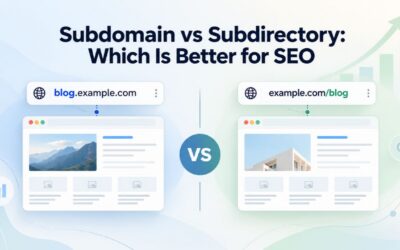
Subdomains (blog.yourdomain.com) and separate domains with different TLDs (yourdomain.com vs yourdomain.org) are distinct. Subdomains function as separate properties in search engines and don’t share authority as efficiently as subdirectories (yourdomain.com/blog/). For most businesses, subdomains help organize content, but if you’re protecting your brand, registering it across multiple TLDs offers clearer ownership and prevents confusion.
Glossary
- Authorization Code (AuthInfo Code): A unique code provided by your registrar that proves ownership of a domain. Required to transfer a domain to a new registrar.
- gTLD (Generic Top-Level Domain): A broad-purpose top-level domain open to any registrant worldwide, with no geographic or eligibility restrictions. Examples: .com, .net, .org.
- Redemption Grace Period (RGP): A 30-day window after a domain expires during which the previous owner can restore it before public release. You can’t transfer the domain during RGP.
- Registry Operator: The organization that manages a specific top-level domain’s infrastructure and database. Verisign manages .com and .net; the Public Interest Registry manages .org.
- TLD (Top-Level Domain): The suffix after the dot in a domain name, such as .com, .net, or .org. Also called a domain extension.