
The Three Validation Levels Explained
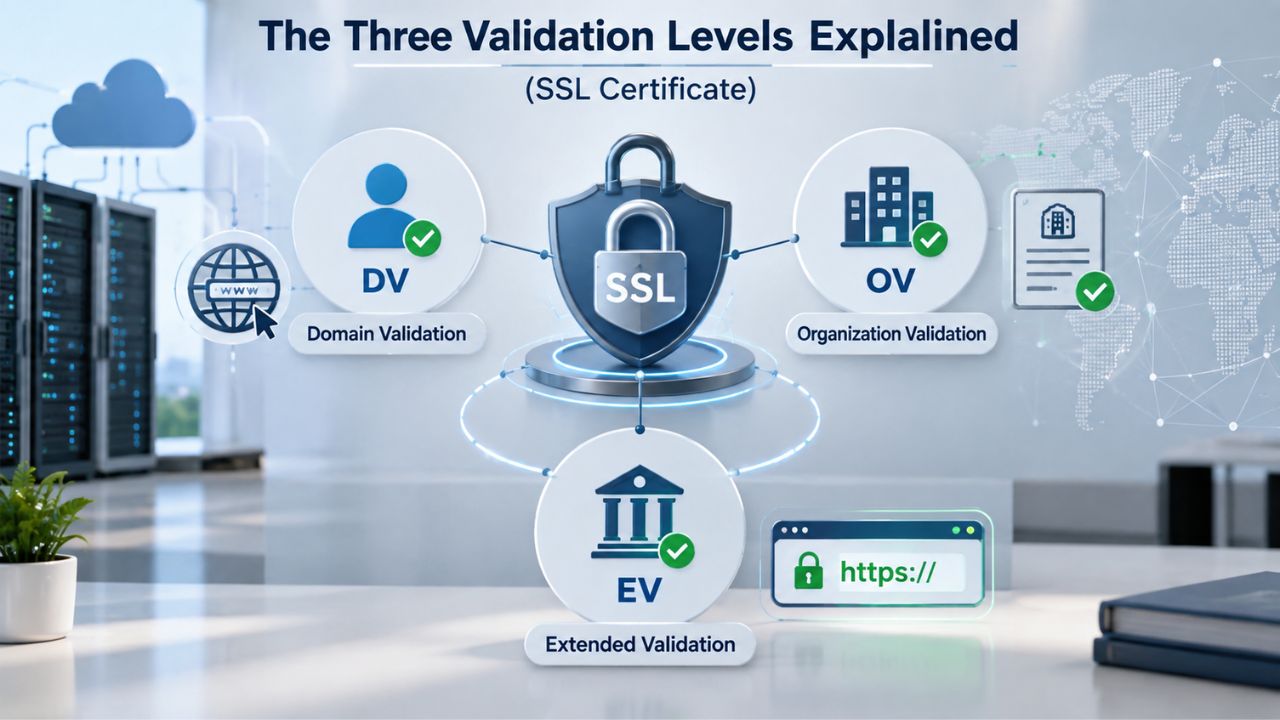
The validation level of an SSL certificate determines how thoroughly the Certificate Authority verifies your identity before issuing that certificate. Each level reflects a deeper commitment to verification, and each carries different implications for your website’s trust signals and your operational burden during issuance. Understanding what each validation level means is the foundation for making an informed choice.
What Each Validation Level Verifies
Domain Validation (DV) certificates verify only that you control the domain, nothing more. At the DV level, the process is fairly short. It requires only that you demonstrate control of the domain or URL through automated email confirmation, DNS record verification, or HTTP file upload. The Certificate Authority checks no organizational information and performs no identity verification beyond confirming you control the domain name.
Organization Validation (OV) and Extended Validation (EV) certificates go much deeper. OV verifies that you control the domain and authenticates the business organization affiliated with the domain, requiring checks of business registration and organizational identity. EV is the highest tier, verifying the domain owner, business organization, and the legal entity behind the business, plus director verification and additional corporate-governance checks. OV and EV certificates differ in the extra layers and steps required to obtain them, and this additional work translates directly into the level of assurance visitors receive when they interact with your site.
How the Issuance Process Works
When you request an SSL certificate through Niya Digital’s SSL Certificates Service, the Certificate Authority, GoDaddy, and its certificate-issuing subsidiary, Starfield Technologies, perform the validation work before issuing your certificate. For DV certificates, this process is nearly automated and completes in minutes because it verifies only domain control. OV certificates require identity and contact-information verification in addition to domain control, with extra checks that may require customer interaction, callbacks to verify business phone numbers, document submission, and business-registry lookups. This extended process typically takes one to three business days.
EV certificates demand the most thorough verification. The Certificate Authority verifies domain control, organization identity, legal entity status, director authorization, and often requires in-person verification or legal document review. This rigorous process can take three to seven or more business days, depending on how straightforward your corporate records are and how quickly you provide the requested documentation. Niya Digital is an authorized reseller of SSL certificates issued and validated by GoDaddy/Starfield, not a Certificate Authority itself, so Niya Digital guides you through certificate selection, manages the purchasing process, and provides installation support and renewal management throughout your certificate’s lifecycle.
SSL Certificate Plans & Pricing
Choose from a selection of SSL certificates designed to meet different website security and validation requirements. Find the right certificate to secure your website, protect sensitive information, improve search visibility, and build trust with your visitors.
Domain Validated (DV) SSL
(1-Site)
Protect 1 site.
- Domain validation
- SHA-2 & 2048-bit encryption.
- Boost SEO rankings
- Fast issuance in 5min
- Display HTTPS & padlock
- Security trust seal
- Support unlimited servers
- Free unlimited reissues
- $100,000 USD warranty
Domain Validated (DV) SSL
(5-Site)
Protect 5 sites.
- Domain validation
- SHA-2 & 2048-bit encryption.
- Boost SEO rankings
- Fast issuance in 5min
- Display HTTPS & padlock
- Security trust seal
- Support unlimited servers
- Free unlimited reissues
- $100,000 USD warranty
Extended Validation (EV) SSL
(1-Site)
Protect 1 site.
- Extended validation
- SHA-2 & 2048-bit encryption.
- Boost SEO rankings
- Display HTTPS & padlock
- Green address bar
- Security trust seal
- Support unlimited servers
- Free unlimited reissues
- $1,000,000 USD warranty
Extended Validation (EV) SSL
(5-Site)
Protect 5 sites.
- Extended validation
- SHA-2 & 2048-bit encryption.
- Boost SEO rankings
- Display HTTPS & padlock
- Green address bar
- Security trust seal
- Support unlimited servers
- Free unlimited reissues
- $1,000,000 USD warranty
Domain Validated (DV) SSL
(Wildcard)
Protect unlimited sub-domains.
- Domain validation
- SHA-2 & 2048-bit encryption.
- Boost SEO rankings
- Fast issuance in 5min
- Display HTTPS & padlock
- Security trust seal
- Support unlimited servers
- Free unlimited reissues
- $100,000 USD warranty
Choosing DV: Speed & Simplicity
Domain Validation certificates are the fastest and simplest option, making them ideal for sites where quick deployment and minimal friction are priorities. If your website doesn’t involve financial transactions, sensitive personal data, or organizational identity verification, DV certificates deliver all the encryption protection you need while getting you online faster.
When DV Is Enough for Your Site
Domain Validation certificates require only an automated verification that confirms the applicant owns the domain behind the website, making them suitable for anyone who wants to quickly establish encryption and remove browser “Not Secure” warnings. DV certificates are the right choice for personal blogs, documentation sites, developer portfolios, development and staging environments, and any low-risk website where the goal is basic HTTPS encryption and visitor data protection during transmission.
DV certificates do not verify that an organization is real, that a business is registered, or that any entity stands behind the domain. They confirm that someone who controls the domain requested the certificate. This is perfectly adequate for sites where visitors are not making high-stakes decisions, submitting sensitive personal data, or trusting your organization with credentials or payment information. For informational and low-risk content sites, DV’s lack of organizational verification is not a limitation; it’s appropriate.
The Speed Advantage
If you can prove domain control through DNS record updates, email confirmation, or HTTP file verification, you can have a fully functioning certificate operational within minutes, without needing to provide business documentation or organizational records. This speed is a genuine asset if you need to launch urgently, are troubleshooting a certificate renewal, or are deploying a time-sensitive project. Domain Validated certificates bypass manual verification entirely, relying on automated domain checks that complete almost instantly.
The tradeoff is visibility. A DV certificate proves someone controls the domain, but it tells visitors nothing about the organization behind it. For most personal sites, developer blogs, and informational websites, this limitation matters very little. Your visitors are seeking information, not evaluating whether an organization is trustworthy. However, for any site where organizational credibility matters- a business website, e-commerce storefront, or professional service- DV falls short of the trust signals your visitors expect.
Choosing OV: Business Trust Without Complexity
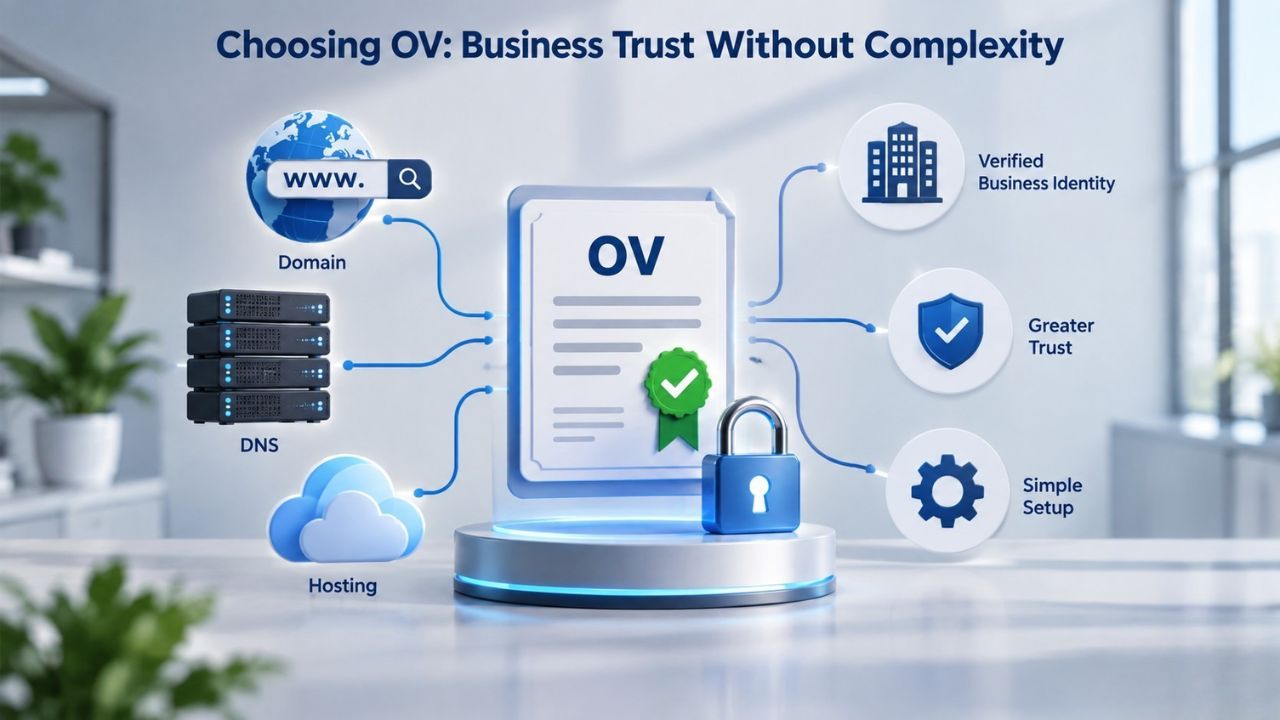
Organization Validation certificates balance DV’s simplicity with EV’s intensive vetting. OV adds organizational verification to domain control, assuring visitors that a real, registered business stands behind your site without the deep legal vetting EV demands.
What Organizational Validation Adds
Organizational Validation verifies the identity of the organization (such as a business, nonprofit, or government agency) listed in the certificate, along with the location where the organization operates. Beyond confirming you control the domain, the Certificate Authority checks business registration records, verifies the organization’s legal name and physical address, and typically contacts a phone number on file to confirm that someone with authority is requesting the certificate. This human verification step is what makes OV take longer than DV, but it also makes OV more valuable for business credibility.
The organizational name you provide during the OV request process becomes part of the certificate itself and is visible when a visitor inspects the certificate details in their browser. This display of a verified organization name, alongside a valid HTTPS connection and padlock icon, signals to visitors that a real, registered business stands behind the site and has undergone verification by a Certificate Authority. It’s a trust signal that helps reassure visitors they’re dealing with a legitimate entity, not an anonymous operator.
Best For Small Business and E-Commerce
Organization Validation certificates are recommended for small-to-medium business websites, e-commerce operations that don’t process credit-card payments through your own servers, professional service sites, and any customer-facing application where displaying verified business credibility strengthens visitor confidence. OV certificates offer a moderate level of trust and work well for public-facing websites with customer engagement or non-payment transactions. If you run a brick-and-mortar business with an online presence, a consulting firm, a digital agency, or an e-commerce shop selling products without handling sensitive payment data directly, OV provides the organizational verification your visitors expect.
The organizational verification name displayed in the certificate details becomes a competitive advantage over sites using basic DV certificates. When potential customers are deciding whether to trust your site with their information or business, the presence of an OV certificate, indicating that a Certificate Authority has verified your business registration and identity, can be the difference between conversion and abandonment. OV sits at the sweet spot for many businesses: it provides real organizational assurance without the time and documentation burden of EV validation.
Choosing EV: Maximum Assurance for High-Stakes Sites
Extended Validation certificates represent the highest standard of SSL certificate validation and organizational verification available to most businesses. EV is the appropriate choice when your site handles high-value transactions, sensitive personal or health information, or operates under regulatory compliance frameworks that expect the most rigorous identity verification standards.
The Highest Validation Standard
Extended Validation certificates are high-assurance identity certificates because they require verification of the domain owner, business organization, and the business’s legal entity, plus additional checks that go far beyond OV requirements. The Certificate Authority must verify director or officer authorization to request the certificate, confirm the business’s legal entity status and good standing, check that the business is actively operating, and sometimes require in-person verification or submission of legal corporate documents. These requirements exist because EV certificates carry enormous weight in the trust model; they’re reserved for organizations that meet strict criteria and warrant the deepest vetting.
This rigorous validation process is intentional design, not a flaw. EV certificates are created for scenarios where trust failure carries real financial, legal, or safety consequences. The weeks-long issuance timeline for some EV certificates reflects the depth of investigation required. For a financial institution, healthcare provider, or payment processor, this isn’t just appropriate; it’s essential. The Certificate Authority essentially vouches for your organization’s legitimacy and legal status, a powerful trust signal worth the extra time and effort.
When Compliance and Trust Demand It
Extended Validation certificates are essential for websites handling high-value financial transactions, payment processing platforms, healthcare providers managing protected patient information, and organizations subject to strict compliance frameworks like PCI DSS (Payment Card Industry Data Security Standard) for payment systems, HIPAA (Health Insurance Portability and Accountability Act) for healthcare, or GDPR (General Data Protection Regulation) for data protection. Financial institutions, major e-commerce operations with sensitive transaction data, and enterprises managing high-volume or high-value customer information require EV’s validation depth to meet audit and regulatory expectations.
Extended Validation SSL Certificates are granted only to organizations that meet strict criteria. These incorporated or limited liability companies are legally registered with “Good Standing,” “Active,” or equivalent status, as well as business entities such as general partnerships, unincorporated associations, DBAs, and sole proprietorships that can demonstrate legal legitimacy and active business operation. Your organizational name and EV status are visible in the browser when visitors inspect certificate details, providing the highest level of visual identity verification available in the modern SSL ecosystem.
Validation Timelines and Operational Implications
Understanding how long each validation level takes to issue is critical for planning your certificate deployment, managing renewal windows, and avoiding service interruption. Each validation level’s timeline reflects the depth of verification work required; DV’s speed comes at the cost of minimal vetting. In contrast, EV’s thoroughness requires substantial time investment from both the Certificate Authority and your organization.
Timeline Comparison Across Validation Levels
| Validation Level | Typical Issuance Time | What Gets Verified | Organization Name in Certificate |
|---|---|---|---|
| Domain Validation (DV) | Minutes to 1 hour | Domain control only (automated) | No |
| Organization Validation (OV) | 1–3 business days | Domain control + business registration, identity, and address | Yes, visible in certificate details |
| Extended Validation (EV) | 3–7+ business days | Domain control + business identity + legal entity status, director authorization, and operational verification | Yes, visible in certificate details and browser menus |
The timeline difference isn’t arbitrary; it reflects the validation work required at each level. DV is nearly instant because the entire process is automated; the Certificate Authority checks DNS records or responds to emails without human intervention. OV requires manual business research, registry lookups, and verification callbacks with company representatives, which takes days as the Certificate Authority coordinates with you and third-party data sources. EV demands investigation into corporate structures, director identities, business legitimacy, and often requires document submission or phone calls with senior company representatives; this work cannot be rushed and legitimately takes a week or more for complex organizations.
Strategic Implications for Your Site
When you’re planning an SSL certificate deployment, these timelines directly affect your project schedule. If you need to launch a website within 24 hours, DV is your only viable option; OV and EV cannot deliver in that timeframe. If you have one to two weeks before launch, OV becomes feasible and adds organizational credibility.
If you’re planning a financial or healthcare product launch with a flexible timeline, EV’s extended timeframe is an acceptable cost for the maximum trust and compliance assurance it provides. Factor these timelines into your renewal planning as well; if your current certificate expires with no planning, you can get a replacement DV certificate online in hours, but switching to OV or EV mid-crisis is not feasible.
Understand Your Timeline and Investment
SSL certificate validation takes time by design; each level’s timeline reflects the depth of verification protecting your site and your visitors. Whether you need a certificate deployed in hours or you’re planning with a flexible timeframe, understanding the relationship between validation speed and organizational assurance helps you commit to a realistic timeline. Niya Digital’s SSL Certificates Service guides you through every validation level with transparent timelines and straightforward processes.
Compliance and Regulatory Drivers for Validation Level Selection
Data-security and privacy frameworks set expectations or mandates around the encryption and organizational verification your website should demonstrate. Knowing which validation level matches your compliance obligations ensures your certificate investment supports both security and audit requirements.
When Regulations Mandate Specific Validation Levels
HTTPS encryption itself is increasingly mandated or expected under major compliance frameworks, PCI DSS for payment systems, HIPAA for healthcare, GDPR for EU-based organizations handling personal data, and SOC 2 for service providers managing customer systems. However, your organization’s risk assessment often determines the specific validation level. A payment-facing website typically needs OV or EV to meet PCI DSS audit requirements and show auditors organizational legitimacy. A healthcare provider handling protected health information benefits from OV or EV for HIPAA alignment, as auditors expect verified identity credentials behind your HTTPS connection. A GDPR-subject business needs HTTPS but may choose any validation level depending on data sensitivity and organizational risk tolerance.
For OV and EV certificates specifically, revalidation requirements add another compliance layer. The organization’s identity information (business name, address, legal registration status) must be revalidated annually, ensuring that your certificate always reflects current, accurate organizational data. This ongoing verification isn’t a burden; it’s a feature that keeps your certificate trustworthy and compliant throughout its active lifecycle. Many auditors and compliance reviewers specifically look for certificates with active organizational verification, not merely current encryption.
Important Note: Regulatory requirements vary significantly by jurisdiction, industry, and organizational context. Always consult with your compliance officer, legal team, or relevant auditors to confirm which validation level applies to your specific situation. What a financial institution needs differs from what a nonprofit needs, and frameworks in different countries set different expectations.
Building a Compliance-First Certificate Strategy
If your organization faces compliance obligations, build your SSL certificate strategy around regulatory requirements rather than choosing the simplest or cheapest option. An organization that skimps on SSL validation to save money and later fails an audit has made a false economy; the cost of audit failure, remediation, and reputational damage far exceeds the cost of appropriate certificates.
Conversely, an organization that invests in EV certificates for a low-risk informational website over-specifies beyond its needs and creates unnecessary renewal management overhead. Your compliance obligations should guide you toward the appropriate validation level without over-investing or under-protecting.
Trust Signals and Browser Display Evolution
How SSL certificates appear to visitors in their browsers has evolved significantly, and understanding both historical and current browser behavior helps you calibrate expectations around EV’s value and visibility. The visual trust signals your certificate provides are one factor in visitor confidence, but they’re not the only factor; organizational verification metadata remains valuable even when browser interface displays change.
Historical and Current Browser Display Differences
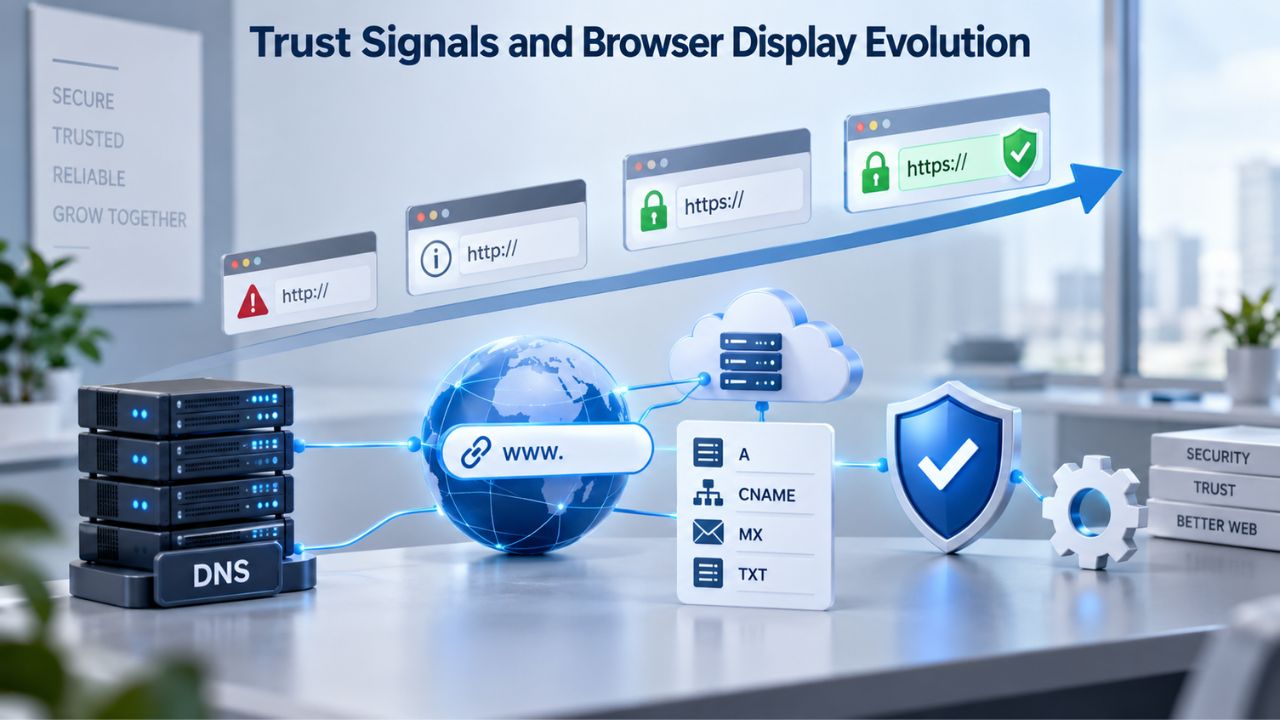
When you land on a website protected by any valid SSL certificate, DV, OV, or EV, your browser displays an HTTPS padlock and address-bar prefix indicating the connection is encrypted. For decades, this was the only browser-level trust signal visitors saw. However, Extended Validation certificates were historically accompanied by a distinctive green address bar that prominently displayed the organization’s name, making EV certificates visually unmistakable to even non-technical visitors. This green-bar display was considered a significant marketing advantage for EV certificates, as it provided immediate visual proof of organizational verification.
Most major browsers, Chrome, Firefox, Safari, and Edge, have de-emphasized or removed the green-bar EV display in recent years, reflecting evolving perspectives on certificate validation and user trust. However, in most major browsers today, EV status remains visible in certificate inspection menus and browser security details, and the deeper organizational verification EV represents remains valuable even without the historical visual marker. Mobile browsers typically display EV certificates the same way they display DV and OV certificates, with no special visual distinction.
Why This Evolution Matters (And Why EV Still Matters)
The shift away from prominent EV display doesn’t mean EV validation is less rigorous or less valuable; it means browsers have changed how they surface that information to users. Organizations and compliance auditors still recognize EV certificates as a marker of deep organizational verification, and for regulated industries like finance and healthcare, EV certificates remain audit-expected. What has changed is the user-facing visual prominence, not the underlying validation quality or compliance value. When a visitor inspects the certificate details (right-click → “View Certificate” in most browsers), they’ll still see the organizational name and validation level, and savvy business decision-makers who care about organizational verification will still look for this information.
For most casual website visitors who don’t inspect certificates, the HTTPS padlock and address-bar changes are sufficient trust signals regardless of validation level. The real value of EV to organizations isn’t the green bar; it’s the compliance expectation, the audit trail of organizational verification, and the deep vetting that goes into validating your organization’s identity. These remain powerful even as browsers no longer use distinctive visual markers to highlight EV certificates.
Combining Validation Level with Certificate Type and Structure
Validation level (DV, OV, EV) is conceptually separate from certificate type and structure (single-domain, wildcard, multi-domain/SAN, or managed SSL). You can purchase DV with any certificate structure; the same applies to OV and EV. Understanding this independence helps you make cost-effective and architecturally sound certificate choices for your site’s structure and growth plans.
How Certificate Types Work Across Validation Levels
A single-domain certificate protects one specific domain, for example, example.com or www.example.com, but not both. A wildcard certificate protects the primary domain and all subdomains under it; for example, *.example.com covers www.example.com, mail.example.com, api.example.com, and any other subdomain you create. A multi-domain SAN (Subject Alternative Name) certificate protects multiple distinct domains under one certificate; for example, example.com, yourshop.com, and myblog.org can all be covered by one SAN certificate. Managed SSL is an optional service where your certificate provider handles renewal automation, lifecycle management, and installation support, removing the burden of manual expiration tracking from your team.
Each structure is available at any validation level. You can purchase a single-domain DV certificate for quick deployment of a simple site, a wildcard OV certificate to cover all subdomains of your business domain with organizational verification, or a multi-domain EV SAN certificate to protect multiple critical business properties under the highest validation standard. The validation level you choose (how deeply your organization is verified) is independent of the certificate’s domain coverage (how many domains or subdomains it protects).
Decision Table: Validation Level × Certificate Structure
| Scenario | Best Validation Level | Recommended Certificate Type | Why |
|---|---|---|---|
| Small blog or personal portfolio | DV | Single-domain | Quick launch, minimal cost, low-risk content, no organizational verification needed |
| Business site with www and non-www variants | OV | Single-domain (with alternate-name covering both) or multi-domain SAN | Organizational trust signal, standard business launch, cleaner certificate management |
| E-commerce with multiple branded storefronts | OV or EV | Multi-domain SAN | Multiple revenue-generating domains, high trust priority, single certificate for easier management |
| SaaS platform with customer subdomains | DV or OV | Wildcard | Unlimited customer-facing subdomains without certificate reissue, managed SSL recommended for automation |
| Financial services or payment processor | EV | Wildcard or multi-domain SAN | Maximum organizational verification, regulatory expectation, multiple service entry points, managed SSL strongly recommended |
| Large enterprise with complex infrastructure | OV or EV | Multi-domain SAN with managed SSL | Centralized lifecycle management, multiple critical domains, automated renewal prevents expiration |
Niya Digital’s SSL Certificates Service offers guidance on which validation level to pair with which certificate structure to match your site’s architecture, growth plans, and trust requirements. As your business grows and you add subdomains or brand properties, managed SSL with wildcard or multi-domain certificates helps you avoid accumulating multiple certificates that require individual renewal tracking.
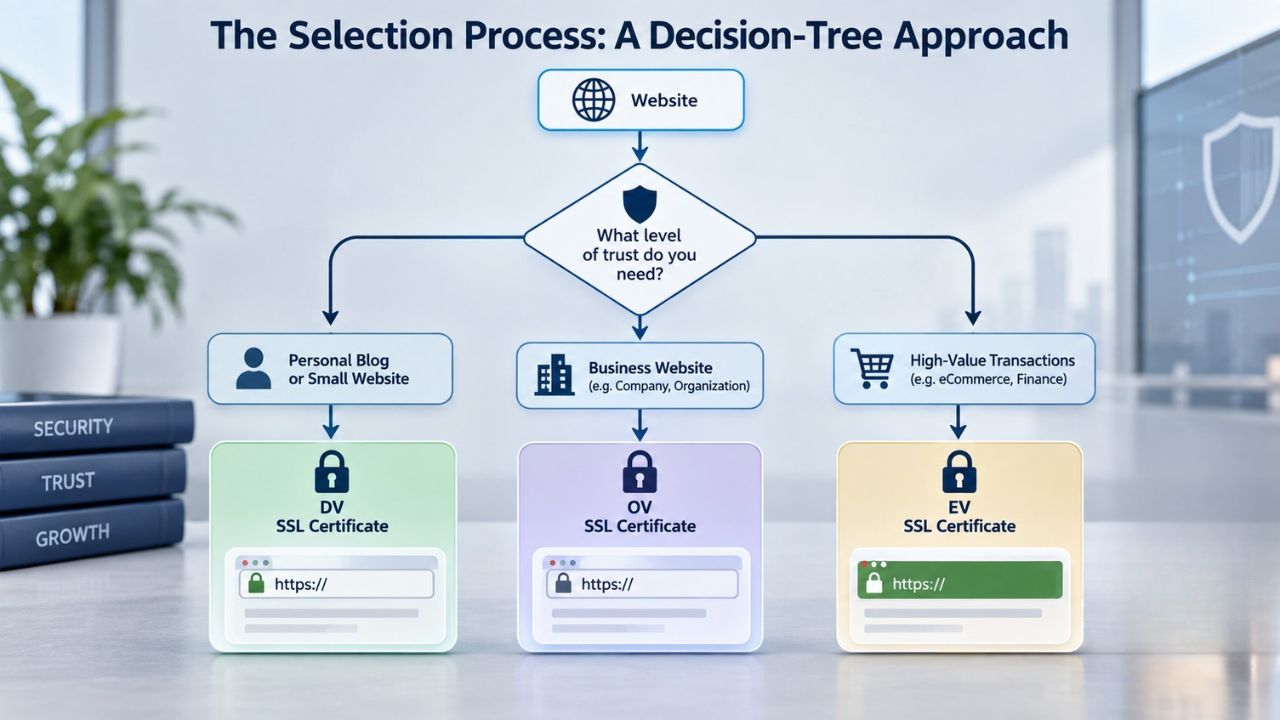
The Selection Process: A Decision-Tree Approach
Choosing the right validation level requires honest assessment of your site’s purpose, your audience’s trust expectations, and your organization’s capacity to provide verification documents during the validation process. Working through these questions in order helps you choose the right validation level without over-specifying or under-protecting.
Key Questions to Ask Before Selecting a Validation Level
Before committing to a validation level, ask yourself these questions in sequence. First, what is the primary purpose of your website? If it’s a personal blog, informational site, developer portfolio, or development/test environment, DV likely suffices; your visitors seek information, not organizational credentials. If it’s a business website, professional service site, or e-commerce storefront, OV adds organizational credibility that supports conversion and visitor confidence. If it handles high-value transactions, payments, sensitive data, or operates in a regulated industry, EV is the appropriate standard that both your business needs and your audience expects.
Second, do you handle payment data or sensitive user information? If yes, check your specific compliance obligations (PCI DSS, HIPAA, SOC 2, or industry-specific frameworks). Most payment-facing sites require OV at minimum; many require EV. If you collect no sensitive data and your site is purely informational or entertainment-focused, DV remains defensible. Third, what is your launch timeline? If you need a certificate within hours, DV is your only option. If you have one to three days, OV becomes feasible. If you have a week or more, EV is achievable without schedule pressure.
Fourth, how ready are your verification documents? DV requires no organizational documentation. OV requires business registration information and contact verification (a few hours of administrative effort). EV requires detailed company information, director verification, and possibly legal documents (days of effort). Choose the level matching your organization’s capacity to verify quickly. Finally, what’s your budget and renewal capacity? DV keeps certificate costs low but requires manual renewal tracking. OV and EV demand more upfront investment but may be offset by managed SSL’s automation if renewal tracking is burdensome.
Avoiding Common Mistakes in Validation Selection
Niya Digital’s team has found that small business owners often overestimate the validation level they need, starting with OV when DV would serve them fine, then later underestimate renewal management complexity until a certificate silently expires and takes their site offline.
Other organizations under-invest in validation levels, choosing DV for sites where OV’s organizational verification would meaningfully increase visitor trust and conversion rates. The goal isn’t to maximize validation level for status, but to match it to actual business risk and audience expectations.
Making Your Final Choice and Getting Started
Once you’ve assessed your site’s purpose, compliance obligations, timeline, and visitor trust requirements, selecting the appropriate validation level becomes clear. The final step is moving from decision to implementation, understanding what happens next and how to manage your certificate through its lifecycle.
Your Validation-Level Decision Framework at a Glance
| Decision Factor | Favors DV | Favors OV | Favors EV |
|---|---|---|---|
| Primary site purpose | Blog, portfolio, informational content | Business, professional services, e-commerce | Financial services, healthcare, high-value transactions |
| Budget or cost sensitivity | Yes, cost-critical priority | Moderate, acceptable business cost | No, compliance/trust requirements drive spending |
| Regulatory or compliance requirements | None | Moderate compliance (basic HTTPS expected) | Strict framework (PCI, HIPAA, GDPR, SOC 2) |
| Timeline to launch | Urgent (hours only) | Standard (days acceptable) | Flexible (week+ available) |
| Visitor trust priority | Low (informational audience) | Medium (business credibility matters) | High (financial/health data, regulatory audit) |
| Organizational verification readiness | Not needed | Business registration docs available | Full corporate vetting capacity available |
| Payment or sensitive data handling | None | Limited or non-payment-processing | Regulated or high-value transactions |
| Site architecture | Single-domain standard | Single-domain or wildcard | Wildcard or multi-domain SAN |
After you select your validation level, choose your certificate type (single-domain, wildcard, or multi-domain SAN) and purchase model (self-managed or managed SSL with automatic renewal). Niya Digital’s SSL Certificates Service supports all three validation levels and certificate types, with guidance on installation, configuration, and renewal management to ensure your certificate stays current throughout its active lifecycle.
Moving from Decision to Implementation
Once you’ve selected your validation level, the next step is choosing your certificate type (single-domain, wildcard, or multi-domain SAN) and purchase model (self-managed or managed SSL with automatic renewal). Niya Digital’s SSL Certificates Service supports all three validation levels and certificate types, with guidance on installation, configuration, and renewal management to ensure your certificate stays current throughout its active lifecycle.
Once you’ve selected your validation level and certificate structure, you’re ready to begin the verification process. For DV certificates, this happens within hours. For OV, prepare business registration documents and confirm your business contact information is current and reachable by phone. For EV, work with your organization’s legal or compliance team to gather corporate documents, director information, and legal-entity verification materials before requesting the certificate. Upfront preparation time prevents delays and speeds issuance once you submit your request.
Getting Your SSL Certificate Today
Choosing the right validation level sets the foundation for a trustworthy, compliant website. Whether you need the speed of Domain Validation, the business verification of Organization Validation, or the maximum assurance of Extended Validation, Niya Digital’s SSL Certificates Service simplifies selection, purchase, and management. With support for installation across major platforms, renewal automation options, and expert guidance on matching validation levels to your site’s risk profile, getting the right certificate and keeping it current is straightforward.
Frequently Asked Questions
What’s the real difference between DV and OV from a visitor’s perspective?
When a visitor lands on your site, both DV and OV show the same HTTPS padlock and address-bar prefix. The practical difference is in the certificate details: OV lists your verified organization name, while DV does not. For most casual browsing, this distinction is invisible.
For high-stakes decisions like payments or login, visitors who inspect certificate details will see OV’s organizational verification as a trust signal that DV lacks. Organizational credibility matters most when visitors are making important decisions on your site.
Can I upgrade from DV to OV or EV without starting over?
No. You cannot upgrade an existing certificate to a higher validation level. To change validation levels, purchase a new certificate at the desired level and deploy it alongside your existing certificate during a transition period. Niya Digital’s installation support team can help manage this transition to minimize downtime and complexity during the changeover.
How long is an SSL certificate valid once it’s been issued?
SSL/TLS certificates are currently valid for up to 398 days from issuance, per CA/Browser Forum baseline requirements established to enhance security and encourage regular certificate rotation. Renew your certificate before it expires to avoid service interruption, security warnings, or email/API failures. Managed SSL services automate renewal reminders and reissuance, so you never have to track expiration dates manually.
Does validation level affect encryption strength?
No. A DV certificate uses the same encryption standard (SHA-2, 2048-bit or stronger) as OV and EV certificates. Validation level determines organizational verification depth and trust-signal strength, not encryption cipher strength or data-protection capability. All three validation levels protect data in transit equally using identical cryptographic standards.
Can I get a wildcard or multi-domain (SAN) certificate with EV?
Yes. Wildcard and multi-domain SAN certificates are available at all three validation levels, DV, OV, and EV. Your validation level choice (what gets verified) is independent of your certificate structure choice (how many domains it protects). You can have a wildcard EV certificate covering all subdomains with maximum organizational verification, or a multi-domain EV SAN covering multiple distinct business domains under one certificate with EV validation applied to all.
What happens if I let my SSL certificate expire?
When a certificate expires, browsers display a security warning (“Not Secure,” “Not Trusted,” or “Your connection is not private”) on your site, and many visitors will leave rather than proceed. Email, APIs, mobile apps, and other services relying on that certificate also fail.
The solution is renewal before expiration through proper tracking or managed SSL automation. Managed SSL services send renewal reminders and handle reissuance automatically so expiration never catches you by surprise.
How do I know which validation level is required by my compliance framework?
Consult your compliance team, external auditor, or the regulatory framework’s own documentation. PCI DSS requires encrypted connections, but validation-level requirements vary by context and payment-processing architecture. HIPAA expects strong verification appropriate to data sensitivity.
GDPR expects encryption in transit but doesn’t mandate a specific validation level in most scenarios. Your industry, data type, and organizational risk assessment should guide the appropriate level; always verify with your compliance stakeholders rather than guessing.
Is EV worth the extra cost and time if browsers no longer show the green address bar?
Yes, absolutely, for regulated industries and high-assurance contexts. EV validation rigor is mandated or expected by PCI DSS audits and HIPAA compliance reviews.
Organizational verification metadata and legal entity validation remain valuable for audit trails and regulatory expectations, even if the visual browser signal has diminished. For e-commerce, financial services, and regulated sectors, EV is an investment in compliance, audit readiness, and organizational credibility, not just visual aesthetics in the browser.
How does the Certificate Authority actually perform OV validation?
The Certificate Authority (GoDaddy/Starfield, in the case of Niya Digital’s certificates) verifies your business registration through public and proprietary databases, confirms your business address through directory lookups, and contacts the phone number on file to authorize the certificate request and confirm that someone with organizational authority is requesting it.
This process typically takes one to three business days depending on verification source availability and your responsiveness. You may need to provide business documentation (articles of incorporation, business license, address verification) if automated verification stalls or cannot confirm your organization’s status.
Can I have multiple SSL certificates at different validation levels for the same domain?
Yes, technically. You could have a DV certificate for www.example.com and a separate OV certificate for shop.example.com if your certificate structure or validation needs differ by subdomain. However, this adds complexity and management overhead; you’re now tracking two separate certificates with separate renewal dates. A single unified certificate (either a single-domain OV covering both, or a wildcard OV covering all subdomains) is simpler from a lifecycle-management perspective.
What happens to my existing DV certificate if I want to switch to OV?
You purchase a new OV certificate at the higher validation level. Your existing DV certificate continues to work until its expiration date (up to 398 days from issuance). During the transition, you deploy the new OV certificate on your web server, updating DNS records or server configuration to point to the new certificate. Once the new OV certificate is live and validated by visitors’ browsers, you no longer use your old DV certificate, though it remains valid until its natural expiration date.
Do I need to change any code or configuration when installing a higher-level certificate?
No. From a technical perspective, DV, OV, and EV certificates are installed the same way; they’re all X.509 certificates in standard PEM or DER format. Web server configuration (Apache, Nginx, IIS, cPanel, WordPress, etc.) is identical regardless of validation level. Validation-level differences are metadata fields within the certificate structure, not architectural or technical changes. Installing an OV or EV certificate uses the same installation process as DV.
Does validation level affect SEO or search engine rankings?
HTTPS itself is a ranking signal, but Google or other search engines do not directly evaluate validation level (DV versus OV versus EV) for ranking purposes. Google and other search engines treat a valid DV certificate the same as a valid OV or EV certificate for ranking purposes. Choose your validation level based on trust, compliance, and audience expectations, not SEO. However, a trustworthy, compliant site with appropriate validation is more likely to drive conversions, which indirectly supports your SEO outcomes through user-engagement signals.
Can I reuse an OV organizational validation across multiple certificate renewals?
Yes, with specific limits. As of March 2026, domain validation records for publicly trusted SSL/TLS certificates expire after 200 days. For OV and EV certificates, the organization’s identity information (business name, address, legal status) is valid for up to 398 days. This means you can renew an OV certificate within the 398-day window without re-submitting organization identity documents; you only need to re-validate domain control. This revalidation window balances security with administrative convenience.
What should I do if my Certificate Authority rejects my validation request?
Contact your certificate provider’s support team immediately. Common rejection reasons include incorrect business information in public registries, unreachable contact phone numbers or email addresses, incomplete documentation, or mismatches between your submitted information and business-registry records. Niya Digital’s support team can help you resolve validation blocks, resubmit corrected information, and expedite reissuance without losing your order or deposit.
Glossary
- SSL/TLS: SSL (Secure Sockets Layer) and TLS (Transport Layer Security) are cryptographic protocols that encrypt data in transit between a visitor’s browser and your web server. Modern certificates use TLS; people often use “SSL” colloquially to refer to both SSL and TLS interchangeably.
- Certificate Authority (CA): The organization that validates your organization’s identity and issues SSL certificates. GoDaddy and Starfield Technologies issue Niya Digital’s certificates and serve as the Certificate Authorities backing Niya Digital’s reseller service.
- Domain Validation (DV): The lightest SSL certificate validation level, requiring only automated proof that you control the domain. Issued in minutes with no organizational verification steps.
- Organization Validation (OV): An SSL certificate validation level requiring the CA to verify the domain owner and confirm the organization’s legal registration, business address, and contact information. Typically issued in one to three business days.
- Extended Validation (EV): The highest SSL certificate validation level, requiring rigorous verification of domain control, organizational identity, legal entity status, director authorization, and operational legitimacy. Typically issued in three to seven or more business days.
- Wildcard Certificate: An SSL certificate protecting a domain and all its subdomains (for example, *.example.com covers www.example.com, mail.example.com, and any other subdomain).
- Multi-Domain SAN Certificate: An SSL certificate protecting multiple distinct domains under one certificate (for example, example.com, shop.example.com, and blog.example.com). “SAN” stands for Subject Alternative Name.