What Public WHOIS Actually Shows Today
Most people picture WHOIS as a fully open directory, but that hasn’t been accurate since 2018. Understanding the current baseline is the first step in deciding whether domain privacy adds meaningful value for your situation.
Registration Data Redaction Since 2018
On 17 May 2018, the ICANN Board adopted the Temporary Specification for gTLD Registration Data, which modified registrar and registry agreement requirements to comply with the EU’s General Data Protection Regulation while trying to keep the WHOIS system available as much as possible. That specification maintains full collection of registration data, including registrant, administrative, and technical contact information. Still, it restricts most of it to layered or tiered access, meaning only requesters with a legitimate and proportionate purpose can apply for it. In practice, this means the redaction most people encounter in public WHOIS or RDAP lookups today is policy, not a gap in the system.
This is the first argument worth stating plainly: what looks like concealment is really a rule ICANN’s contracted parties must follow. Because most personal data is already withheld from public view by default, domain privacy is best understood as an additional layer sitting on top of that baseline, not a replacement for it. Some registrants assume they decide whether their address becomes public; in reality, that decision was largely made for them once the Temporary Specification took effect, and privacy services address what’s left.
Registration Data Fields, What’s Public By Default Today
| Data Field | Public by Default Today? | Why |
|---|---|---|
| Registrant Name | Typically redacted | Restricted to layered/tiered access under the Temporary Specification. |
| Registrant Organization | Sometimes visible | Organization name may fall outside personal-data redaction depending on registry practice. |
| Registrant Email | Typically redacted or proxied | Personal contact fields are among those restricted to layered access. |
| Registrant Phone | Typically redacted | Personal contact detail covered by the same tiered-access restriction. |
| Street Address | Typically redacted | Personal contact detail covered by the same tiered-access restriction. |
| Admin/Technical Contact | Typically redacted | Falls under the same registrant, admin, and technical contact categories the Temporary Specification restricts. |
| Domain Status Codes | Public | Non-personal data required to remain publicly accessible. |
| Creation/Expiration Dates | Public | Non-personal data required to remain publicly accessible. |
Fields That Still Stay Visible
Not every field disappeared from public view. Under current ICANN policy, ICANN-accredited registrars and gTLD registry operators must still provide public access to non-personal gTLD domain registration data, which typically includes the domain’s creation and expiration dates, status codes, and the sponsoring registrar’s name. Redaction also isn’t perfectly uniform: across registrars and registry operators, which fields are redacted can vary, so two lookups on domains registered through different providers may not look identical.
That variance matters for anyone trying to reason about what a lookup will actually reveal. A registrant relying on redaction alone shouldn’t assume every registrar handles the same fields the same way, since policy sets a floor rather than a single fixed template. Reading the specific fields returned for your own domain, rather than assuming a general rule applies uniformly, is a more reliable way to know what’s public before deciding whether WHOIS Privacy Protection is worth adding.

Domain Name Registration
Each and every domain name comes with all you need to get online.
- Domain Forwarding and Masking: Direct any domain name you own to your website. Anyone who types that domain name into their browser is taken directly to your website.
- Domain Locking: Domain locking prevents accidental or intentional transfers of domain ownership and stops anyone from redirecting your nameservers.
- Total DNS Control: Manage your domain nameserver (DNS) records and set your email, FTP, sub-domains and website location all from one control panel.
- Change of Registration: Assign your domain name to someone else or change the contacts for your domain online anytime.
- Status Alerts: Monitor the status of your domain and get instant alerts if there's been a change.
- Auto Renew Protection: No need to watch expiration dates to make sure you renew on time! Auto renew keeps your domains, hosting, website builders, and other products in your name and under your control.
Domain Disclaimers:
- Special savings apply only to first year of registration. You must purchase entire section to qualify for special savings.
- The final price may differ because of additional sales, fees, and promotions.
- Products will automatically renew until cancelled. You may turn off the auto-renewal feature by visiting your account.
- Change of registration may require a fee for certain domains.
How WHOIS Became RDAP
The protocol behind these lookups has changed as much as the policy governing them. Knowing why WHOIS was replaced helps explain some of the confusion around what today’s tools actually show.
A Protocol Built For An Older Internet
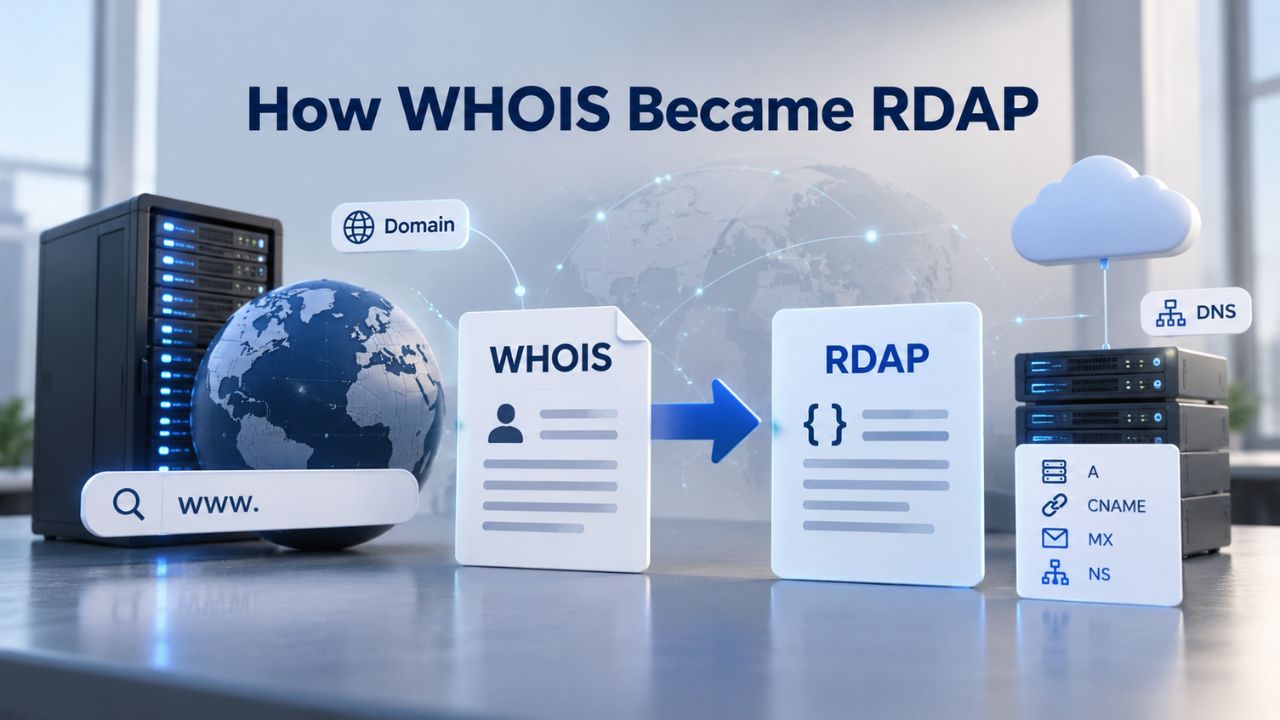
WHOIS refers to the protocols, services, and data types associated with domain name and IP address registration information, historically returned in loosely structured text. It was never designed with modern privacy expectations, automation needs, or international character sets in mind. ICANN’s own technical review identified specific deficiencies with the older system, including a lack of support for internationalization, no secure access to data, no differentiated access, and no standardized query or response formats. Those gaps made it difficult to build consistent tools around WHOIS, and they made it nearly impossible to apply privacy rules cleanly across every registry.
Because the underlying protocol couldn’t support structured, permission-based access, the industry needed something built for different expectations. That’s the second thread connecting WHOIS’s technical limitations to the privacy questions registrants ask today: the tool itself wasn’t built to distinguish between a curious visitor and someone with a legitimate legal reason to see more.
What Changed When RDAP Took Over
The Registration Data Access Protocol, or RDAP, was developed as a standardized replacement. As of 28 January 2025, it became the definitive source for delivering gTLD registration information, replacing sunsetted WHOIS services. RDAP returns registration data in structured, machine-readable formats and supports several capabilities WHOIS never had, including internationalization, secure access to data, and automatic location of authoritative servers. It also supports differentiated access by design, a technical foundation that layered redaction policy can run on.
The scale of that shift is significant: RDAP query volume across all server types is now estimated at more than 10 billion queries per month, reflecting how deeply embedded registration-data lookups are in security tooling, domain research, and everyday verification. For most registrants, the practical difference between old WHOIS and current RDAP is invisible day to day: you’re still looking up a domain and getting a result, but the infrastructure underneath now supports redaction and a request-based access model that shapes what you see.
What Domain Privacy Adds On Top
With the current baseline established, it’s worth being precise about what a domain privacy service actually changes. It isn’t a separate database; it’s a substitution layered over standard registration data.
Replacing Contact Details With Proxy Information
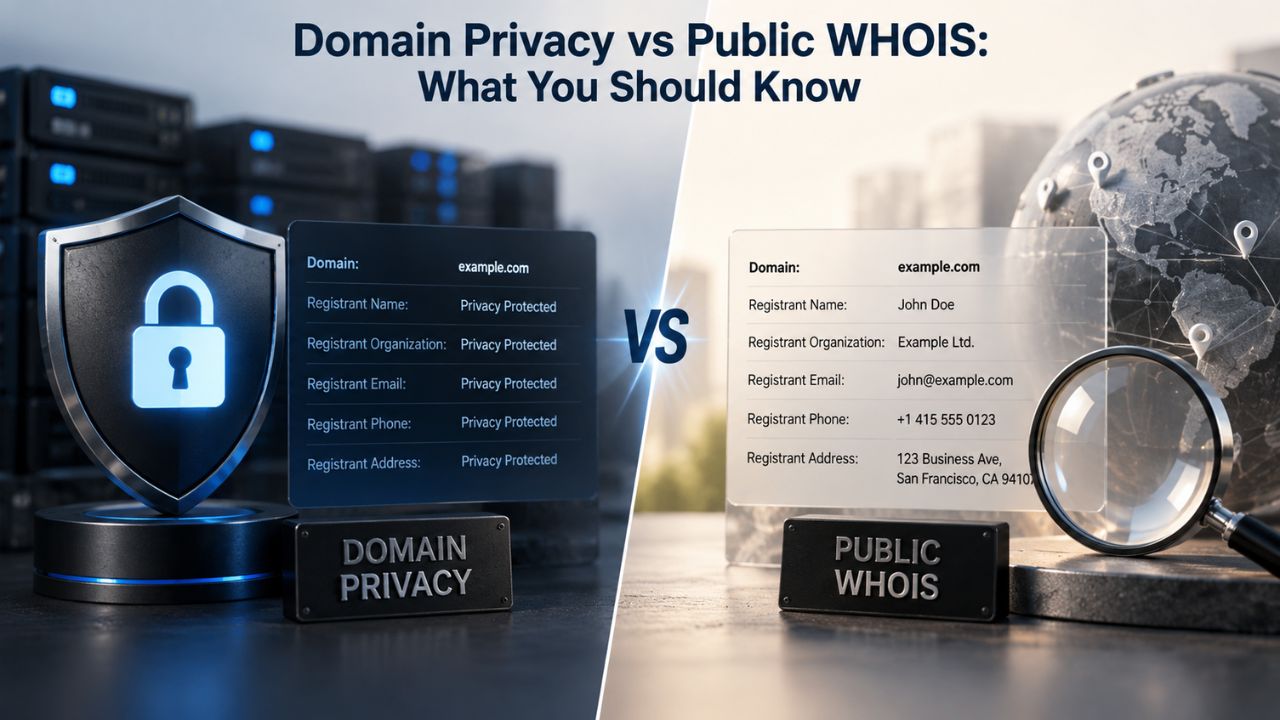
Domain privacy hides a domain registrant’s personal contact information from public WHOIS or RDAP records by replacing the registrant’s name, address, email, and phone number with forwarding or anonymized contact details. The domain still resolves normally, still functions across the internet exactly as before, and the registrant remains the legal owner on file with the registrar; only the publicly displayed contact fields change. Existing requirements for privacy and proxy service registrations offered through registrar affiliates and resellers are set out in the 2013 Registrar Accreditation Agreement’s Specification on Privacy and Proxy Registrations, which is the contractual basis most current privacy offerings operate under.
A fully separate, dedicated accreditation program specifically for privacy and proxy providers has been discussed for years but remains on hold pending further community review. That doesn’t mean privacy services are unregulated; they still operate under existing registrar agreement terms. Still, it does mean the landscape isn’t governed by one single, dedicated accreditation framework the way domain registration itself is.
Privacy Is A Layer, Not Invisibility
Because domain privacy sits on top of already-redacted registration data rather than replacing an otherwise fully public record, it’s more accurate to describe it as narrowing exposure than eliminating it. Real ownership records, billing information, and legal registrant status all remain on file with the registrar regardless of whether privacy is enabled, and that data can still be produced through appropriate legal or policy channels. A registrant weighing domain privacy shouldn’t treat it as a way to disappear from the domain system entirely, since the service was never designed to work that way.
This distinction matters most when someone is deciding how much protection a given domain actually needs. A personal blog and a business’s primary commercial domain may carry very different exposure profiles, even though both could technically use the same privacy add-on. Thinking of domain privacy as a targeted reduction in contact-detail exposure, rather than a blanket shield, sets more realistic expectations for what changes and what doesn’t.
Who Can Still Request Your Data
Redaction and privacy both raise an obvious question: if personal data isn’t publicly visible, is it gone for good? It isn’t, and understanding the request-based access model clarifies why.
Legitimate Purposes Under ICANN Policy
The Temporary Specification’s tiered-access model was built specifically so that users with a legitimate and proportionate purpose could still request access to non-public personal data through registrars and registry operators. This is the third recurring idea worth stating in full: privacy and redaction-gated access rather than deletion. Law enforcement inquiries, intellectual property disputes, and security investigations are the kinds of situations this request-based model was designed to accommodate, since those parties often have a documented reason to see contact information that a casual visitor does not.
That gating function is also what separates domain privacy from anonymity in any legal sense. A registrant using a privacy service is still identifiable through the registrar’s own records when a valid request is made, and the registrar remains responsible for maintaining that underlying data accurately regardless of what’s shown publicly.
Requesting Non-Public Registration Data
RDAP’s technical design supports this model more cleanly than legacy WHOIS ever could, since it was built to support redaction and role-based access as core features rather than workarounds. Structured request processes for accessing non-public gTLD registration data give parties with a documented need a defined path, rather than relying on informal outreach to a registrar’s support team. [CHECK: prefer a direct ICANN page on this request process if a more specific source is later confirmed; current sourcing generalizes the mechanism rather than naming a specific tool.]
For an everyday registrant, the practical takeaway isn’t that data requests happen constantly; most domains never trigger one, but that the option exists as a structural backstop. That backstop helps redaction and privacy coexist with dispute resolution, abuse reporting, and law enforcement needs without requiring registration data to be fully public again.
Domain Privacy And Hijacking Risk
Security is often the first reason people ask about domain privacy, and it’s worth being specific about what kind of risk it actually reduces.

How Social Engineering Exploits Public Contacts
Publicly visible WHOIS information can help attackers construct convincing social engineering attempts, because a name, phone number, and physical address give an attacker material to impersonate a domain owner credibly. One documented pattern involves attackers impersonating the domain owner and contacting the registrar to request a transfer; if a registrar’s verification process is weak, it can approve the transfer before the real owner even notices something is wrong. Attackers don’t need much, often just enough personal detail to sound legitimate on a phone call or in a support ticket.
Niya Digital’s team has found that domains with exposed contact information tend to draw more phishing and impersonation attempts against their registrant accounts than domains with privacy enabled. This pattern aligns with broader security research on how attackers gather information before attempting account takeover, transfer fraud, or targeted phishing. It’s also a reminder that the risk isn’t hypothetical; it shows up in support patterns, not just security whitepapers.
Reducing Exposure Without Eliminating Risk
Domain privacy narrows the amount of identifying information available to a would-be attacker, which is a genuine, measurable reduction in one specific attack surface. It does not, however, prevent every path to account compromise, and it can’t substitute for weak passwords, missing two-factor authentication, or a registrar account with poor recovery controls. Framing privacy as risk reduction rather than a guarantee keeps expectations aligned with what the service can actually do; public contact exposure is one entry point among several that attackers use, and closing it doesn’t close the others.
That’s the fullest statement of the second recurring idea in this guide: domain privacy shrinks one specific slice of risk without eliminating the broader threat landscape around domain security. Anyone evaluating WHOIS Privacy Protection as a security measure should treat it as one control in a layered approach, not a stand-alone fix.
Explore Domain Privacy Options With Niya Digital
If you’re weighing domain privacy against a fully public registration, Niya Digital can help you evaluate the right option for your domain portfolio, whether you’re managing a single personal website or multiple business domains through Bulk Domain Registration. Working alongside an ICANN-accredited registrar partner, Niya Digital helps you understand what information is currently visible for your domains and how domain privacy protection can help safeguard your personal contact details.
TLD And Regional Variation In Privacy
Privacy availability isn’t identical everywhere, and that variation often confuses anyone managing domains across multiple extensions.
Why Some Extensions Restrict Privacy
Not every top-level domain permits privacy or proxy services the same way. GDPR’s redaction requirement applies specifically to gTLD registrars operating under ICANN’s framework; separately, country-code registries set their own rules that don’t automatically follow the gTLD approach. Some country-code registries require full registrant contact data to remain visible for most domains, regardless of the registrant’s personal preference, because their policies were written independently of ICANN’s consensus process.
This is a case where a single-country rule shouldn’t be treated as a global default. Rather than assuming privacy is available everywhere a domain can be registered, it’s safer to treat availability as varying by TLD and region, and to check the specific extension you’re registering under rather than extrapolating from a different one.
Country-Code Domains Follow Local Rules
ICANN’s own policies on transfer locks, redemption grace periods, and WHOIS or RDAP formatting are global by design, since they apply across the gTLD system ICANN directly governs. Country-code domains sit outside that direct governance in many respects, which is why privacy rules, contact requirements, and even renewal grace periods can differ meaningfully from one country-code registry to the next. A registrant who’s used to privacy being available by default on a .com domain may find a specific country-code extension handles it differently, or not at all.
The practical guidance here is straightforward: confirm privacy eligibility for the specific extension you’re using rather than assuming uniform rules across your entire domain portfolio. This matters most for businesses managing Domain Hosting for Agencies or multi-region brand presence, where a mix of gTLDs and country-code domains is common, and each may carry different privacy defaults.
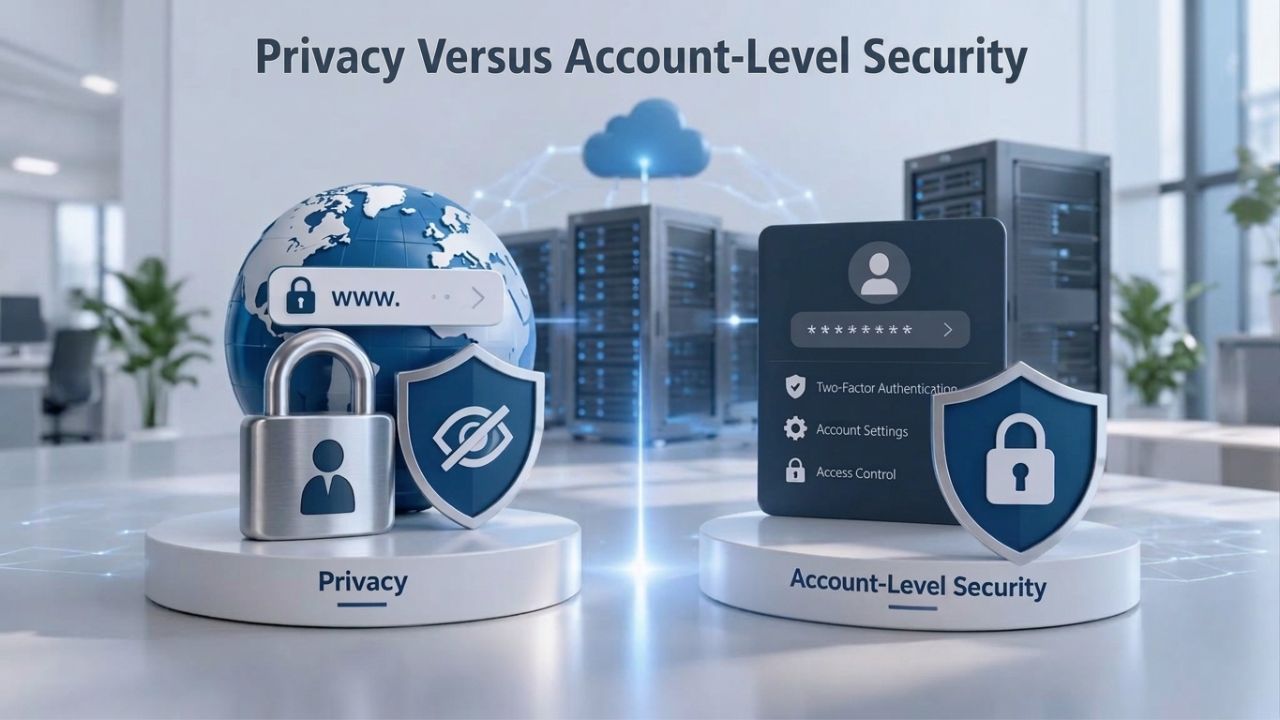
Privacy Versus Account-Level Security
Domain privacy addresses what’s publicly visible, but it isn’t the only, or even the primary, layer standing between your domain and unauthorized changes.
Locks, Authentication, And Ongoing Monitoring
Beyond privacy, several other controls directly reduce the odds of a successful takeover. Enabling a domain registry or transfer lock stops unauthorized transfer attempts by requiring manual approval before ownership or registrar changes take effect, which closes a path that privacy alone doesn’t address. Two-factor authentication on a registrar account, regularly updated contact details, and periodic review of domain status codes each target a different stage of the account-compromise chain, from initial credential theft through to the final unauthorized change.
None of these controls is redundant with the others. A transfer lock does nothing to stop credential phishing, and two-factor authentication does nothing to stop expired-domain reclamation if a renewal is missed, so treating any single control as sufficient tends to leave gaps elsewhere.
Why One Layer Is Never Enough
Attackers who fail to exploit public WHOIS data will often move to the next weakest point, whether that’s a reused password, an outdated recovery email, or a domain that lapsed without auto-renewal enabled. Domain hijacking often results from several small gaps compounding rather than one dramatic failure, which is why security guidance in this space consistently recommends layering controls instead of relying on any single one.
For registrants managing Secure Domain Registration across a growing portfolio, that layered approach becomes more, not less, important as the number of domains grows. A privacy setting reviewed once at registration and never revisited is a weaker posture than one paired with active account monitoring, current contact information, and locks checked periodically rather than assumed to remain active.
Common Misconceptions About Going Private
A few persistent misunderstandings about domain privacy are worth addressing directly, since they shape expectations more than the technical details usually do.
Privacy Does Not Mean Full Anonymity
One common misconception treats domain privacy as equivalent to anonymous registration, as if enabling it removes any trace of who actually owns a domain. That isn’t accurate. The registrar still maintains accurate registrant records behind the privacy layer, and those records remain subject to the same accuracy obligations under the Registrar Accreditation Agreement that apply to any domain. Privacy changes what’s publicly displayed; it doesn’t change what’s on file or who’s legally accountable for the registration.
This distinction has practical consequences beyond curiosity. In dispute resolution, trademark conflicts, or law enforcement matters, the underlying registrant record, not the public-facing privacy substitution, is what governs accountability. Treating privacy as a shield against those processes rather than against public visibility is a misunderstanding that can lead to unrealistic expectations.
Ownership Records Still Exist Behind The Scenes
A related misconception assumes that once privacy is enabled, no meaningful record connects a person to their domain. In reality, registrars are contractually obligated to maintain accurate underlying data regardless of what privacy settings a registrant chooses, and that obligation doesn’t lapse just because the public display changes. The privacy layer is a display setting on top of a record that still exists in full.
Understanding this helps registrants make more informed decisions about which domains genuinely need privacy and which don’t. A domain used for casual personal projects and one tied to a formal business entity may carry different stakes if that underlying record is ever produced through a legitimate request, even though both display the same redacted information publicly.
When Public Registration Data Helps
Privacy isn’t automatically the right choice for every domain, and visible registration data can serve a genuine purpose.
Transparency Expectations For Certain Organizations
Some organizations, particularly those built around public accountability, journalism, or regulated services, may keep registrant information visible rather than adding a privacy layer, since visible ownership can support trust with an audience or partner organization. This isn’t a universal rule, and it varies significantly by industry, audience expectations, and a domain’s relationship to public trust. For most standard Business Domain Hosting situations, though, this consideration is secondary to the more common goal of reducing unwanted contact.
Weighing transparency against exposure is ultimately a judgment call specific to the organization, not something a general guide can resolve universally. What matters is making that choice deliberately, rather than defaulting to whatever a registration flow happens to preselect.
Balancing Visibility With Personal Exposure
For most individual registrants and small businesses, the calculus tends to favor privacy, since the personal exposure, spam, unsolicited marketing calls, and social-engineering material usually outweigh any benefit from public visibility. That said, deliberately choosing to remain publicly listed, with a clear understanding of what that means, differs from simply leaving a default setting unchanged.
Reviewing this decision periodically, rather than treating it as fixed at registration, also accounts for how a domain’s purpose can change over time. A personal project that grows into a public-facing brand, or a business domain that shifts toward more direct customer engagement, may warrant revisiting whether the original visibility choice still fits.
| Factor | Why It Matters |
|---|---|
| Public transparency norms | Some organizations rely on visible ownership to support trust with their audience. |
| Spam and phishing exposure | Visible contact details can assist attackers in social engineering attempts. |
| Legitimate-access requests | Even private domains remain reachable through documented, policy-based requests. |
| TLD-specific eligibility | Privacy availability varies by extension and by country-code registry rules. |
| Account-level security layering | Privacy reduces one attack surface but doesn’t replace locks or two-factor authentication. |
| Renewal and transfer continuity | Privacy settings can require reactivation at renewal depending on the registrar. |
| Registrant type (personal vs. business) | Exposure and transparency trade-offs differ meaningfully between individuals and organizations. |
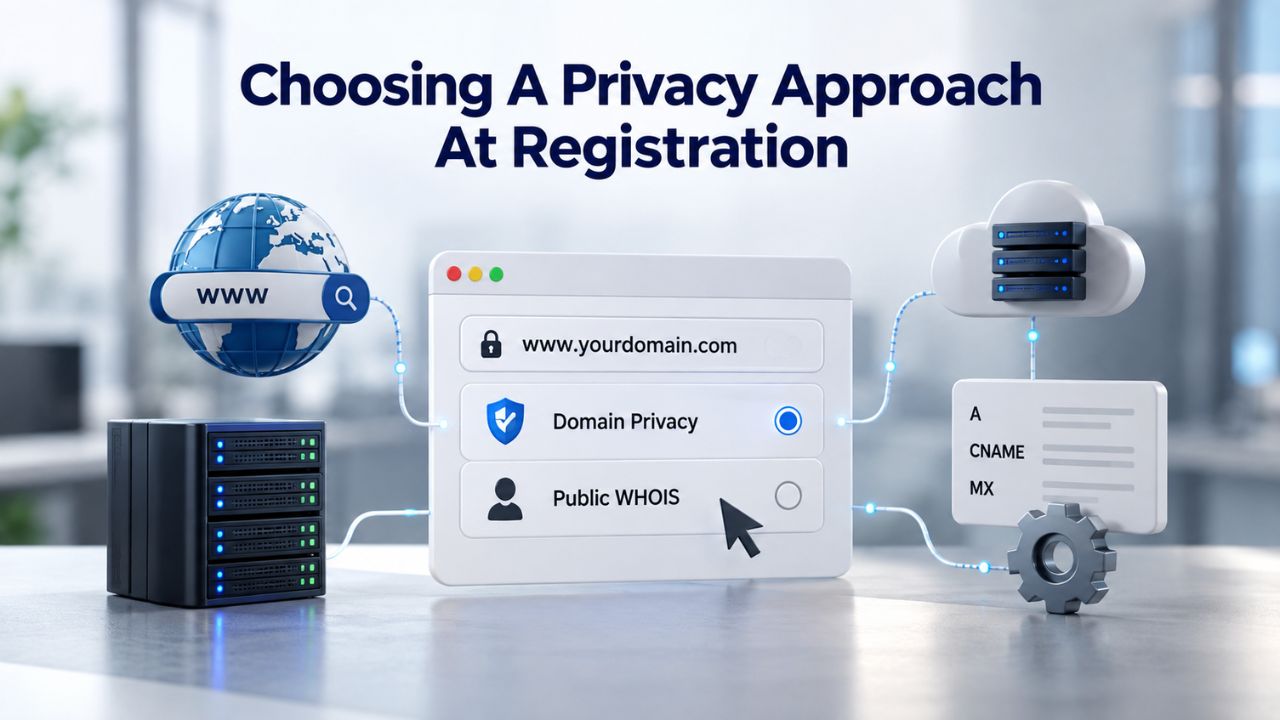
Choosing A Privacy Approach At Registration
To bring it all together, a few concrete questions can guide your decision when registering a Domain Name. There’s no single correct answer for every registrant, but working through these questions deliberately, rather than accepting whatever a registration flow defaults to, puts the choice on firmer ground.
Questions Worth Asking Before You Register
Before registering, ask whether the domain extension supports privacy at all, since availability varies by TLD (see the earlier point on this, worded differently from the full statement above). It’s also worth considering who the domain is for: a personal project, a small business, or a larger organization with existing transparency norms, since each carries a different exposure profile. Finally, check whether the registrar or reseller handles privacy as a standard option or treats it as something to configure separately, since that affects how easy it is to enable consistently across a portfolio.
None of these questions has a universally correct answer, but working through them at registration, rather than after a spam surge or a suspicious transfer attempt, puts the decision on more solid footing. Domains registered in bulk for Domain Hosting for Startups or growing portfolios benefit especially from settling this approach early, since retrofitting privacy settings across dozens of domains later is more work than deciding once at the outset.
Reviewing Privacy Settings At Renewal
Renewal is also a natural checkpoint for revisiting privacy decisions, since a domain’s purpose, ownership structure, or exposure profile can shift meaningfully between registration and renewal. Checking that privacy settings remain active, since some registrars and registries require reactivation under certain circumstances, is a small but meaningful part of routine Domain Name Management. Treat this as a two-minute check alongside a broader look at contact accuracy and transfer-lock status, rather than an isolated task.
For registrants managing multiple domains across different registrars, extensions, and privacy defaults, this is also where the earlier point about redaction gating rather than eliminating access resurfaces, worth keeping in mind, since renewal is often when contact details get updated, and old assumptions about visibility get revisited. Treating Domain Renewal Services as an opportunity to reassess, rather than a purely administrative task, helps catch outdated settings before they become a problem.
Talk To Niya Digital About Your Domain Portfolio
Whether you’re registering a single domain or managing renewals across a larger portfolio, Niya Digital works alongside an ICANN-accredited registrar partner to help you apply consistent privacy and security settings. This is especially useful for businesses using Domain Reseller Services or planning Domain Migration Services, where maintaining security, ownership, and consistency across multiple domains is essential.
Frequently Asked Questions
Is public WHOIS data still fully visible today?
No. Since ICANN’s 2018 Temporary Specification for gTLD Registration Data, most personal contact information is restricted to layered or tiered access rather than shown publicly by default. Non-personal fields like status codes and dates typically remain public, but personal contact details usually no longer appear in a standard lookup.
What’s the difference between WHOIS and RDAP?
WHOIS is the older protocol for looking up domain registration data, while RDAP is its structured, standardized replacement. As of 28 January 2025, RDAP became the definitive source for gTLD registration information, offering better support for redaction, internationalization, and differentiated access than legacy WHOIS ever provided.
Does domain privacy make my domain completely anonymous?
No. Domain privacy replaces publicly displayed contact information with proxy details, but the registrar still maintains your actual registrant record on file. That record can still be produced through legitimate legal or policy-based requests, so privacy reduces visibility rather than removing identifiability altogether.
Can domain privacy prevent domain hijacking entirely?
No single measure prevents hijacking entirely. Domain privacy reduces one specific risk- attackers using exposed contact details for social engineering- but account security controls like two-factor authentication and transfer locks address other, separate attack paths that privacy alone doesn’t cover.
Is domain privacy available for every domain extension?
Not universally. GDPR-driven redaction applies to gTLDs under ICANN’s framework, but country-code registries set independent rules that can restrict or exclude privacy services for certain extensions. Check availability per extension rather than assuming it across an entire domain portfolio.
Who can access my data if I have domain privacy enabled?
Parties with a documented, legitimate, and proportionate purpose can request access to non-public registration data through established processes, typically involving the registrar or registry. This commonly includes situations like law enforcement inquiries or documented intellectual property disputes, handled through defined request channels rather than open public access.
Why did WHOIS change to RDAP in the first place?
The original WHOIS protocol had significant technical limitations, including no support for internationalization, no secure access, and no standardized response formats. RDAP was developed to address those gaps while also supporting the differentiated, permission-based access that current privacy policy requires.
Does enabling privacy affect how my domain functions online?
No. Domain privacy only changes what’s displayed in public WHOIS or RDAP lookups. Your domain continues to resolve, route email, and function exactly as it did before, since privacy is a display setting layered on top of registration data rather than a change to how the domain technically operates.
Should a business use domain privacy on its primary website domain?
It depends on the business. Some organizations, particularly those built around public transparency, may prefer visible registrant data, while others, especially smaller businesses concerned about spam or targeted contact, often lean toward privacy. Weighing transparency expectations against personal or organizational exposure is a deliberate choice, not a default.
Does domain privacy need to be re-enabled at renewal?
Sometimes. Depending on the registrar, privacy settings can require manual reactivation after a renewal cycle rather than carrying over automatically. Checking that privacy remains active as part of routine renewal review helps avoid an unintended gap in coverage between renewal periods.
Are all fields redacted the same way across every registrar?
No. While the Temporary Specification sets a general framework, registrars and registry operators can vary in which fields they return as redacted. Checking the actual lookup result for your specific domain is more reliable than assuming a single uniform standard applies everywhere.
Is there a dedicated ICANN accreditation specifically for privacy providers?
A separate, dedicated accreditation program for privacy and proxy service providers has been proposed but remains on hold pending further community review. Current privacy offerings instead operate under existing terms in the Registrar Accreditation Agreement’s specification on privacy and proxy registrations.
Does WHOIS privacy stop all spam related to my domain?
It substantially reduces one common source, contact-detail scraping from public WHOIS records. Still, it can’t address spam arriving through other channels unrelated to domain registration data, such as a business’s publicly listed customer-support email.
What happens to my data if I stop using domain privacy?
If privacy is disabled, the fields it previously masked return to whatever the standard redaction policy allows for your specific registry and TLD. Since most personal fields are already restricted under the Temporary Specification regardless of privacy status, disabling privacy typically reveals less than it would have before 2018.
Is registration data ever fully public for gTLD domains?
Non-personal elements, such as domain status codes, sponsoring registrar, and key dates, remain publicly accessible under current ICANN policy. Personal contact fields are the ones typically restricted, so “fully public” in the pre-2018 sense generally no longer applies to standard gTLD registrations.
Glossary
- Registrant: The individual or organization that owns and is legally responsible for a domain name registration.
- Registry Operator: The organization responsible for maintaining the authoritative database for a specific top-level domain, distinct from the registrar that sells the registration.
- Redaction: The practice of withholding specific registration-data fields from public display while retaining them in the registrar’s records.
- Layered/Tiered Access: An access model where different requesters see different levels of registration data depending on their documented purpose, rather than one uniform public view.
- Authorization Code (EPP Code): A unique code required to transfer a domain from one registrar to another, used to verify the registrant’s authorization for the move.
- Proxy Service: A service that substitutes a third party’s contact information for the registrant’s own details in public registration records, while forwarding legitimate communications.
- Non-Public Data: Registration information that exists in the registrar’s records but is not displayed in standard public WHOIS or RDAP lookups.